



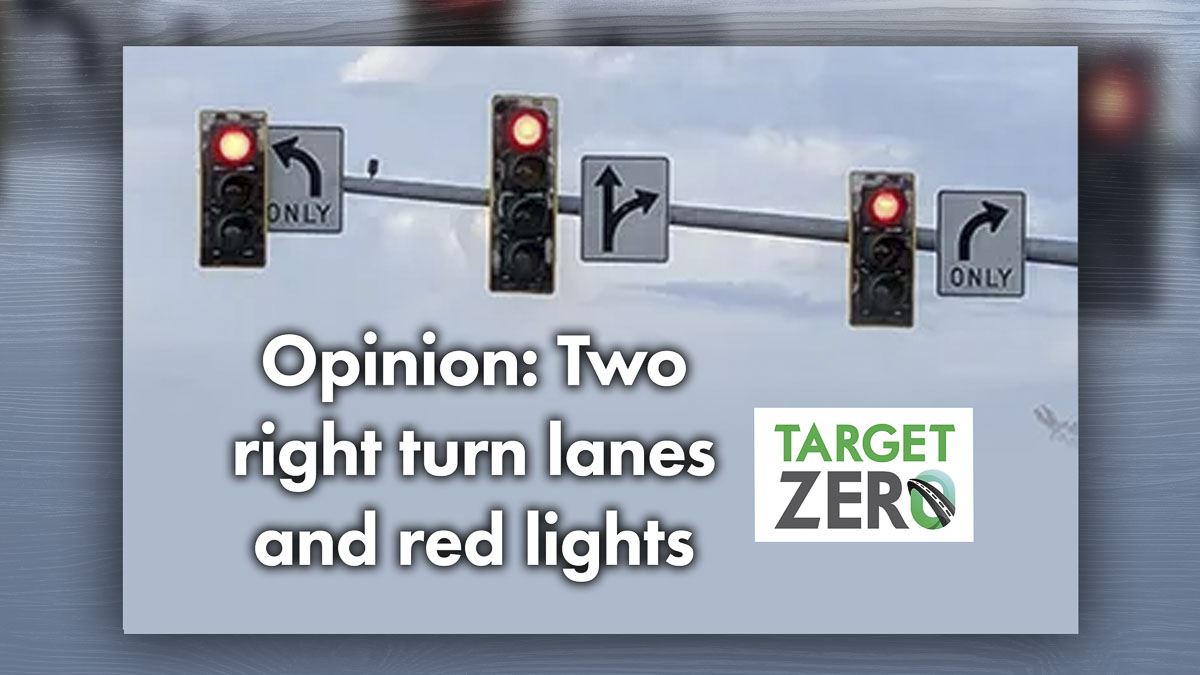
Target Zero Manager Doug Dahl answers a question about two-lane right turns
Doug Dahl
The Wise Drive
Q: I have a question about two-lane right turns. Can you take a right turn on a red light on the outer lane of the two lanes too? Everybody does it, but I’m never sure if I am really allowed to do it.
A: For the people who need an answer to this question right now, yes, you can make a right turn on a red light in either lane. The same rules apply to both lanes. And for the folks who aren’t willing to accept a “yes” without evidence, even if it’s the answer you want, thank you for your skepticism. The most important time to question something is when it aligns with the outcome you were hoping for.

The Revised Code of Washington has the evidence you’re looking for, so we’ll start there. And then as a bonus, we’ll take a look at another law that, on the face of it, would seem to outlaw a second right turn lane entirely.
To make sure we’re all driving in the same clown car, let’s review the right turn on red (RTOR) law. At a red light (including a red arrow), a driver intending to take a right turn (or a left turn onto a one-way street) may, after stopping for the red light and yielding to other cars and pedestrians (and as of 2019, personal delivery devices) in the intersection, make their turn. Of course, when a sign is posted prohibiting a right turn on red, it’s not allowed.
I said the law has the evidence, but the proof is more of an absence of evidence. The law doesn’t specify that a RTOR is only allowed in the furthest right lane or make any statement prohibiting right turns from an additional right-turn lane.
So yes, you can make a right turn on red from either right turn lane. I’d like to point out though, that the law states that a driver “may, after stopping proceed to make a right turn.” It is an option, not a requirement. You probably see where I’m going with this; some drivers might not to take the turn because they see something you don’t, some might know that right turns on red lights account for a disproportionately high number of crashes with pedestrians so they’ve chosen not to take them, some may not know they can. With all those possibilities, right turns at red lights are an opportunity to practice patience.
If you do decide to take that right turn, stay in your lane through the intersection. The law doesn’t call this out specifically, but does state that a driver shall not move from a lane until they have “ascertained that such movement can be made with safety.” The Washington Driver Guide, and every driving instructor I’ve asked, presumes that it’s unsafe to make a lane change in an intersection.
And the bonus: There’s a law that requires drivers making right turns to do so “as close as practicable to the right-hand curb or edge of the roadway.” That extra right-turn lane certainly isn’t close to the edge of the roadway, so how do you comply with the law if you’re in that lane? It comes down to the word “practicable,” which is often defined as “feasible or capable of being done.” If you’re the only vehicle approaching the intersection, you can set up at edge of the roadway to make your right turn. But if traffic has filled both lanes, “as close as practicable” could be understood as “as close as you can without becoming a hazard to other vehicles.”
The Wise Drive is hosted by Doug Dahl, a Target Zero manager for the Washington Traffic Safety Commission.

Also read:
- POLL: Do you agree with giving a state commission the power to remove an elected sheriff?
 A new poll asks if a state commission—not voters—should have the power to remove an elected sheriff, following concerns raised by Clark County Sheriff John Horch.
 - Opinion: Defending Democracy by denying it?
 Washington voters are blocked from weighing in on new income taxes as state lawmakers and officials bypass public input, drawing criticism from Northwest voices.
 - Opinion: Stalin would be proud – Clark County Socialists gathered for ‘No Kings’
 Reform Clark County’s Rob Anderson criticizes local and national groups for organizing protests that featured Auditor Greg Kimsey as a keynote, raising concerns about public trust and political partisanship.
 - Letter: Vancouver Mayor Anne McEnerny-Ogle makes several serious and incorrect engineering statements
 Bob Ortblad critiques engineering claims by Vancouver Mayor Anne McEnerny-Ogle, highlighting cost and safety advantages of an immersed tunnel for the I-5 crossing.
 - Opinion: The beginning of the end of anchor babies
 Lars Larson argues the Constitution excludes children born to non-legal residents, as the Supreme Court debates birthright citizenship and public opinion data shows limited support.
