




Todd Myers of the Washington Policy Center discusses the belief that we can meet future energy needs with more wind power
Todd Myers
Washington Policy Center
The last week of July was the hottest of the year in Washington state and demand for electricity jumped to its highest level in the BPA region since March 10. Simultaneously, wind-generated electricity fell to nearly zero across Idaho, Oregon, and Washington. It is a good example of why wind power is a poor substitute for hydroelectric power. Energy that disappears when it is needed most is simply not sustainable.
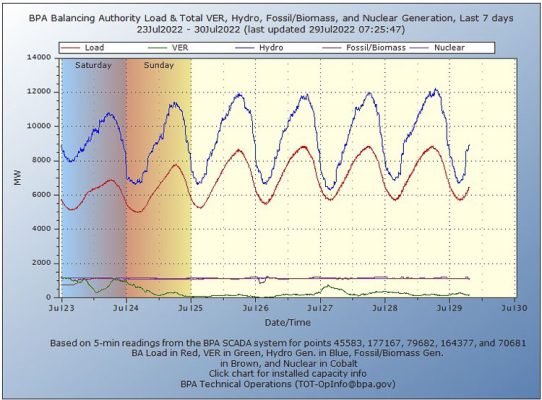
During a four-day period July 25-28, wind and solar power across the entire region generated between 150 and 270 megawatts (MW) during peak demand hours in the early evening. That is only 2 percent of total generation and about the same as just one of the four Lower Snake River dams.
This isn’t rare.
Between January 25 and 28, when peak demand was over 9,000 MW every morning, total wind and solar generation provided between zero and 0.3 percent of total energy demanded. And when the BPA region had its highest demand of the year on February 23, reaching 10,422 MW, wind and solar accounted for less than 1 percent of energy used by customers across the Northwest.
When demand for electricity is greatest – due to hot or cold weather – too often, wind disappears.
The only meaningful amount of wind occurred just after midnight on the morning of July 27 when demand for electricity was at the lowest point of the day. As demand increased, the wind died down.
There are some who believe we can meet future energy needs with more wind power. Some argue we can replace hydro, which can be turned on when demand increases, with wind and solar. The experience of this week and earlier this year demonstrate that when wind is needed most, it is unreliable.
Todd Myers is the director of the Center for the Environment for the Washington Policy Center.

Also read:
- Letter: Freeze the scope and build the bridge
 Vancouver resident calls for project discipline after 22 years of planning and nearly half a billion in costs.
 - Opinion: Public workers’ First Amendment rights are getting attention – in Idaho, not Washington
 Idaho moves to stop public schools from collecting union dues through government payroll while Washington continues favoring unions over worker choice.
 - Opinion: Lawsuit filed against the unconstitutional income tax in Washington state
 Former Attorney General Rob McKenna and Supreme Court Justice Phil Talmadge challenge the 9.9% income tax in Klickitat Superior Court.
 - Letter: ‘Oregon and Washington aren’t refusing to clean their rolls — they’re contesting federal jurisdiction and timing’
 Camas resident challenges Lars Larson’s fraud claims, explaining legal disputes over federal jurisdiction.
 - Opinion: ‘When are we going to get the full and complete details of the Interstate Bridge Replacement Program’s I-5 Bridge replacement project?’
 IBR team buried key details about light rail ending at waterfront with massive elevator system required.
