




Chris Cargill of the Mountain States Policy Center celebrates education choice by providing evidence of its impact
Chris Cargill
Mountain States Policy Center
If you had these odds, you’d buy a lottery ticket.
This is the week each year that we celebrate education choice. Those across the political spectrum have recognized the need to provide kids with more options, whether they be public, private, religious, charter or magnet. Education choice means all the above. It does not mean shutting down public schools.
As of March 2023, there have been nearly 190 studies on the impact of education choice. Researchers have looked at fiscal effects, parent satisfaction, test scores, attainment, civic values, school safety and racial integration.
Remarkably, 84% of studies show a positive effect, 10% show no impact, and 6% show a negative result.
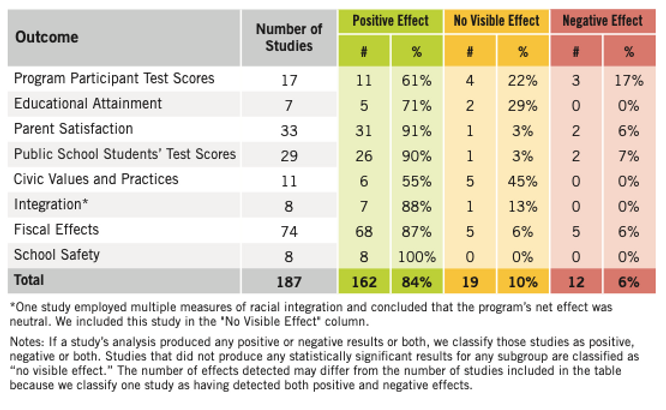
Studies were completed in red states and blue states, in those rural and urban. With 187 studies now published, we have more information on the impact of education choice than ever before.
When it comes to student test scores, researchers across five states and Washington, D.C., produced 17 pieces of analysis. Eleven found that vouchers and scholarships improved test scores for at least some students. Four studies found no effect, while three found that vouchers and scholarships negatively impacted test scores for certain groups.
Seven studies across five states and Washington, D.C. examined the educational attainment of students in four voucher programs, one tax-credit scholarship program, and one privately funded scholarship program. Five of these studies found that the programs had a positive impact on educational attainment for some or all participating students, while two studies found no discernible effect. None of the studies uncovered negative outcomes for any student group.
Thirty-three studies across thirteen states and Washington, D.C. have examined parent satisfaction with education choice programs. These studies looked at three Education Savings Account programs, seven voucher programs, eight tax-credit scholarship programs, and at least seven privately funded scholarship programs. Of these thirty-three studies, thirty-one found that private school choice programs had positive effects on parent satisfaction, one study found no discernible effect, and two studies found negative effects.
Examining the effects of private school choice programs on public school student test scores, 26 of 29 studies across eight states and Washington, D.C. found positive effects. These studies analyzed nine voucher initiatives, one tax-credit scholarship, and one privately funded scholarship. Only one study found no effect, while two studies saw negative effects.
The studies examined two voucher programs and at least three privately funded scholarship programs across four states and Washington, D.C.. Of the 11 studies examining the effects of private school choice programs on civic values and practices, six found positive effects, five found no visible effect, and none found negative effects.
Examining five voucher programs across three states and Washington, D.C., eight studies found mostly positive effects on racial integration in schools with seven showing integration improvements, one detecting no discernible effect, and none revealing negative consequences.
The largest body of research we have is on the fiscal impact of school choice. Researchers have examined 24 voucher programs, 18 tax-credit scholarship programs, three education savings account programs, and one privately funded scholarship program in 23 states and Washington, D.C. Of the 74 studies reviewed, 68 found that these programs generated net savings for taxpayers. Another 5 studies found the programs to be cost-neutral, while 5 estimated net costs. However, 4 of the studies that found net costs also reported net savings over the long term, with only short-term costs.
Finally, across four states and Washington, D.C., eight studies examined the impact of five voucher programs and three privately funded scholarship programs on school climate and safety. All eight studies found that educational choice programs had positive effects on school climate and safety, with none finding negative outcomes.
The point here is that every program is different. Every state is different. Every child is different. It shouldn’t matter what school a child is attending, so long as they are receiving a quality education.
It’s easy to understand why increasing numbers of Americans support education choice. The facts and the research don’t lie.
Chris Cargill is the President of Mountain States Policy Center, an independent free market think tank based in Idaho, Montana, Wyoming and Eastern Washington. Online at mountainstatespolicy.org.

Also read:
- Opinion: Someone explain the Democrat Party to me please
 Lars Larson criticizes Democrat politicians for shutdown threats, Homeland Security funding refusals, and positions on election laws, housing, and gun rights.
 - POLL: Do you agree with requiring board members to follow council direction?
 Disagreement among county councilors centers on whether C-TRAN board members should reflect the council’s collective wishes or act independently, highlighting ongoing concerns about public accountability.
 - Opinion: In plain sight – yielding to pedestrians
 Drivers often fail to see pedestrians due to inattentional blindness, which highlights the need for more focused awareness at intersections and stronger safety practices.
 - Opinion: The legislature has committed $2.4 billion to recurring pension increases since 2018
 Six legislative COLAs have raised public employer costs by $2.38 billion since 2018, driving up unfunded pension liabilities and increasing burdens on county and city budgets.
 - Opinion: ‘Just because they got away with it doesn’t mean they weren’t wrong’
 A Skamania County deputy’s report found violations of county rules and the Open Public Meetings Act, but no prosecutor acted on the findings.
