



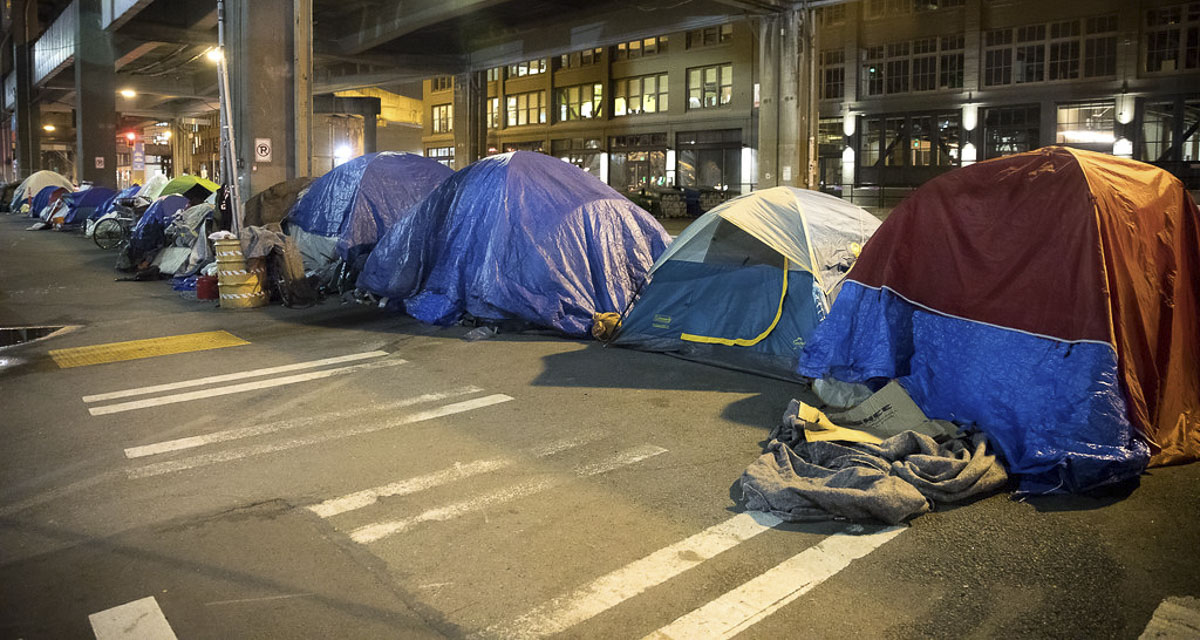
Mark Harmsworth explains how uncontrolled homelessness undermines the livability of our cities
Mark Harmsworth
Washington Policy Center
Homeless camps on city property have become a growing concern for communities across Washington state, with Camas’ recent city-wide camping ban shining another spotlight on the issue. The Camas City Council passed an ordinance unanimously on August 19, 2025, that prohibits public camping in tents, RVs, or otherwise on all public spaces within city limits. This follows a 2022 ban on camping near rivers and parks, expanded in response to the July 2024 Supreme Court ruling in Grants Pass v. Johnson. The ruling clarified that such laws do not violate the Eighth Amendment’s “cruel and unusual punishment” clause. While some criticize these measures, the negative impacts of unchecked encampments on public property demand attention and action.

Public spaces, parks, sidewalks, and libraries are meant to serve everyone, but uncontrolled encampments often render them inaccessible or unsafe. In Camas, city officials cited numerous complaints about camping on public property, noting decreased public safety and reduced community use of amenities like parks. Encampments can block sidewalks, violating the Americans with Disabilities Act, and create health hazards through litter, human waste, and drug paraphernalia. These conditions deter families from using public spaces, erode community trust, and strain city resources tasked with cleanup and enforcement.
The economic toll is equally significant. Businesses near encampments often report declining foot traffic as customers avoid areas perceived as unsafe. Property values can suffer, and cities face rising costs for sanitation, law enforcement, and legal battles over encampment management. In Camas, the lack of permanent shelters exacerbates the problem, as the city struggles to balance enforcement with compassion. Without viable alternatives, bans may simply displace individuals to neighboring towns, creating a ripple effect across Clark County, where homelessness (as of January 30, 2025) rose 12% from the previous year.
Health and safety risks extend beyond aesthetics. Encampments in sensitive areas, like near waterways or wooded regions, pose environmental threats, including pollution and fire hazards.
The Washington Policy Center advocates for balanced solutions. While public safety and accessibility must be prioritized, cities must pair enforcement with increasing the availability of affordable housing, mental health services, and addiction treatment. There are many private entities willing to work with government to help solve this problem. Government doesn’t always have to be the sole participant in a solution. Camas’ ordinance, which includes a 72-hour notice before camp removal and 60-day storage of personal property, is a step toward accountability. However, the absence of local shelters and the removal of requirements for police to offer shelter space before issuing citations risks alienating those in need. Neighboring Vancouver’s experience, where nearly half of displaced campers accepted shelter, shows that offering resources alongside enforcement can work.
Uncontrolled homelessness undermines the livability of our cities. Camas’ ban reflects a broader trend across Washington, but it’s only part of the solution. Cities must address root causes, housing shortages, mental health crises, and addiction, while ensuring public spaces remain safe and accessible for all. Without comprehensive strategies, we’re merely shifting the problem, not solving it.
Mark Harmsworth is the director of the Small Business Center at the Washington Policy Center.

Also read:
- Opinion: Sheriffs fight back
 Four county sheriffs are suing to block a new law giving a governor-appointed board power to decertify and remove sheriffs, bypassing voter oversight in Washington.
 - Opinion: The growing gap between public voice and political power
 Todd Myers describes how large-scale protest and sign-ins often fail to sway state leaders, and argues authentic influence is most likely found through local action.
 - Opinion: Who is winning the race for affordable power?
 Hydroelectric power keeps Washington competitive, but new laws and carbon pricing are driving up electricity costs for residents each year.
 - Opinion: Half the road, full stop – Understanding pedestrian right-of-way
 Doug Dahl explains how Washington’s law requires drivers to stop when a pedestrian is within one lane of their half of the road, not just when directly in front.
 - Opinion: The state’s RFK-proofing bill comes with a cost
 Mandates like HB 2242 can lead to higher premiums as insurance companies absorb costs for new preventive services, affecting affordability statewide.
