



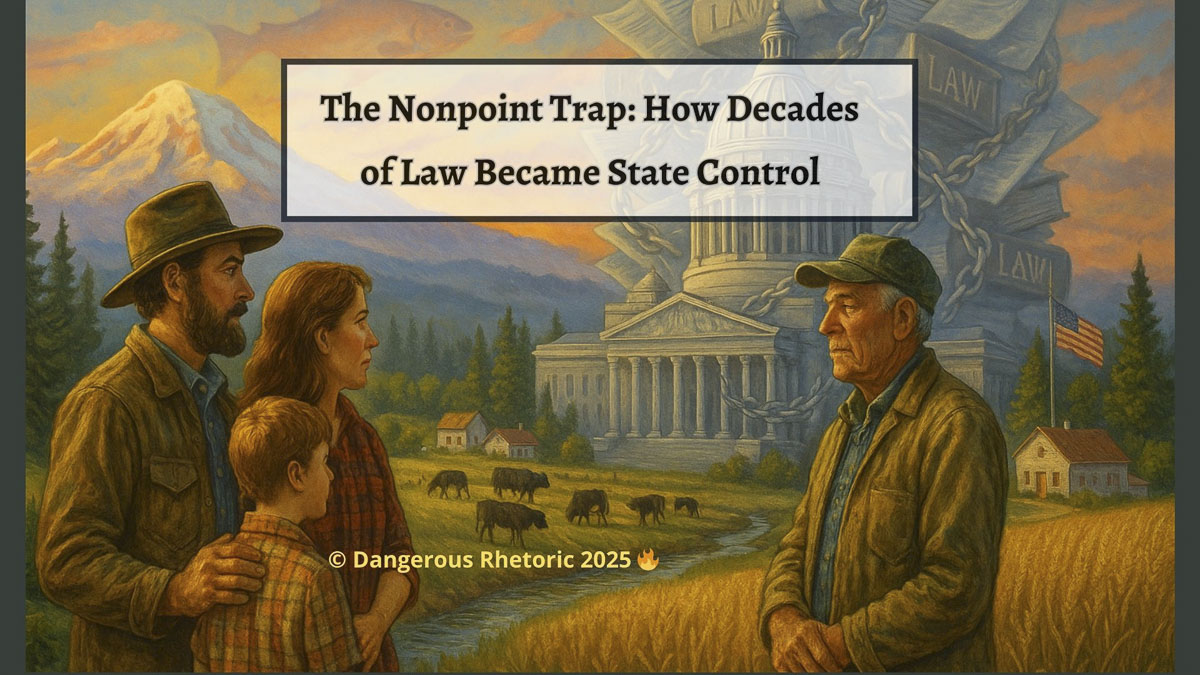
Nancy Churchill discusses what decades of quiet lawmaking mean for rural landowners today
Nancy Churchill
Dangerous Rhetoric
The Washington Department of Ecology, cheered on by environmentalists and some tribes, is weaponizing the Clean Water Act (CWA) against property owners. Under the banner of “nonpoint pollution,” they are steadily seizing control over how rural Washingtonians live, work, and use their land.

Brick by brick, over decades, Olympia has stacked laws and regulations that now give Ecology sweeping power over rural life. The Water Pollution Control Act (Chapter 90.48 RCW) provides the foundation, reinforced by the federal Clean Water Act and the Coastal Zone Act. Federal funding flows to the state to implement the CWA and police so-called nonpoint pollution.
Layered on top are state laws like the Forest Practices Rules, the Dairy Nutrient Management Act, and On-Site Sewage System regulations. Together, these laws form a legal fortress that lets Ecology dictate nearly every aspect of rural land use.
Targeting federal and private lands
Consider the Colville National Forest. Washington is the only state to use the Clean Water Act to impose a Total Maximum Daily Load (TMDL) — a regulatory straitjacket — on a federal forest. Years of monitoring by the USFS have shown that cattle grazing isn’t the culprit; in most cases, wildlife like beavers are to blame for water quality spikes. Yet the state insists on impossible baselines and continues to blame ranchers on grazing allotments.
The same hammer is being raised over private timberlands and working forests. New buffer rules for forest streams are being rammed through the Forest Practices Board. And for all types of agriculture, Ecology is rewriting federal voluntary guidelines into state mandates. They call them “guidelines,” but if you don’t comply, you’re breaking Washington Clean Water law. Voluntary has become mandatory by sleight of hand.
Who really pays the price?
The timber industry can afford lobbyists to fight back against extreme buffer rules. But individual landowners, small ranchers, and family farms don’t have a lobbyist in Olympia. That means they’re the easiest targets. Already, landowners in Ferry, Stevens, and Pend Oreille counties are receiving threatening letters from Ecology — flagging potential violations based on profiling, not proof. (By the way, If you’ve gotten a letter, respond right away!)
Meanwhile, the real water quality issues — the expensive ones, like small-town water and sewer systems that need costly updates — go largely unaddressed. Ecology prefers the easy target: the cattleman who pays taxes, creates jobs, and dares to live on the land. Even landowners with aging septic systems may need to be worried about future nonpoint enforcement.
Power, not salmon
If this were truly about saving salmon, the state would start where the problem is worst: Puget Sound’s working waterfronts, urban stormwater, and industrial runoff. Instead, they zero in on rural landowners who lack the money or political muscle to fight back. Ecology has the authority to mandate costly changes on farms using new state “Best Management Practices,” which are based on cherry-picked science, not federally approved standards. This isn’t about clean water. It’s about power and control over rural communities.
A call to action
The update to the nonpoint pollution plan is long, complex, and wrapped in technical jargon.
But its impact on you is simple: loss of property rights and over regulation. This is a regulatory taking without compensation. Ecology is writing rules that give it the authority to dictate what you can do with your land, even if you’ve done nothing wrong.
That’s why the public comment period matters. Tribes and environmental groups had years of input. Now, ordinary citizens have only weeks. It’s up to us to speak up — because no one else will. Submit your comment to the Department of Ecology before the deadline on Aug. 29, 2025. Tell them enough is enough: voluntary must mean voluntary, not a state power grab dressed in green.
In your comment, demand fairness. Request that any rule include water testing to prove a problem comes from a specific property before imposing costly mandates. Ask Ecology to extend the deadline so agriculture groups, rural county commissioners, and property rights advocates can fully participate in this process. All stakeholders should have a seat at the rulemaking table, not just some.
Recommend flexibility — the freedom to choose between federal or state best-practice guidelines. And insist that Ecology review all the science, not cherry-pick the data that supports their predetermined solution.
Prepare to work for a federal solution
But we also need a federal solution. The nonpoint section of the Clean Water Act itself must be updated. U.S. Reps. Baumgartner (CD 5) and Newhouse (CD 4) can help carry that message to the ears of federal leaders who have the authority to act. Reach out to them by email or by calling their offices.
Congress should strip Washington state of its power for regulatory overreach by either removing CWA nonpoint authority, changing the funding structure, or both. A real win would be pushing both the authority and the funding for managing nonpoint water pollution down to the county level, where local problems can be solved by locals who understand them. That’s the way to get clean water without destroying rural life.
The Nonpoint Trap is complicated by design, but the impact on you is simple: lost rights and heavier burdens on rural life. Olympia has had decades to build this legal fortress. Now they’re using it to seize control of how you live and work. It’s up to us to speak out — in the comment period and in Congress — before “voluntary” becomes mandatory for good.
Nancy Churchill is a writer and educator in rural eastern Washington State, and the chair of the Ferry County Republican Party. She may be reached at DangerousRhetoric@pm.me. The opinions expressed in Dangerous Rhetoric are her own. Dangerous Rhetoric is available on Substack, X, and Rumble

Also read:
- Opinion: Washington’s retail theft crisis is getting worse and Gov. Ferguson’s veto won’t help
 Ferguson vetoed $500,000 for proven anti-theft program despite Washington losing $2.7 billion to retail crime in 2021.
 - Letter: Is it bad enough yet in Clark County, Washington?
 Vancouver resident calls for voters to reject status quo amid housing crisis and education decline.
 - Opinion: Cowards in black robes
 Judge refuses emergency protection for constitutional sheriffs facing removal by unelected board.
 - Opinion: Internal emails show income tax bill was designed to bypass the Constitution and lock out voters
 Internal communications show legislators and AG’s office strategically designed income tax bill to prevent public referendum while forcing Supreme Court review.
 - Letter: HB 2266 and fairness for Clark County communities
 Vancouver resident argues the housing bill expands placement options while limiting local government oversight of siting decisions.
