



Nancy Churchill believes taxpayer money should not be wasted on one stretch of river, only to leave Washington’s electricity less reliable
Nancy Churchill
Dangerous Rhetoric
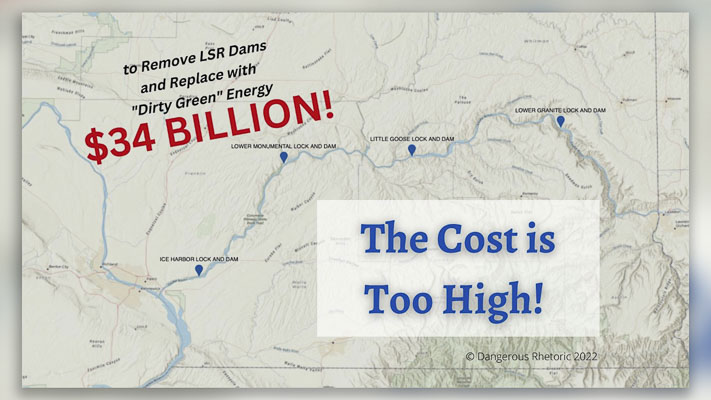
At the beginning of November, the Washington Policy Center and Center of the American Experiment published a joint analysis titled “The High Cost of Removing the Lower Snake River Dams”. This report details how Gov. Inslee and Sen. Patty Murray’s proposal to remove the LSR dams and replace them with wind, solar, and battery storage would likely cost Washington State taxpayers around $34.3 billion. This would also mean that Washington electricity customers would pay an additional $330 per year, on average, through 2050.

Inslee and Murray recommend the removal of these dams because they believe that salmon and other species in Washington state will not recover while the four dams are in place. The four Lower Snake River dams are Ice Harbor, Lower Monumental, Little Goose, and Lower Granite. Removing these dams would transform Washington from a state with some of the lowest electricity prices in the country to a state with much higher costs.
Inslee is pushing for all electric vehicles in Washington State by 2030. All these new electric vehicles will increase demand for electricity. Democrats have also passed laws to require home heating to become all electric. Removing the dams affordable, carbon-free electricity generation capacity while pushing consumers into greater electricity use just doesn’t make much sense.
The report estimates “the total cost of replacing the generation of the LSR dams with 100 percent wind, solar and battery storage would be $34.3 billion based on 2021 LSR dam generation and real-world wind and solar capacity factors for the region.” Electricity rates would increase about 25%. Relying on weather dependent sources like wind and solar will also decrease the reliability of the grid, which would increase the likelihood of brown-outs or black-outs during very cold or very hot weather.
The dams provide other benefits, including transportation for goods, irrigation, and tourism, which must be addressed in any proposal advocating their removal.
Focusing on agriculture, most of Eastern Washington’s agriculture industry would be difficult to maintain without the irrigation provided by the dams and reservoirs.
According to the Washington Department of Commerce, “Washington’s 15 million acres of farmland produce 300 different crops, ranking second in the nation.” Commerce continues, “Combined with the state’s low-cost energy —some of the lowest in the nation—and superior crop and harvest yields, Washington is a natural choice for agricultural operations, food production, storage and manufacturing.” How could we possibly continue to be the 2nd most productive state in the nation without the dams? Is this even a responsible choice given the looming food shortages elsewhere in the world?
Policy recommendations
This report offers three important common-sense policy recommendations which would keep Washington’s energy affordable while improving outcomes for salmon recovery. If adopted, these policies could save Washington electricity customers and taxpayers billions of dollars in the coming decades.
First, Washington should keep our renewable and green hydropower dams. These represent an important taxpayer investment that should not just be thrown away in favor of dirty-green energy production that is unreliable, expensive, and environmentally toxic.
Next, allow for the construction of new natural gas plants in Washington. It is currently not legal. Dam opponents admit dam removal will increase reliance on natural gas, so a first step would be to build some new electrical capacity. We should also allow for the construction of nuclear power plants, which have great potential with the development of new plant technology.
Finally, Washington should dedicate funding for salmon recovery to projects across the state. Rather than waste huge amounts of taxpayer money on one stretch of river, only to leave Washington’s electricity less reliable, salmon-recovery advocates should push for funding to be used where it can be most effective across the Northwest. Many successful projects have helped to increase runs and have brought new life back many of our inland rivers. Let’s continue and redouble these practical and effective salmon recovery projects and focus on doing what works rather than on destroying the amazing, productive, powerful and green Snake River Dams.
Nancy Churchill is the state committeewoman for the Ferry County Republican Party. She may be reached at DangerousRhetoric@pm.me. The opinions expressed in Dangerous Rhetoric are her own.

Also read:
- Opinion: Stalin would be proud – Clark County Socialists gathered for ‘No Kings’
 Reform Clark County’s Rob Anderson criticizes local and national groups for organizing protests that featured Auditor Greg Kimsey as a keynote, raising concerns about public trust and political partisanship.
 - Letter: Vancouver Mayor Anne McEnerny-Ogle makes several serious and incorrect engineering statements
 Bob Ortblad critiques engineering claims by Vancouver Mayor Anne McEnerny-Ogle, highlighting cost and safety advantages of an immersed tunnel for the I-5 crossing.
 - Opinion: The beginning of the end of anchor babies
 Lars Larson argues the Constitution excludes children born to non-legal residents, as the Supreme Court debates birthright citizenship and public opinion data shows limited support.
 - Opinion: Defend bail now or face more chaos on our streets
 A proposed Washington court rule would cap bail for most misdemeanors and allow defendants to bypass bondsmen, raising concerns about accountability and public safety.
 - Opinion: Some worker rights get a poster, others get fine print
 Elizabeth New questions why Washington state highlights some workplace protections while Janus First Amendment rights for public employees remain hidden in official materials.
 wpDiscuz
