


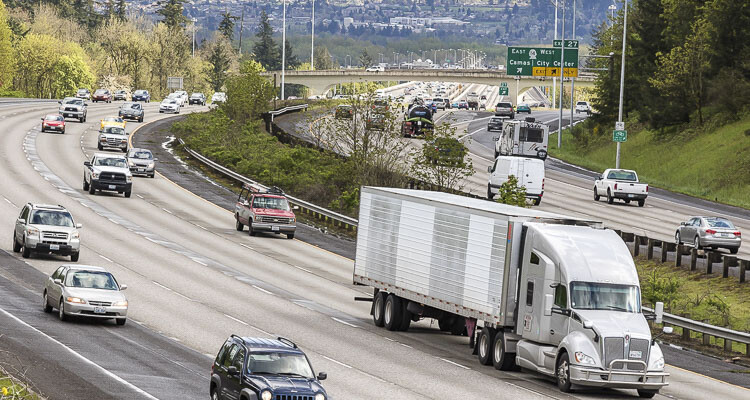
Charles Prestrud says that even though motorists are paying taxes on CO2 emissions, they won’t see any benefit when it comes to highway maintenance or completion of needed improvements
Charles Prestrud
Washington Policy Center
An editorial in the July 5th Wall Street Journal suggests that Washington State is imitating California. They don’t mean that in a good way. Their point is that Washington residents shouldn’t be surprised that the state’s new tax on carbon-based fuels has made our gas prices the highest in the U.S. Several years ago California enacted a similar cap-and-trade tax on carbon fuels and their gas prices are nearly as high as ours.

My colleague Todd Myers has shown that Washington’s carbon tax has increased the price of gas by about 44 cents per gallon, and that is on top of Washington’s 49.4 cent per gallon gas tax, which was already one of the highest in the U.S. It’s easy to blame the oil companies for high prices but their profit margins are slim compared to the taxes the state is raking in.
The Wall Street Journal editorial hit the nail on the head, but the high price of gas is only half the story. Washington is also following California’s lead in another way that isn’t good, which is the deteriorating condition of our highways. Anyone who has driven on I-5 through Seattle will have noticed this, and it’s confirmed by the Reason Foundation’s Annual Highway Report which ranks Washington State’s highways 46th out of the fifty states, just one notch above California. The dire need for highway system repair and repaving has not escaped the attention of WSDOT. WSDOT Secretary Roger Millar has gone so far as to say “the system is on a glide-path to failure”. WSDOT has estimated that an additional $350 million per year is needed to bring the state highway system up to a state of good repair, but they have no plan to accomplish that.
You might think the hundreds of millions of dollars the State is collecting from the tax on CO2 emissions ought to go a long way toward funding high priority maintenance work. However, when the State Legislature adopted the carbon tax they specifically prohibited using the revenue for fixing state highways. Instead, the revenue is doled out to a smorgasbord of “green” programs the effectiveness of which remains to be seen. Meanwhile the backlog of deferred maintenance continues to grow.
So, even though motorists are paying taxes on CO2 emissions every time they go to the gas station, they won’t see any benefit when it comes to highway maintenance or completion of needed improvements.
Charles Prestrud is the director of the Coles Center for Transportation at the Washington Policy Center.
Also read:
- Opinion: Portland’s War on Cars Part 4 – A smarter automobile strategy to end gridlock
 O’Toole argues fuel wasted in Portland-area congestion has sextupled since 1982, generating 250,000 tons of extra greenhouse gases annually.
 - Opinion: Transit ridership trends are dismal but regional plans are oblivious
 Puget Sound transit passenger-miles fell 31% from 2015 to 2024 despite a half-million-resident population increase.
 - Interstate Bridge Replacement Program seeks qualified firms for bridge replacement contract
 The CRBR project is backed by $5.7 billion from state funds, federal grants, and future tolling.
 - Opinion: Bankrupt – A $3.5 billion Rose Quarter Freeway widening project
 Joe Cortright argues ODOT’s Rose Quarter project has grown from a $450M approval to a $3.5B estimate, with a $2B funding gap.
 - Opinion: Portland’s War on Cars 3 – Ending the war on automobiles
 O’Toole argues Portland should add toll lanes, fix safety hazards, and redesign TriMet routes to end its anti-auto policies.
 wpDiscuz