



Clark County Today Editor Ken Vance addresses the continuing struggle to fund public schools in Washington state
Ken Vance, editor
Clark County Today
If it’s that time of the year for the children in our community to go back to school, it must be time for another strike or two by unions representing teachers and other employees of our public schools. Nevermind that teacher strikes are unlawful, they’ve been happening seemingly every year for nearly a decade.

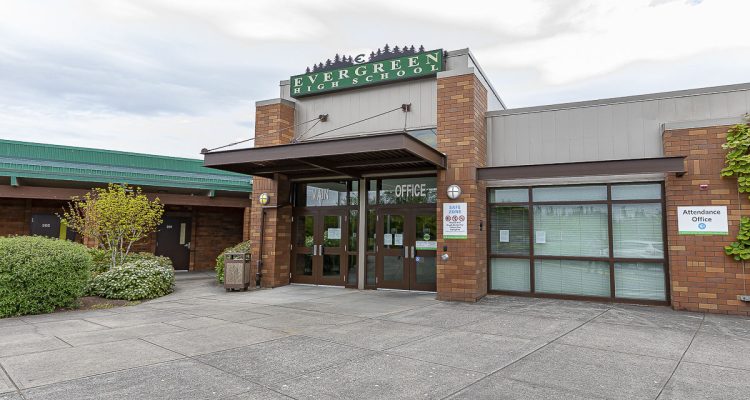
In Clark County this year, it’s the teachers in the La Center School District and the certified workers in the Evergreen School District who recently have approved strike votes. The Evergreen School District has delayed the start of the 2025-26 school year. As I write this, the Wednesday (Sept. 3) scheduled start of the La Center school year is still in jeopardy as the district and its teachers continue to attempt to negotiate an agreement.
The problems with funding for public schools, especially in the state of Washington, is a complex conversation. Basically for years, the state has struggled to keep up with the funding area school districts say they need to educate our children. Those problems were exacerbated in 2017 when the legislature passed the McCleary legislation that increased the state property tax and reduced local levies. In 2019, Democrats increased local levies back to pre-McCleary levels.
A little history lesson
The McCleary Decision was the result of a lawsuit (McCleary v. Washington). The case alleged that the state had failed to meet the state constitutional duty (in Article IX, Section 1) “to make ample provision for the education of all children residing within its borders.”
A King County Superior Court judge sided with the plaintiffs, stating that the state was indeed failing to adequately provide for basic education. On January 5, 2012, the Supreme Court agreed with the opinion of the King County Superior Court that the state was not fulfilling its obligation to fully fund education in the state. It wasn’t until June 7, 2018 that the Supreme Court declared the state had fully covered the funding of basic education.
The Big Lie
In the McCleary ruling, the Supreme Court cited teacher pay as a primary issue with the failure of the state to fund public education. The state teachers union, Washington Education Association (WEA), seized the opportunity and promoted the increase in state public school funding as justification to increase teacher salaries, and sponsored multiple teachers’ strikes to demand them.
As a result, teachers’ salaries have skyrocketed since the McCleary Decision. The teachers unions used strikes or the threat of strikes to get its members raises of more than 10 percent and sometimes even as much as 20 percent.
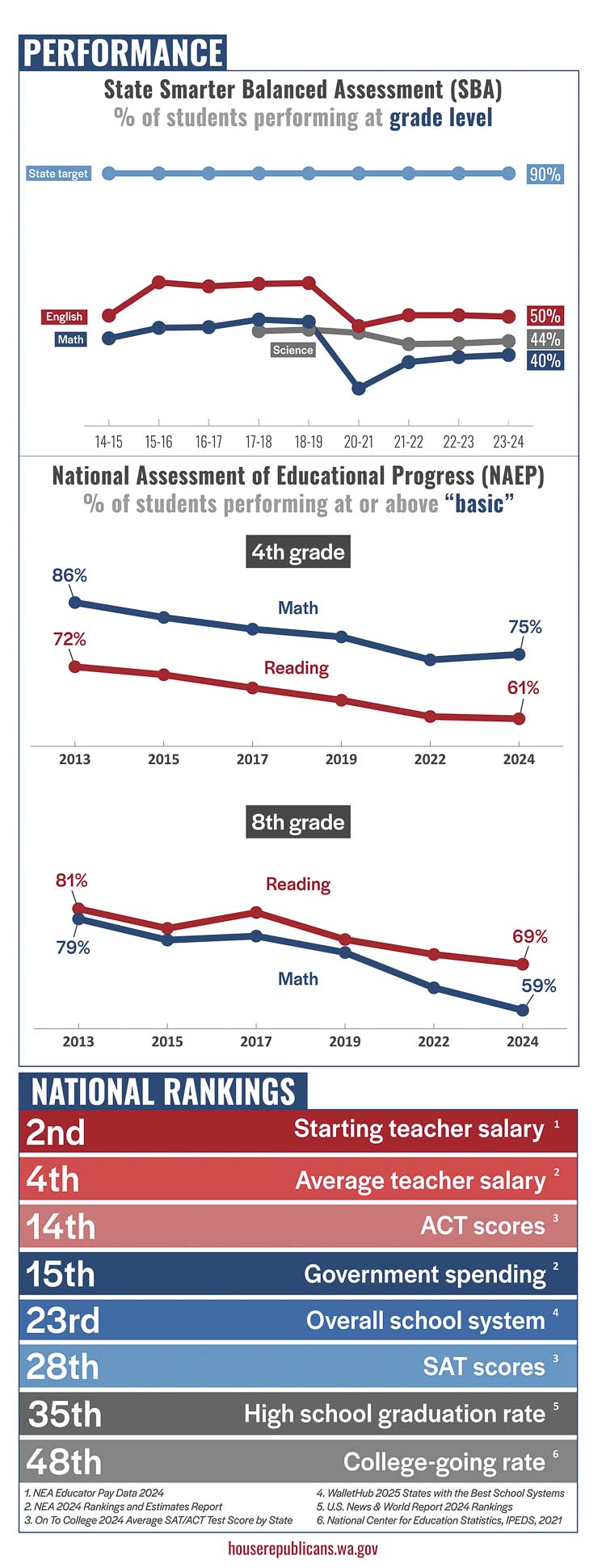
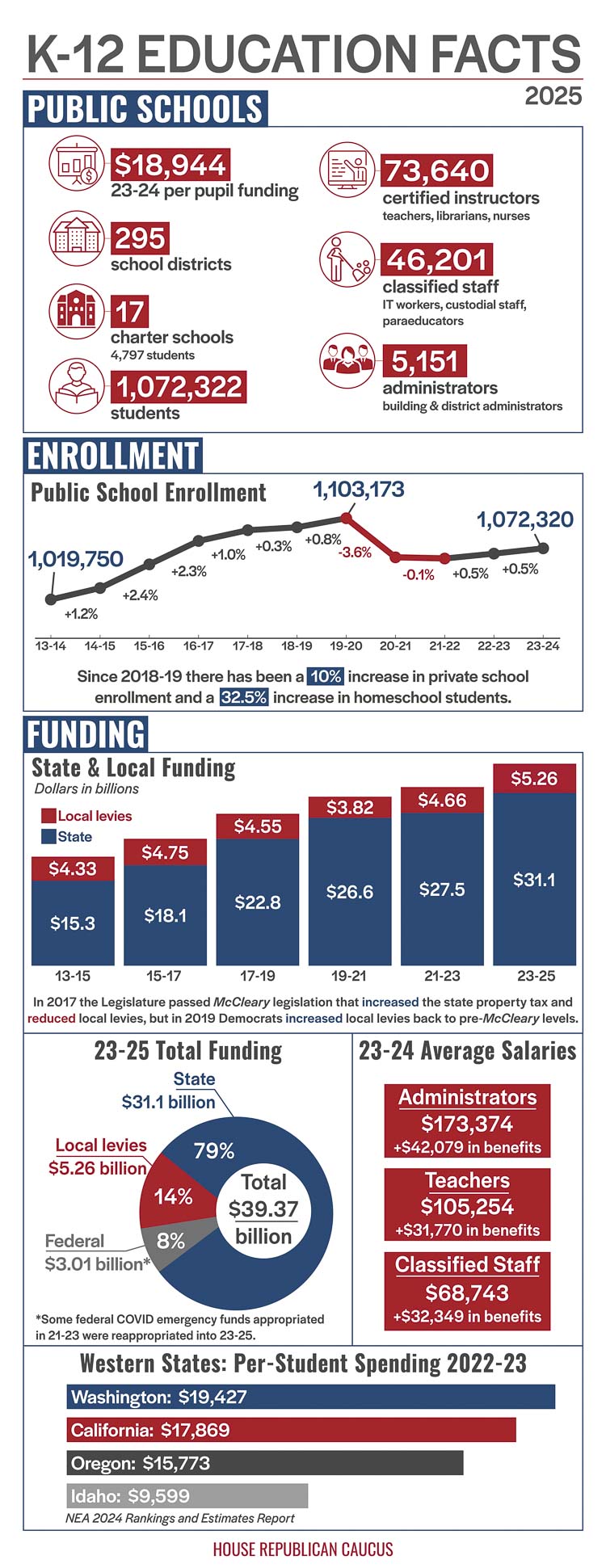
A graphic produced by the Washington State House Republican Caucus reports that Washington teachers rank second in the nation in starting teacher salaries and fourth in the nation in average teacher salary. Administrators in the state make on average $173,374 in salary and $42,079 in benefits. Teachers in our state average $105,254 in salary and $31,770 in benefits. Classified staff in our state average $68,743 in salary and $32,349 in benefits. In the 2022-23 school year, public schools in Washington state spent $19,427 per student.
The big lie was that the increased funding for public schools in Washington to satisfy the McCleary Decision was all to be used for teacher salaries. You see, there is only one pie when it comes to funding for public schools and there are many mouths to feed with that one pie. If a disproportionate amount of that pie is spent on teacher salaries something else will suffer. The WEA representatives knew this when they insisted the McCleary money go strictly to teacher salaries. They didn’t care because they knew the state would be forced to fund public education and Democrat lawmakers would be counted on to raise taxes to increase funding. A former state legislature told me that Democrat lawmakers purposely wait until the end of the session to fund education because they know they are bound to do so. So, they pass all the other funding they can prior to addressing public school funding. The education beast and its enormous appetite will always be fed one way or another.
According to the Washington State House Republican Caucus, total funding for public schools increased to $39.37 billion in 2023-25. Of that, $31.1 billion (79 percent) came from the state, $5.26 billion (14 percent) came from local levies and $3.01 billion (8 percent) came from federal funding.
The result
The increasing crisis in public school funding in Washington state has led to some alarming results. Since 2018-19 there has been a 10 percent increase in private school enrollment and a 32.5 percent increase in homeschool students.
While Washington has the fourth-highest average teacher salaries in the nation, the state is 14th in ACT scores, 28th in SAT scores, and 35th in high school graduation rate.
The state has a goal of having 90 percent of its students test at grade level (State Smarter Balanced Assessment). In the 2023-24 school year, 50 percent of Washington students tested at grade level in English, 44 percent in Science and 40 percent in Math.
So, taxpayers are paying more and getting less from its public schools.
A fan of teachers
A friend of mine recently posted a fun question on social media. She asked others to share who was their favorite teacher and why. I quickly responded, even though it is extremely difficult for me to choose just one. I was blessed with far too many amazing teachers and mentors than I can name. The same goes for my children and their experiences in public schools.
Teachers have been some of the most important people in my life. I don’t remember a single one of them complaining that they didn’t make a fair salary and I certainly never had my education interrupted by a teachers’ strike. My mom spent her entire career as a certified staff employee (cook) in the Stevenson-Carson School District so my appreciation for the certified staff at public schools is also enormous. But, we shouldn’t be spending $20K to educate each student each year. The funding mechanism for public schools in our state is broken and the answer isn’t higher salaries.

Also read:
- Opinion: Sheriffs fight back
 Four county sheriffs are suing to block a new law giving a governor-appointed board power to decertify and remove sheriffs, bypassing voter oversight in Washington.
 - Opinion: The growing gap between public voice and political power
 Todd Myers describes how large-scale protest and sign-ins often fail to sway state leaders, and argues authentic influence is most likely found through local action.
 - Opinion: Who is winning the race for affordable power?
 Hydroelectric power keeps Washington competitive, but new laws and carbon pricing are driving up electricity costs for residents each year.
 - Opinion: Half the road, full stop – Understanding pedestrian right-of-way
 Doug Dahl explains how Washington’s law requires drivers to stop when a pedestrian is within one lane of their half of the road, not just when directly in front.
 - Opinion: The state’s RFK-proofing bill comes with a cost
 Mandates like HB 2242 can lead to higher premiums as insurance companies absorb costs for new preventive services, affecting affordability statewide.
 wpDiscuz
