



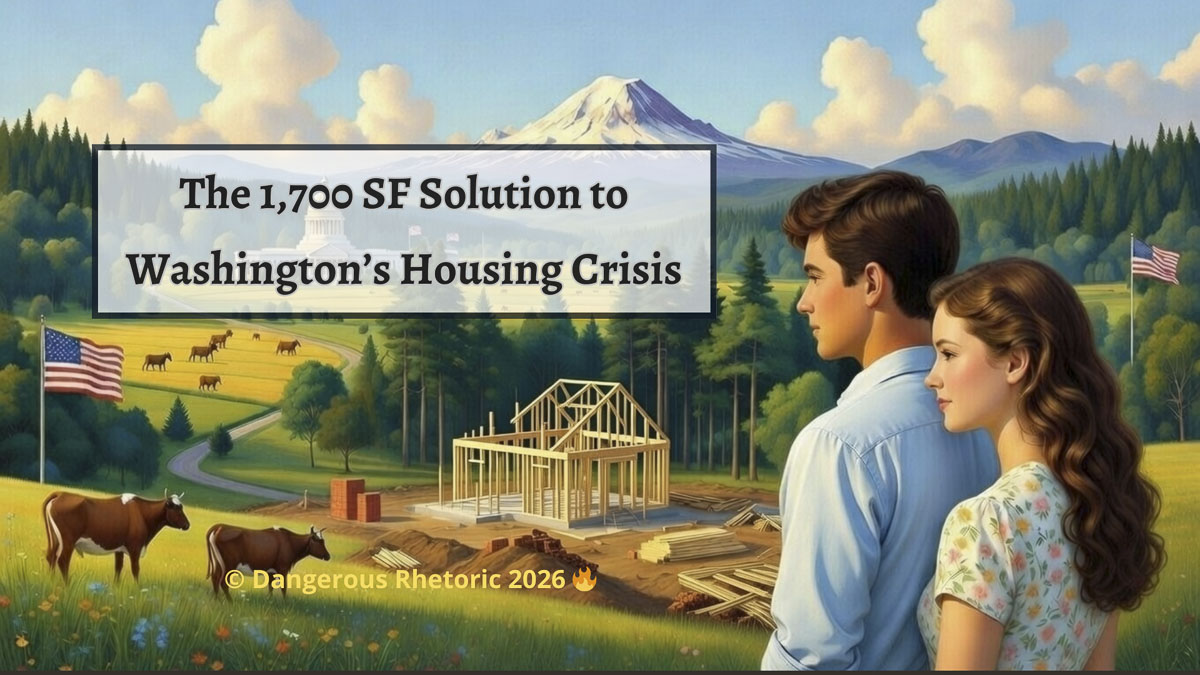
Nancy Churchill discusses how HB 2486 balances energy goals with housing affordability
Nancy Churchill
Dangerous Rhetoric
Washington state faces a severe housing shortage. This crisis isn’t some natural disaster. It’s the result of man-made, governmental overreach which adds thousands to the costs of every home. Families search for starter homes and come up empty. Young couples delay marriage. Workers commute hours from cheaper counties. The state needs over a million new homes in the coming decades, yet permits lag far behind. This crisis hits hardest in rural and working-class areas, where land exists but red tape strangles building.

Thoughtful representatives refuse to sit idle. In the 7th District, Rep. Andrew Engell is stepping up with simple solutions and practical fixes. He gets it: Washington’s working people deserve homes they can actually afford, not fairy-tale mandates from climate warriors who never swung a hammer. He understands that real problem-solving starts with removing barriers, not adding more. Engell’s new bill, HB 2486, targets one major culprit: the state energy code that is driving up costs for modest homes.
The Green Code’s Stealth Tax on the American Dream
The Washington State Energy Code demands high-efficiency standards for new homes. It requires extra insulation, special windows, advanced ventilation, and often all-electric systems. No more reliable natural gas or propane heat in new builds in order to meet climate goals by 2031.
These rules sound noble on paper. Yet they add serious money to the price tag upfront. According to a 2025 report from the Building Industry Association of Washington, cumulative energy code changes since 2009 have tacked on about $39,876 per new home. The latest package alone adds between $13,800 for all-electric setups and $29,000 for homes that once used dual-fuel options.
Consider a simple 1700-square-foot home, the kind a young family or retired couple might afford. At average construction costs around $300 per square foot in Washington, the base cost already stings. Then tack on those energy code extras and suddenly that modest home jumps $20,000 or $30,000 higher.
Pile on tens of thousands from energy mandates, and that starter home slips out of reach. The median new home sales price hovers near $690,000 for larger builds, but even scaled-down versions feel impossible when regulations inflate costs by thousands per house. Regulators claim long-term energy savings pay it back over decades. But families need affordable homes now, not promises in 20 years.
These mandates ignore rural realities, where winters bite hard and affordable heating matters. The code favors urban elites with deep pockets over young couples, working class people or seniors who just want a roof that doesn’t bankrupt them.
A Practical Fix in HB 2486
Rep. Engell and co-sponsors Rep. Manjarrez and Rep. Barkis introduced HB 2486 to rein in these costs. “The bill directs the State Building Code Council to prioritize affordability in future energy code updates. It puts hard limits on price hikes for smaller homes.
For homes of 1,700 square feet or less, the bill caps cost increases beyond the Jan. 1, 2026, energy code levels in the 2026 and 2029 cycles. Local “code officials” gain authority to approve designs that skip overly expensive requirements if compliance proves economically impractical, meaning the upfront cost far outweighs energy savings in a 10-year window. This flexibility extends especially to affordable housing projects. The measure amends state law to protect officials who use this common-sense approach.
This isn’t about gutting safety or efficiency. It’s about balance. Let builders offer a “Toyota” option alongside the “Tesla” mandate. Families deserve choices that fit their wallets, not one-size-fits-all green requirements from Olympia.
Hope lies in local action and common sense
Washingtonians have faced tough times before. They tamed wilderness with chainsaws and grit. They built dams that powered the nation. They raised families on ranches where self-reliance wasn’t a slogan but survival. The same spirit can tame this housing mess. With just a little tweaking to the rules, Washingtonians can have housing that is both affordable AND energy efficient.
The path forward embraces practical steps that restore local freedom to create practical solutions. Bills like HB 2486 prove that targeted reforms work. They protect property rights, strengthen families, and keep faith in free enterprise alive. Conservative leaders like Rep. Engell remind us that government should solve problems, not create them.
Your move: Make your voice heard
This bill (2486) sits in the House Local Government Committee. Chair Davina Duerr (davina.duerr@leg.wa.gov), Vice Chair Janice Zahn (janice.zahn@leg.wa.gov), Ranking Minority Member Mark Klicker (Mark.Klicker@leg.wa.gov), and Assistant Ranking Minority Member David Stuebe (David.Stuebe@leg.wa.gov) hold the keys to a hearing.
Without pressure from citizens, this good idea will never get a committee hearing. Write or call these committee members today. Keep your message short and direct. Tell them you support HB 2486 because it controls energy code costs and makes starter homes possible again.
Mention the $13,800 to $29,000 added by current energy code rules and how a 1700-square-foot home should remain within reach for working families. Ask for a prompt hearing and passage to help ease the housing shortage.
Personal stories carry weight: a son who can’t buy near home, a daughter commuting from afar, or your own struggle to downsize affordably. One voice matters. Hundreds together move mountains.
This fight isn’t abstract. It’s about handing the next generation a free republic where hard work buys a home, not endless debt. We serve a higher purpose when we defend property, family and opportunity. Stay persistent. Act now. The 1700-square-foot solution starts with you picking up the phone or writing an email to ask for a committee hearing on this practical idea. Take action today and let’s make housing affordable again.
Nancy Churchill is a writer, educator, and conservative activist in rural eastern Washington State. She chairs the Ferry County Republican Party and advocates for effective citizen influence through Influencing Olympia Effectively. She may be reached at DangerousRhetoric@pm.me. The opinions expressed in Dangerous Rhetoric are her own. Dangerous Rhetoric is available on Substack and X.

Also read:
- Opinion: Lawsuit filed against the unconstitutional income tax in Washington state
 Former Attorney General Rob McKenna and Supreme Court Justice Phil Talmadge challenge the 9.9% income tax in Klickitat Superior Court.
 - Letter: ‘Oregon and Washington aren’t refusing to clean their rolls — they’re contesting federal jurisdiction and timing’
 Camas resident challenges Lars Larson’s fraud claims, explaining legal disputes over federal jurisdiction.
 - Opinion: ‘When are we going to get the full and complete details of the Interstate Bridge Replacement Program’s I-5 Bridge replacement project?’
 IBR team buried key details about light rail ending at waterfront with massive elevator system required.
 - POLL: Do you support extending light rail beyond the waterfront to connect with C-TRAN at Library Square?
 Readers can weigh in on Anne McEnerny-Ogle’s proposal to extend light rail beyond the waterfront to Library Square for improved C-TRAN connections.
 - Opinion: Passing a cyclist – Law, myth and a little patience
 Most drivers can’t legally pass cyclists in-lane due to vehicle width versus road measurements.
