



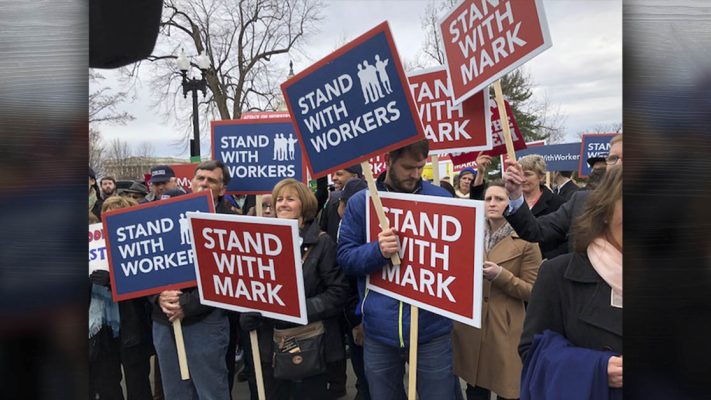
Elizabeth New (Hovde) believes First Amendment rights are being abused and our state is aiding those abusing them
Elizabeth New (Hovde)
Washington Policy Center
The U.S. Supreme Court “Janus” decision on June 27, 2018, affirmed the right of public employees to opt out of union membership without penalty, fees or a compulsion to pay dues. The Janus decision was a significant advance for the rights of public workers, as no one should have to fund the political causes and priorities of a private organization with which they disagree.

As plaintiff Mark Janus said of the ruling, “The right to say ‘no’ to a union is just as important as the right to say ‘yes.’ Finally, our rights have been restored.”
That hopeful statement was so 2018.
Instead of respecting workers’ rights, unions erected hurdles to dissociation. Some public unions limit the ability to leave a union with opt-out windows. These are short time periods in which members are allowed to disassociate. That limitation is coupled with the tricky move of having employees sign union pledges during overwhelming onboarding processes and union orientations that accompany new jobs — before employees know about their rights of refusal or what their signatures commit them to.
Many public workers still don’t realize they have a right not to join a union. Unions aren’t generous with that information. Washington state and the federal government aren’t either. And we’re not talking about insignificant funds. Public employee union dues can add up to $1,000 or more each year.
While unions readily give information about joining and the many benefits of union membership, information about disassociating is not advertised.
Information about Janus rights also is absent from a Washington State Department of Labor and Industries web page devoted to workers’ rights. The web page highlights overtime, paid sick leave, minimum wage, meal periods, rest breaks and how workers can file workplace complaints, but it leaves out mention of what Janus rights mean for public employees’ wages and working conditions. There is also a conspicuous absence of Janus rights information on posters issued to employers to display in workplaces where workers can read them.
The U.S. Department of Labor has hundreds of A-Z listings. Entries on “Janus rights,” “worker right not to join a union” or other likely terms and phrases that would provide information about the right to leave a union are absent. There is information about “union elections,” “union finances,” “union records” and the rights of union members. A form called “Your Rights at Work” does not include information that union dues should be voluntary, not compulsory. The main headline at dol.gov, says, “Interested in unions & collective bargaining? The Worker Organizing Resource and Knowledge (WORK) Center has resources that can help.”
The government provides inducement to join a union, but it hides information on how to leave a union. It is failing to be neutral.
Despite these sins of omission committed by unions and governments, at least 22,000 workers in Washington state left their unions since Janus. That is how many workers the Freedom Foundation says sought help from it to leave their union behind. It’s difficult to know the actual number of public disassociations. I did look around for a compilation. I also called one leading public union in the state to ask the impact of Janus in terms of membership but did not receive a response.
Axios reports that private and public union membership numbers keep dropping in Washington state. “The share of Washington workers who are union members dipped slightly in 2023,” Axios reports, “falling to 16.5% of the state’s total workforce, per the latest federal data.” It added Washington still had one of the highest rates of union membership in the country trailing only Hawaii and New York, per the Bureau of Labor Statistics.
Unions are an option chosen by many. They will continue to be. But workers who don’t agree with unions’ workplace goals and standards or political activity should have an easier time getting out. Washington state agencies and lawmakers must communicate to public employees that they have rights under the Janus ruling, in the same way it makes information about other rights available to our taxpayer-paid workforce.
Further, public employers should be prohibited from collecting dues for unions. It is not the role of government to play private dues collector. Automatically deducting pay from workers’ paychecks and remitting money to unions insinuates a mandatory relationship instead of a voluntary one, and it helps keep some workers in the dark.
First Amendment rights are being abused and our state is aiding those abusing them. Until public employee unions recognize and respect the voluntary nature of their relationship with members, the state needs to do its job and stand up for the constitutional rights of all who are hired to serve the public.
Elizabeth New (Hovde) is a policy analyst and the director of the Centers for Health Care and Worker Rights at the Washington Policy Center. She is a Clark County resident.
Also read:
- White House govt. Funding request for 2027 cuts $73 billion
 President Trump’s budget seeks to boost defense funding while cutting $73 billion from agencies like the EPA, NASA, and Agriculture, prompting sharp criticism from Democratic leaders.
 - Heywood asks WA Supreme Court to allow referendum effort on income tax
 Brian Heywood is petitioning the state Supreme Court after the Secretary of State rejected a referendum to repeal Washington’s new 9.9% tax on income over $1 million.
 - Opinion: Half the road, full stop – Understanding pedestrian right-of-way
 Doug Dahl explains how Washington’s law requires drivers to stop when a pedestrian is within one lane of their half of the road, not just when directly in front.
 - Clark County seeks volunteer for Law and Justice Council
 Applicants with experience in mental health services are encouraged to help guide Clark County’s coordination of local criminal justice and corrections planning.
 - VIDEO: Families at center of WA transgender sports debate face-to-face with OSPI
 Two Washington high school students and their parents met with Superintendent Chris Reykdal to discuss concerns about sports policies after one student faced an investigation for harassment.
 - As Washington lawmakers punt on school cellphone ban, some want more action
 At Robert Eagle Staff Middle School, all-day phone removal led to fewer conflicts and more student engagement, but some parents and lawmakers argue a ban should not be imposed statewide.
 - Opinion: The state’s RFK-proofing bill comes with a cost
 Mandates like HB 2242 can lead to higher premiums as insurance companies absorb costs for new preventive services, affecting affordability statewide.
