



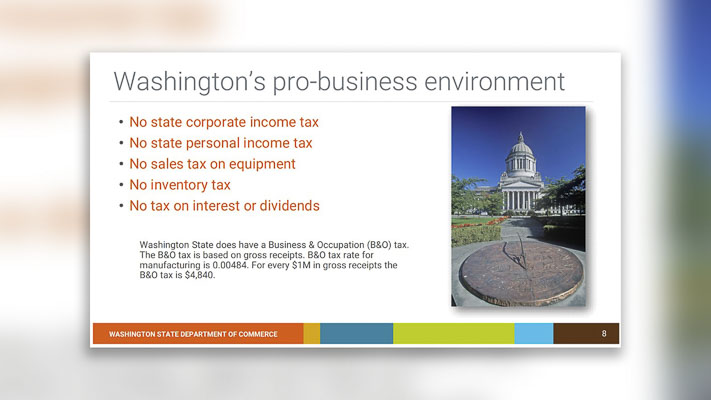
Jason Mercier of the Washington Policy Center explains why Washington has consistently ranked as having relatively stable tax collections compared to other states
Jason Mercier
Washington Policy Center
The State Treasurer put out a press release last week highlighting Washington’s strong credit rating and the impact on bond sale savings. The Treasurer said this about Standard and Poor’s (S&P) credit rating for the state:
“S&P Global Ratings affirmed its long-term and underlying ratings, characterizing Washington’s credit profile by its strong fiscal management practices, including strong forecasting, a history of timely budget adjustments adapting to changes in forecasts. S&P, Moody’s and Fitch are the three largest rating agencies today. These agencies rate the creditworthiness of both private enterprises and governments throughout the world.”
Another thing that S&P said was a credit strength for Washington is the relatively low volatility of our tax collections due to no state income tax. S&P said:
“The ratings reflect our view of Washington’s: Sales tax-based revenue structure, which has demonstrated less sensitivity to economic cycles than income tax-reliant states…”
Though there is no recession-proof tax structure, Washington has consistently ranked as having relatively stable tax collections compared to other states. The reason for this is Washington’s three major tax sources (sales, gross receipts, and property) are among the least volatile taxes. Graduated income taxes, however, are the most volatile taxes. The worst of these for volatility are capital gains income taxes.
The extreme volatility of capital gains income taxes is well known by tax experts. When issuing Washington’s August 2019 bond credit rating Standard & Poor’s noted:
“Washington’s revenues have historically exhibited less cyclicality than others (due in part to the lack of a personal income tax) . . . we have observed that capital gains-related tax revenues are among the most cyclical and difficult to forecast revenues in numerous other states.”
Washington’s Department of Revenue also warned in 2012:
“Capital gains are extremely volatile from year to year.”
It is also important to remember that the state’s Department of Commerce previously said not that having a capital gains income tax “is great marketing” for Washington. Commerce warned in 2018 that imposing a capital gains income tax would mean “one less tool that we have in our economic development toolbox.”
Despite recently scrubbing any mention of no state income tax from its “Choose Washington” webpage, here is what Commerce previously said on the site:
- December 13, 2012: “We offer businesses some competitive advantages found in few other states. These include no taxes on capital gains or personal or corporate income. We also offer industry-specific tax breaks to spur innovation and growth whenever possible.”
- May 1, 2015: “We offer businesses some competitive advantages found in few other states. This includes no personal or corporate income tax. We also offer industry-specific tax breaks to spur innovation and growth whenever possible.” – You’ll note the reference to no capital gains tax was removed (here is what Commerce said then when asked why).
Despite the recent website changes, Commerce is still making no state income tax pitches to employers in direct presentations using this:
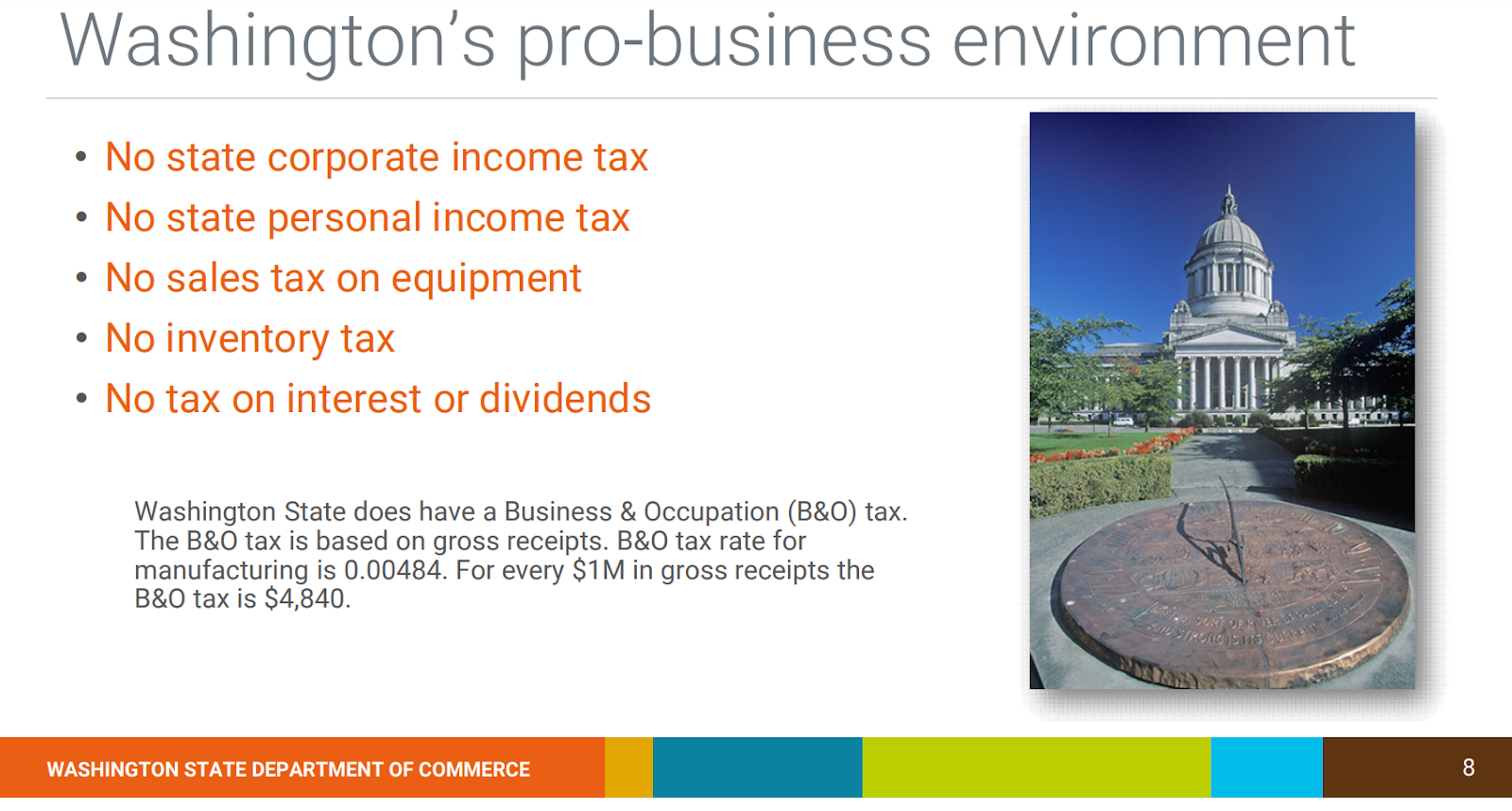
S&P says no income tax is a credit strength for Washington, and Commerce has advertised it as being a competitive advantage. Let’s hope the state supreme court doesn’t mess with a good thing with the capital gains income tax lawsuit, especially since voters have been crystal clear on their opposition to income taxes.
Jason Mercier is the director of the Center for Government Reform at the Washington Policy Center.

Also read:
- Opinion: Lawsuit filed against the unconstitutional income tax in Washington state
 Former Attorney General Rob McKenna and Supreme Court Justice Phil Talmadge challenge the 9.9% income tax in Klickitat Superior Court.
 - Letter: ‘Oregon and Washington aren’t refusing to clean their rolls — they’re contesting federal jurisdiction and timing’
 Camas resident challenges Lars Larson’s fraud claims, explaining legal disputes over federal jurisdiction.
 - Opinion: ‘When are we going to get the full and complete details of the Interstate Bridge Replacement Program’s I-5 Bridge replacement project?’
 IBR team buried key details about light rail ending at waterfront with massive elevator system required.
 - POLL: Do you support extending light rail beyond the waterfront to connect with C-TRAN at Library Square?
 Readers can weigh in on Anne McEnerny-Ogle’s proposal to extend light rail beyond the waterfront to Library Square for improved C-TRAN connections.
 - Opinion: Passing a cyclist – Law, myth and a little patience
 Most drivers can’t legally pass cyclists in-lane due to vehicle width versus road measurements.
