


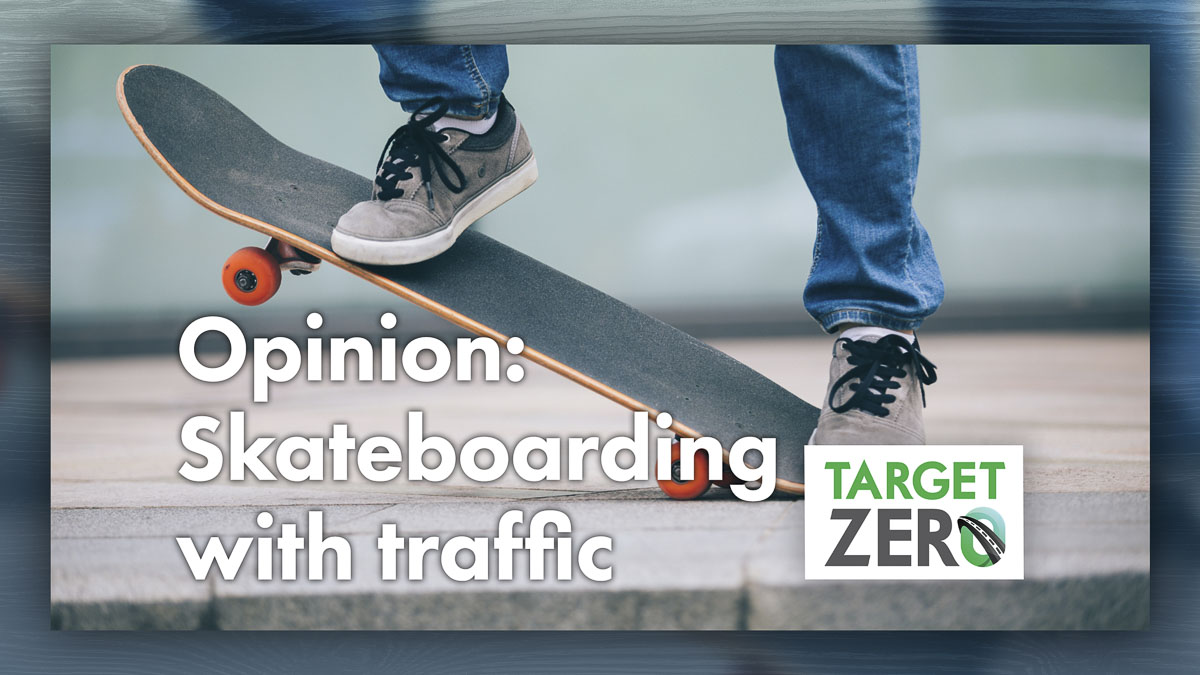
Target Zero Manager Doug Dahl answers as question about the use of skateboards on streets and roads
Doug Dahl
The Wise Drive
Q: We live in a neighborhood with sidewalks. Skateboarders are using our streets and speeding down the hills. We have almost hit them by simply driving and being overcome by speeding skateboarders passing us. Is it illegal for them to be using the roads?
A: Just for fun, I’d like to add a second question to this: Does the speed limit apply to pedestrians? Unless you’re capable of running at speeds in the range of Usain Bolt (max of 27 mph) this seems like a pointless question. But the legal definition of a pedestrian includes more than walkers and runners. The Revised Code of Washington defines a pedestrian as, in addition to folks on their feet, a person using a wheelchair, power wheelchair, or “a means of conveyance propelled by human power other than a bicycle.”

Skateboarders, roller skaters, kids on kick scooters; they’re all pedestrians. And some of those modes of transportation can get absurdly fast. A few examples: World’s fastest power wheelchair – 67 mph, fastest rollerblader – 82 mph, fastest skateboarder – 91 mph. All performed on a closed course, obviously.
The speed limit law applies only to vehicles (“No person shall drive a vehicle on a highway at a speed greater than is reasonable …”), so does that give skateboarders, rollerbladers, and really fast runners freedom to travel at whatever speed they’d like? Nope. While I can’t find a state speed limit law for skateboarders, there are other laws that apply here. (At least one jurisdiction, Western Washington University, has a maximum speed limit of 7 mph for skateboards, and 3 mph near other pedestrians.)
Wherever there are sidewalks it’s unlawful for a pedestrian to travel in the roadway, so in your neighborhood skateboards would have to stick to the sidewalks. (This is state law; many local jurisdictions have laws that prohibit skateboarding in specific locations, like downtown districts, so in those locations even on the sidewalks skateboarders need to pick up their boards.) But let’s say there aren’t sidewalks. In that case, pedestrians are required to walk or move on the shoulder of the roadway, facing traffic, “as far as is practicable from the edge of the roadway.” If there are no shoulders, pedestrians must travel on the outside edge of the roadway, facing traffic, and when practicable move clear of the roadway for oncoming vehicles.
Conceivably then, if there is no sidewalk or shoulder a skateboarder could use the edge of the road, but they’d have to ride facing traffic to comply with the law. That sounds potentially scary at slow speeds, and at high speeds I’d argue that it wouldn’t be legal.
In addition to the rules listed above, when a pedestrian is on a roadway, they are required to “exercise due care to avoid colliding with any vehicle upon the roadway.” I think we can agree that riding a skateboard down a hill at even a neighborhood speed limit like 25 mph when there’s the potential to encounter a car coming up the hill at the same speed isn’t exercising due care. That’s a 50-mph closing speed (and impact speed if things go badly). It also means that every second the skateboarder and the car are getting 73 feet closer, leaving a driver and skateboarder only a few seconds to respond.
That’s probably why we don’t see skateboarders riding downhill facing traffic. And we’ve confirmed that riding with traffic isn’t legal. But making a law and getting everyone to follow it aren’t the same thing, so quick reminder: let’s all stay alert to the errors and misjudgments we encounter on the roads.
The Wise Drive is hosted by Doug Dahl, a Target Zero manager for the Washington Traffic Safety Commission.

Also read:
- Opinion: Were Republican voters just sleeping during the August primary election?
 CCRP Chairman Matt Bumala says 60% of primary no-shows in the 17th and 18th districts were Republicans.
 - Opinion: WA Cares’ launch showcased care WA Cares did not provide
 Gov. Ferguson showcased a caregiving arrangement at the WA Cares launch that the program had not paid for a single day of.
 - Opinion: Portland’s War on Cars Part 4 – A smarter automobile strategy to end gridlock
 O’Toole argues fuel wasted in Portland-area congestion has sextupled since 1982, generating 250,000 tons of extra greenhouse gases annually.
 - Opinion: The Tooth Fairy’s secrets to making brushing & flossing magical
 Delta Dental of Washington’s Tooth Fairy Experience offers free resources to help children build lifelong brushing and flossing habits.
 - Opinion: Transit ridership trends are dismal but regional plans are oblivious
 Puget Sound transit passenger-miles fell 31% from 2015 to 2024 despite a half-million-resident population increase.