


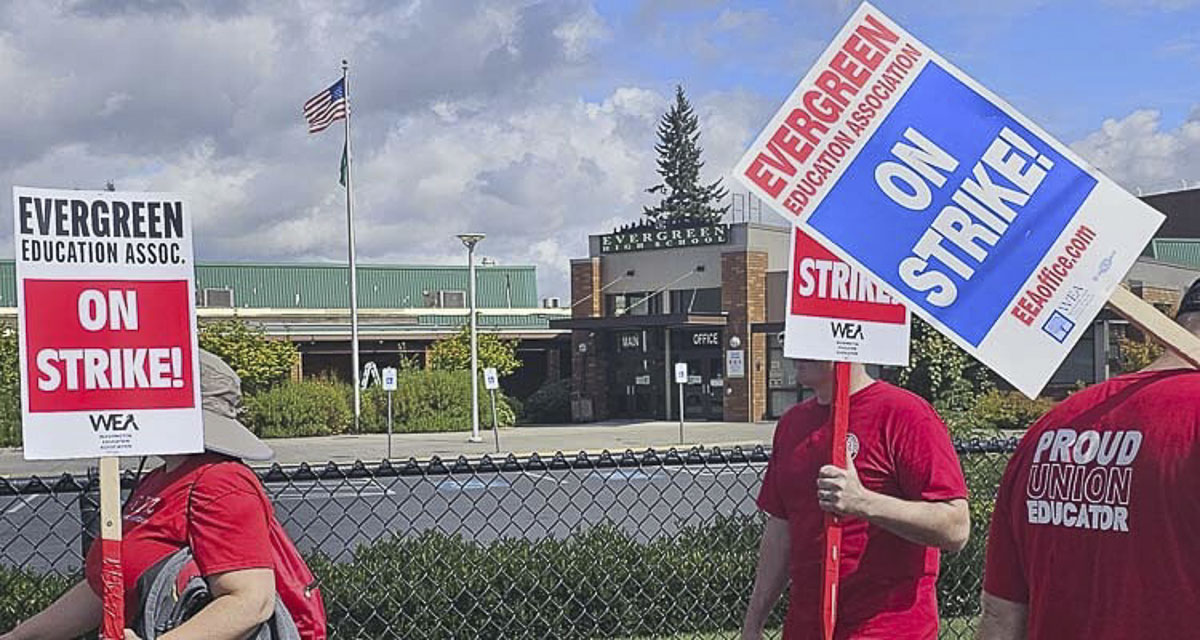
Elizabeth New (Hovde) says ‘cross your fingers that strikes don’t add to UI fund woes in 2026 or give businesses an even worse landscape in which to offer workers work’
Elizabeth New (Hovde)
Washington Policy Center
When lawmakers were deciding whether to allow Washington state’s unemployment insurance (UI) fund to be used to pay striking workers, proponents of the idea insisted the fund was healthy enough to be stretched beyond its role of providing temporary financial help to workers who lose a job through no fault of their own.

Guess what? That doesn’t seem to be the case, just as Washington Policy Center and others warned.
The Washington State Standard reported on Nov. 3, “Washington businesses would need to shoulder roughly $700 million in additional taxes in a few years unless the projected finances of the state’s unemployment insurance fund improve.” Author Jake Goldstein-Street reminds, “News of this potential tax comes as Washington businesses begin to shoulder billions of dollars in new and increased taxes passed this year to fill a shortfall in the state’s operating budget.”
Lawmakers were some of Senate Bill 5041’s strongest proponents, with more than half of the state’s Democratic Senate delegation sponsoring the bill that granted the favor labor unions sought nationwide. (Nearly all Democrats in the House and Senate voted for the bill, with no Republican support. See voter roll calls here.)
Four states, New York, New Jersey, and now Washington and Oregon, starting in 2026, have gone along with the bad idea that even California Democrat Gov. Gavin Newsom rejected as risky. In vetoing legislation similar to SB 5041, he wrote, “Now is not the time to increase costs or incur this sizable debt.”
Unions, of course, applauded Gov. Bob Ferguson not vetoing the bill here. “As a fiscal matter, 5041 will have a negligible – if any – impact on the UI trust fund,” Joe Kendo, chief of staff for the Seattle-based Washington State Labor Council, told The Center Square in May. “ESD [Employment Security Department] estimated something like $1.4m in increased benefits for months during which a qualifying strike occurs. That $1.4m is out of an approximate $120m monthly total benefit average,” he reasoned.
First, I don’t agree now, and didn’t agree then, that $1.4 million in increased benefits during a month that a strike occurs is negligible. Maybe it is to labor leaders whose organizations rake in multiple millions each year in dues revenue. This is why labor should offer strike pay to workers in financial need on its own. Unions sometimes do have strike funds and should be using member dues to help during strikes more.
Next, that partial-cost analysis is horribly misleading. ESD says administering these benefits will require additional state resources. It estimates more than a million in operating costs alone this biennium and writes in its agency impact note, “A large-scale strike would impact the claims center workload.”
ESD also projected striking workers would receive $5.7 million in benefits in fiscal year 2027, with that amount going up in future years, given wage inflation. That will cost employers, leaving them with less money to offer employees — ones who strike and ones who don’t. As the fiscal note explains, “UI benefits paid to striking workers would be charged to the employer and recovered over a 4-year period via the experience tax.”
By trying to help a minority of workers, or their unions, lawmakers have potentially hurt the majority of workers, businesses and an ailing state budget.
This new role for UI Funds could eventually impact taxpayers even more: The bill allows public employees who strike to be included among those who can collect UI benefits, even though they are prohibited from striking and usually receive back pay. Educators strike often, and SB 5041 could cost school districts, kids and parents who need to go to work. (Accepting UI funds while on strike if the worker receives regular pay will result in an overpayment that ESD says it will try to recoup.)
New Jersey?
The fiscal note and thinking attached to 5041 was as disappointing as the argument that $1.4 million of payouts in a month is no big thing. The note did not adequately account for large strikes we have in our state (like those involving a major employer such as Boeing), nor did it appropriately weigh the possibility of increased strike frequency. (We have a lot of headlines about Baristas, nurses and educators participating in work stoppages in Washington state.) Instead, the note used experiences New Jersey was having with its similar law. We’re not New Jersey, and the law is too new there to draw predictive conclusions.
Cross your fingers that strikes don’t add to UI fund woes in 2026 or give businesses an even worse landscape in which to offer workers work. The vast majority of states still consider striking workers to have left their jobs voluntarily and, therefore, ineligible for UI benefits.
Employers finance the UI fund. Benefits are generous. And the fund should remain one that helps workers who lose work through no fault of their own (think economic downturns, federal layoffs, COVID business closures, etc.). Trouble with the fund’s finances should have lawmakers regretting and rethinking bad policy.
Elizabeth New (Hovde) is a policy analyst and the director of the Centers for Health Care and Worker Rights at the Washington Policy Center. She is a Clark County resident.

Also read:
- Opinion: Were Republican voters just sleeping during the August primary election?
 CCRP Chairman Matt Bumala says 60% of primary no-shows in the 17th and 18th districts were Republicans.
 - Opinion: WA Cares’ launch showcased care WA Cares did not provide
 Gov. Ferguson showcased a caregiving arrangement at the WA Cares launch that the program had not paid for a single day of.
 - Opinion: Portland’s War on Cars Part 4 – A smarter automobile strategy to end gridlock
 O’Toole argues fuel wasted in Portland-area congestion has sextupled since 1982, generating 250,000 tons of extra greenhouse gases annually.
 - Opinion: The Tooth Fairy’s secrets to making brushing & flossing magical
 Delta Dental of Washington’s Tooth Fairy Experience offers free resources to help children build lifelong brushing and flossing habits.
 - Opinion: Transit ridership trends are dismal but regional plans are oblivious
 Puget Sound transit passenger-miles fell 31% from 2015 to 2024 despite a half-million-resident population increase.