




Area resident Rob Anderson says Ridgefield School District’s ballooning budget has not led to better academic outcomes
Rob Anderson
for Clark County Today
The first article took a closer look at Ridgefield School District’s two levy proposals: Proposition 12, an operational levy, and Proposition 13, labeled as a “Technology and Capital” levy. Proposition 12 requests a 41% increase in operational funding compared to 2022, amounting to $44 million annually. Proposition 13 seeks $21 million, primarily for capital projects, including a previously rejected proposal for a new elementary school*, various maintenance projects**, and — despite its name — only 7% of Proposition 13’s funds are allocated for technology.

The analysis raised concerns about the district’s fiscal responsibility, transparency, and respect for voter intent, highlighting that voters previously rejected similar projects when they were part of a bond proposal requiring a supermajority. The discussion emphasized the burden these levies would place on taxpayers and questioned whether the district has prioritized its existing resources effectively.
These concerns become even more alarming when measured against Ridgefield’s educational outcomes, which have either stagnated or declined. As taxpayers are asked for an unprecedented financial commitment, it’s imperative to question whether increased budgets are delivering better results — or simply fueling the bureaucratic education machine here in Ridgefield.
Budget growth vs. academic performance
Ridgefield School District’s budget trajectory is startling. In 2017-18, the operational budget was $34 million. By 2019, it had risen to $45 million — a 32% increase in just two years. Fast-forward to 2024, and the budget stands at a staggering $71 million, reflecting a 69% jump since 2019, even without factoring the potential Proposition 12 infusion.
Despite this significant increase in funding, academic performance has declined. According to data from the Office of Superintendent of Public Instruction (OSPI):
- Language Arts: 62% proficiency (down from 72% in 2018)
- Math: 50% proficiency (down from 62% in 2018)
- Science: 56% proficiency (down from 58% in 2018)
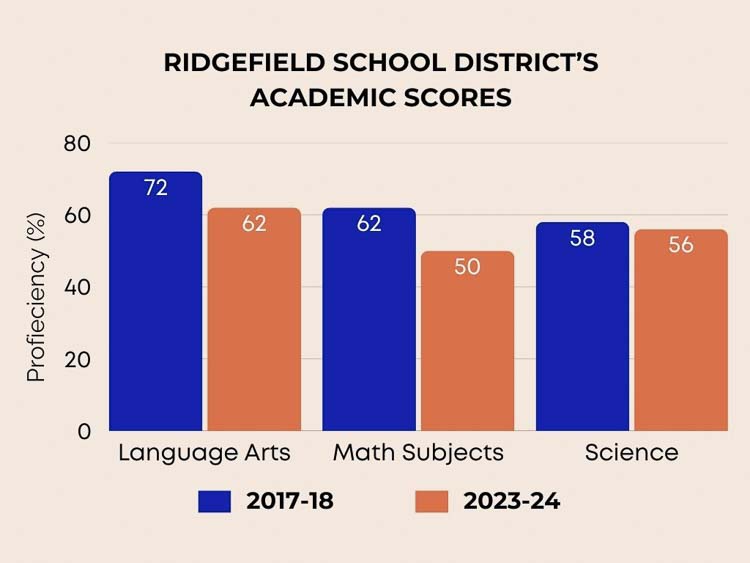
Fewer than two-thirds of students are proficient in reading, and only half meet math standards. This stark disconnect between rising budgets and declining outcomes raises serious questions about the district’s spending priorities and effectiveness in delivering educational excellence.
Enrollment vs. spending
Proponents of increased levies claim that Ridgefield’s rapid population growth necessitates higher taxes, but the data tells a different story. According to RSD data, between 2019 and 2024, enrollment grew by 18%, from 3,491 to 4,116 students. Yet during the same period, per-student spending soared by 50%, from $10,509 in 2017-18 to $15,798 in 2022-23. The district’s overall operational budget grew by nearly 70%, that’s a 380% increase compared to student enrollment (data collected from RSD Board presentations).
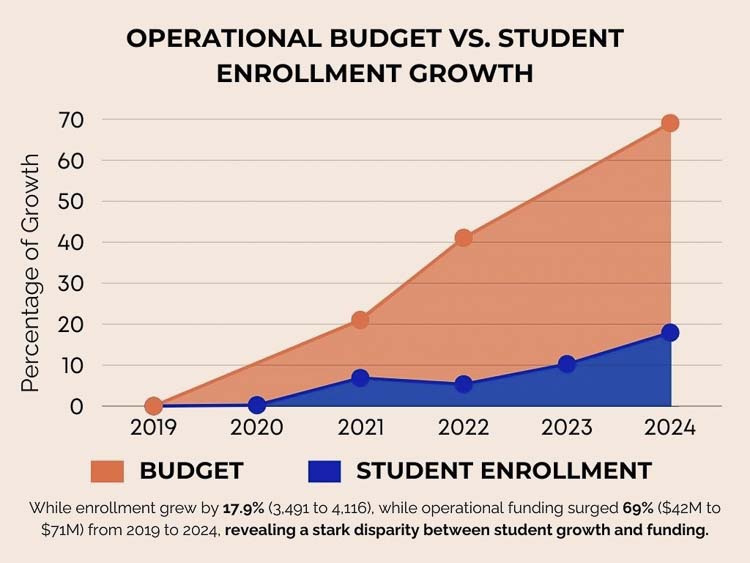
This disparity — budget growth outpacing enrollment by a factor of almost four — indicates that Ridgefield does not face a revenue problem but a failure to align spending with academic needs. Taxpayers deserve transparency and accountability, particularly when such significant financial resources are being mismanaged.
Ridgefield has a spending problem, not a revenue problem
Ridgefield School District’s ballooning budget has not led to better academic outcomes, despite claims that enrollment growth necessitates higher spending. Propositions 12 and 13 ask taxpayers to fund even more spending without addressing this glaring imbalance or the declining academic standards that persist. Voting “yes” won’t solve these problems — it will only feed a larger, less accountable bureaucratic educational machine. To achieve real improvement, voters must demand reforms that prioritize student success and align spending with actual needs, not excuses.
For more information go to reformclarkcounty.com
Note* – The proposed new elementary does have minor changes that include a 5 percent reduction in square footage, a regular-sized elementary gym rather than a full-sized gym and replacing the proposed turf with natural grass.
Note of Correction: I have recently confirmed that RSD did remove the turf replacement and track resurfacing at the high school from the presented Prop 13. According to the Nov. 12, 2024 RSD Board presentation, that was still included but I was able to confirm this week that the turf and track projects were removed.

Also read:
- Opinion: In plain sight – yielding to pedestrians
 Drivers often fail to see pedestrians due to inattentional blindness, which highlights the need for more focused awareness at intersections and stronger safety practices.
 - Opinion: The legislature has committed $2.4 billion to recurring pension increases since 2018
 Six legislative COLAs have raised public employer costs by $2.38 billion since 2018, driving up unfunded pension liabilities and increasing burdens on county and city budgets.
 - Opinion: ‘Just because they got away with it doesn’t mean they weren’t wrong’
 A Skamania County deputy’s report found violations of county rules and the Open Public Meetings Act, but no prosecutor acted on the findings.
 - Opinion: Small things grow great by concord
 Washington’s initiative process gives citizens direct power to challenge lawmakers. Failed restrictions and new measures on girls’ sports, parental rights, and citizenship prove the influence of grassroots action.
 - Opinion: California’s $20 fast food minimum wage creates less jobs and lower income
 Study data show California fast food workers now face fewer shifts, higher menu prices, and widespread automation after the $20 wage hike.
 wpDiscuz
