



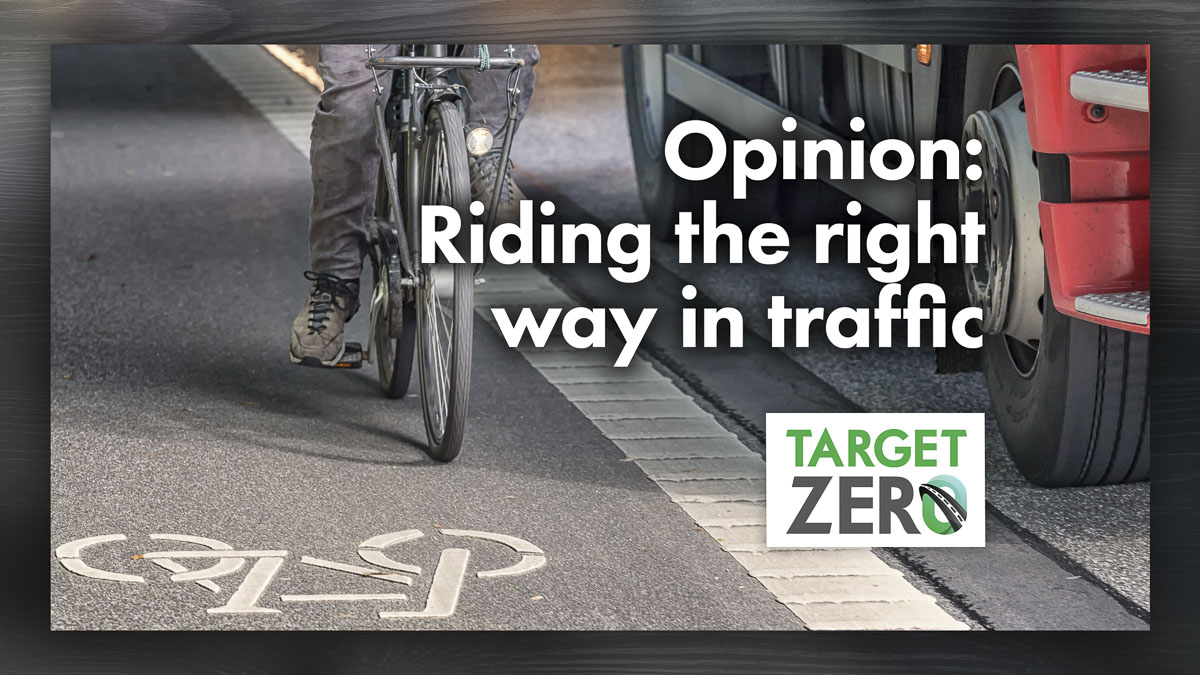
Target Zero Manager Doug Dahl addresses the question of ‘is it okay to ride my bike facing traffic?’
Doug Dahl
The Wise Drive
My fellow cyclists, I want you to live. From conversations I’ve had with bike riders and observations on the road there’s a question a few cyclists aren’t asking, and they should. It goes something like this: “Is it okay to ride my bike facing traffic?”

That’s a hard no. I’ll get to the law in a minute, but this is one of those things where the physical consequences are far worse than any potential legal consequences, so let’s start there. I’ve heard people say things like, “I ride facing traffic because I want to see what’s coming at me.” That’s understandable. But it’s misplaced.
Let’s consider some basic practicalities. If you’re riding in the roadway against traffic, what happens when you inevitably meet a car? Best case scenario, there’s room to move to the shoulder, but if there was space on the shoulder you’d have already been riding there. The driver might be able to pass you, but narrow lanes and oncoming traffic would eliminate that option. Maybe they spotted you far enough away to be able to stop. Now you’ve created a traffic jam, and you still don’t have a clear route. Worst case scenario, the driver can’t stop in time and is forced to choose between an oncoming car and an oncoming bike. Human survival instincts being what they are, you know how that’ll play out.
Even if there is room to ride on the shoulder, it’s still a problem. What happens when you meet another cyclist? I can tell you how I’ve handled it when I’ve encountered a wrong-way rider; I stay to the right. Yes, in order to pass me, the wrong-way cyclist will likely have to move into the car lane. I started out by saying I want you to live, and that’s true, but I want me to live even more.
Then there’s vehicle speeds. Say you’re riding along at 15 mph, in the same direction as a car driving at 35 mph. That’s a speed differential of 20 mph. I don’t have data on impact speeds for cyclist/vehicle crashes but there’s plenty on pedestrian/vehicle crashes, which should be a decent comparable given the lack of protection for both pedestrians and cyclists. When struck at 20 mph, 90 percent of pedestrians survive the crash. If we take those same speeds but have the cyclist ride against traffic that’s a 50-mph speed differential, and only 25 percent of pedestrians survive at that speed.
There’s also the issue of reaction time. In studies an attentive driver will spot a cyclist from 1000 feet away. Using the same speeds, that gives a driver 34 seconds to adjust when the cyclist is riding with traffic, and only 14 seconds when the cyclist is riding against traffic. But even the best drivers aren’t always attentive; a real-world distance might be as low as to 200 to 300 feet. With a 50-mph speed differential a driver doesn’t have enough time to stop. If you ride with traffic, the car behind has time to slow down and wait until there’s a safe opportunity to pass.
All this leads to wrong-way cyclists being about four times more likely to be killed in a crash with a vehicle. Wrong-way cyclists account for more than 11 percent of cyclist fatalities. That’s three times what it was in 2016.
The law part is simple. When cyclists ride on the road (including the shoulders), they’re required to follow the same traffic laws as drivers (with a few exceptions). That means riding on the right side of the road, the same direction as the cars.

Also read:
- Opinion: The growing gap between public voice and political power
 Todd Myers describes how large-scale protest and sign-ins often fail to sway state leaders, and argues authentic influence is most likely found through local action.
 - Opinion: Who is winning the race for affordable power?
 Hydroelectric power keeps Washington competitive, but new laws and carbon pricing are driving up electricity costs for residents each year.
 - Opinion: Half the road, full stop – Understanding pedestrian right-of-way
 Doug Dahl explains how Washington’s law requires drivers to stop when a pedestrian is within one lane of their half of the road, not just when directly in front.
 - Opinion: The state’s RFK-proofing bill comes with a cost
 Mandates like HB 2242 can lead to higher premiums as insurance companies absorb costs for new preventive services, affecting affordability statewide.
 - Opinion: What is the cost of a bridge?
 John Ley argues the I-5 Bridge replacement’s soaring cost stems from costly extras like light rail, noting other states deliver larger, toll-free bridges for much less.
