


Ridgefield School District has partially created its own capacity and overcrowding issues, according to Ridgefield resident Heidi Pozzo
Heidi Pozzo
for Clark County Today
Ridgefield School District has partially created its own capacity and overcrowding issues. In a prior article, I walked through a series of decisions the District made that impacted capacity related to the last bond.

Since then, the district has made more decisions that impact overcrowding. We need to understand those decisions so they are not repeated in the future.
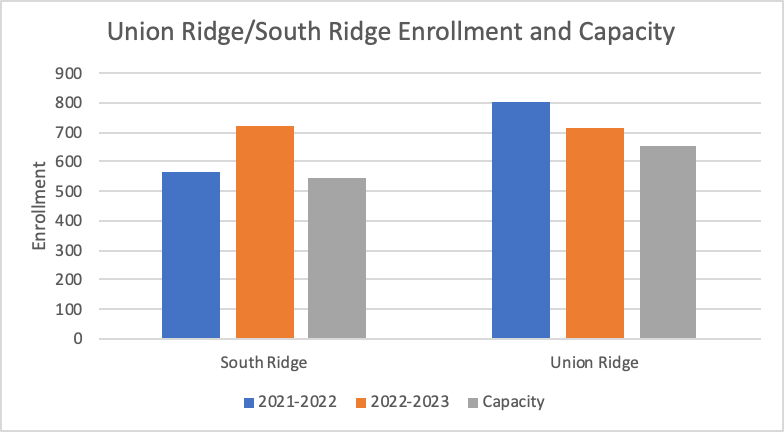
In 2021-2022, Union Ridge Elementary School was 22 percent overcapacity and South Ridge Elementary School was 5 percent over. So the district understandably wanted to address the issue and rebalanced enrollment so the students were spread equally across schools. But the schools don’t have the same capacity.
Rebalancing put South Ridge 33 percent over capacity while Union Ridge dropped to 9 percent over capacity. The numbers don’t tell the whole story though. Union Ridge has an elementary school-sized gym and a middle school-sized gym, as well as two play areas. South Ridge has one elementary school-sized gym and one play area.
It is much more difficult for South Ridge to handle having its enrollment pushed so far over capacity than Union Ridge because it is a significantly smaller overall facility.
As the district contemplates rebalancing enrollment for a third elementary school, the plan is to spread students evenly across schools once again. Only this time, the rebalancing will create a significantly higher strain on South Ridge than the other schools.
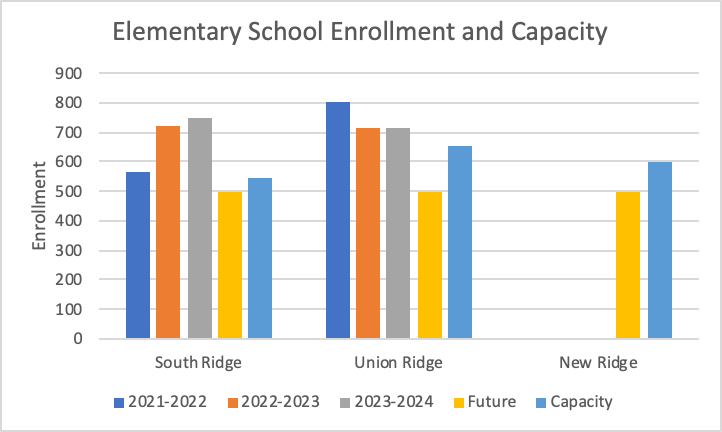
By spreading students evenly across schools, Union Ridge and the new elementary will have significant room for growth. South Ridge, however, will only have room for 42 more students before reaching capacity. And South Ridge is the school that has been growing the fastest.
By not looking at growth rates and capacity for each school, the district has been driving overcrowding at South Ridge.
To be clear, as I’ve stated in the past, there is a need for another elementary school. The existing elementary schools have reached the point where it is difficult to manage the populations. However, there are a number of issues with the proposed school and the propositions that are up for a vote.
Whichever path the voters choose, the district should keep growth rates, school design and capacity in mind to not unfairly burden any one school.
Heidi Pozzo has been a Ridgefield resident for 16 years. She is a concerned citizen who would like students to get a good education and thinks we can do it in a more cost-effective way.

Also read:
- Opinion: Were Republican voters just sleeping during the August primary election?
 CCRP Chairman Matt Bumala says 60% of primary no-shows in the 17th and 18th districts were Republicans.
 - Opinion: WA Cares’ launch showcased care WA Cares did not provide
 Gov. Ferguson showcased a caregiving arrangement at the WA Cares launch that the program had not paid for a single day of.
 - Opinion: Portland’s War on Cars Part 4 – A smarter automobile strategy to end gridlock
 O’Toole argues fuel wasted in Portland-area congestion has sextupled since 1982, generating 250,000 tons of extra greenhouse gases annually.
 - Opinion: The Tooth Fairy’s secrets to making brushing & flossing magical
 Delta Dental of Washington’s Tooth Fairy Experience offers free resources to help children build lifelong brushing and flossing habits.
 - Opinion: Transit ridership trends are dismal but regional plans are oblivious
 Puget Sound transit passenger-miles fell 31% from 2015 to 2024 despite a half-million-resident population increase.
 wpDiscuz