



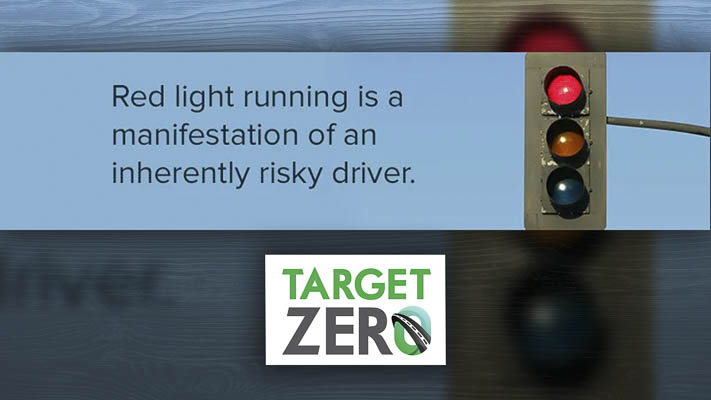
The Revised Code of Washington states: ‘Vehicle operators facing a steady circular red signal shall stop before entering the intersection control area’
Doug Dahl, manager
Target Zero
Q: Do you need to come to a complete stop before turning right at an intersection when the light is red, if the red traffic signal is located across the intersecting street for vehicles proceeding through the intersection? In other words, do you have to stop before turning right only if the traffic signal light is on the right curb of the right turn lane?
A: The Manual of Uniform Traffic Control Devices (MUTCD), the official guide book for traffic road signs, markings, and signals, devotes 70 pages to traffic control signals and how they’re configured. It includes over one hundred charts, graphs, and diagrams showing the various approved methods for using traffic control signals. None of them match what you’ve described.

However, we don’t need all those pages and diagrams to get to the core of this question. The Revised Code of Washington has a much shorter answer. It states (edited for brevity), “Vehicle operators facing a steady circular red signal shall stop before entering the intersection control area.”
The location of the red light has no bearing on the requirement to stop before turning. If a driver is facing a red light, no matter if the light is on a crossbar in the center of the intersection, mounted on a post across the street, or on the curb to the driver’s right, the driver must stop prior to making a right turn on a red light.
This might seem obvious, and I hope you are defaulting to stopping at all red lights pending clarification. However, I did mention over one hundred diagrams showing various traffic signal configurations; with all those options a driver might start wondering.
Don’t worry, you don’t need to read the MUTCD to understand the rules. That book is for the engineers who design our roadways. Here’s what you need to know: At intersections where every lane is controlled by a steady red light (or lights), every driver facing the red light is required to stop, no matter which direction they’re headed. Drivers facing a steady red arrow are prohibited from entering the intersection to make the movement indicated by the arrow. Drivers intending to make a right turn when facing either a steady red light or arrow may only do so after stopping and yielding to vehicles and pedestrians in the intersection.
To summarize: If the light is red, you’re required to stop. I tried to come up with a catchy rhyme to reinforce the message, but they were all too corny or too graphic (dead and bloodshed both rhyme with red).
Besides, the folks who don’t stop at red lights may need more remedial training than can be offered in a pithy lyric. Researchers found that red light runners in crashes are more likely than other drivers to “have prior moving violations and convictions for driving while intoxicated, have invalid driver’s licenses, and have consumed alcohol prior to the crash.” Or in other words, red light running is a manifestation of an inherently risky driver.
Red light running was a factor in 1149 traffic fatalities in the US in 2022. That’s a 22 percent increase from what had been a ten-year high 939 deaths in 2017, which was already a 28 percent increase from 2012.
According to a AAA survey, 100 percent of us agree that it’s at least slightly dangerous to run a red light. But 25 percent of drivers admitted to doing it in the previous month. Drivers are saving a few seconds with a behavior that predictably kills around 1000 people every year. So one more time: stop at red lights.
TheWiseDrive is hosted by Doug Dahl, a Target Zero manager for the Washington Traffic Safety Commission.

Also read:
- Opinion: Someone explain the Democrat Party to me please
 Lars Larson criticizes Democrat politicians for shutdown threats, Homeland Security funding refusals, and positions on election laws, housing, and gun rights.
 - POLL: Do you agree with requiring board members to follow council direction?
 Disagreement among county councilors centers on whether C-TRAN board members should reflect the council’s collective wishes or act independently, highlighting ongoing concerns about public accountability.
 - Opinion: In plain sight – yielding to pedestrians
 Drivers often fail to see pedestrians due to inattentional blindness, which highlights the need for more focused awareness at intersections and stronger safety practices.
 - Opinion: The legislature has committed $2.4 billion to recurring pension increases since 2018
 Six legislative COLAs have raised public employer costs by $2.38 billion since 2018, driving up unfunded pension liabilities and increasing burdens on county and city budgets.
 - Opinion: ‘Just because they got away with it doesn’t mean they weren’t wrong’
 A Skamania County deputy’s report found violations of county rules and the Open Public Meetings Act, but no prosecutor acted on the findings.
