


🎧 Portland’s 50-Year War on Cars: How Did It Get Here?
Naomi Inman provides an introduction to the series: Portland’s War on Cars
Naomi Inman
Cascade Policy Institute
Introduction to the series: Portland’s War on Cars
By Naomi Inman
This July, Cascade published a new report by adjunct scholar Randal O’Toole, “The Portland Transportation Disaster: The High Cost of Anti Auto Planning in Portland.” To accompany that report, Cascade is launching a month-long series about Portland’s 50-year “War on Cars,” culminating with a look at the 40th anniversary of MAX light rail and a personal reflection on the opening of the Gresham line by John Charles.
This series is rooted in a fight Portlanders have been waging for years—citizens and small business owners pushing back against the Portland Bureau of Transportation’s (PBOT) relentless campaign to prioritize bus and bike lanes while removing lanes for cars through road diets and BAT (Business Access Transit) lanes.
The 82nd Avenue project is just one example of PBOT’s overarching agenda, spelled out in the Portland 2035 “Transportation System Plan” (TSP) and illustrated in its 2-page directive to “prioritize walking, bicycling, transit,” and shift 70 percent of Portlanders into “shared vehicles.”
PBOT’s “strategy for people movement” simply does not include personal automobiles. Their own graphics illustrate the progression they want: 200 people in cars replaced by 200 people on a single light rail train.
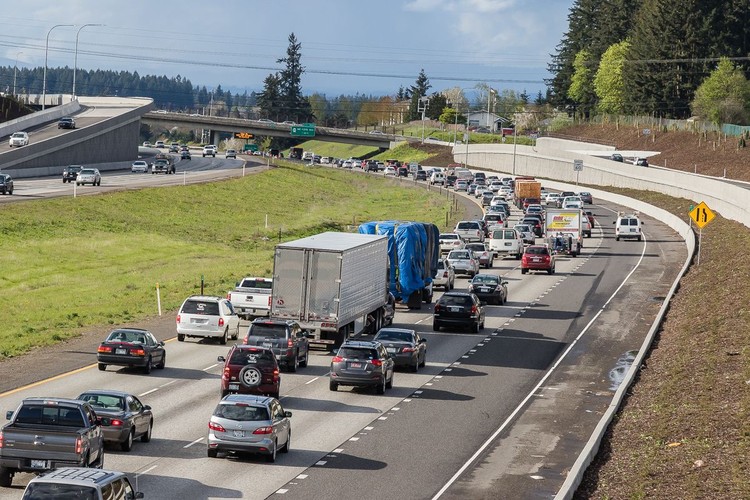
In PBOT’s worldview, “transportation” means walking, bicycling, and transit—and every policy is designed to reduce vehicle miles traveled. Success is defined, not by improving mobility for people who travel, but by ensuring buses, bikes, and trains move freely while drivers sit in manufactured congestion created by lane reductions, road diets, BAT lanes and other similar schemes.
Portland’s transit planning has been guided by the same delusion for half a century: that the personal vehicle can be regulated, nudged, or inconvenienced out of existence. The result is an overbuilt, financially unsustainable transit system and a planning model that has failed by every measurable metric.
Buckle up! This series with Randal O’Toole and John Charles will take you through how Portland got here — and what it will take to restore mobility in a city that has spent decades trying to engineer it away.
Naomi Inman is external relations manager at Cascade Policy Institute, Oregon’s free market public policy research organization. As a staff journalist and writer, Naomi helps Cascade make the case for free-market policies through media affairs and publications.

Also read:
- Opinion: Were Republican voters just sleeping during the August primary election?
 CCRP Chairman Matt Bumala says 60% of primary no-shows in the 17th and 18th districts were Republicans.
 - Opinion: WA Cares’ launch showcased care WA Cares did not provide
 Gov. Ferguson showcased a caregiving arrangement at the WA Cares launch that the program had not paid for a single day of.
 - Opinion: Portland’s War on Cars Part 4 – A smarter automobile strategy to end gridlock
 O’Toole argues fuel wasted in Portland-area congestion has sextupled since 1982, generating 250,000 tons of extra greenhouse gases annually.
 - Opinion: The Tooth Fairy’s secrets to making brushing & flossing magical
 Delta Dental of Washington’s Tooth Fairy Experience offers free resources to help children build lifelong brushing and flossing habits.
 - Opinion: Transit ridership trends are dismal but regional plans are oblivious
 Puget Sound transit passenger-miles fell 31% from 2015 to 2024 despite a half-million-resident population increase.