



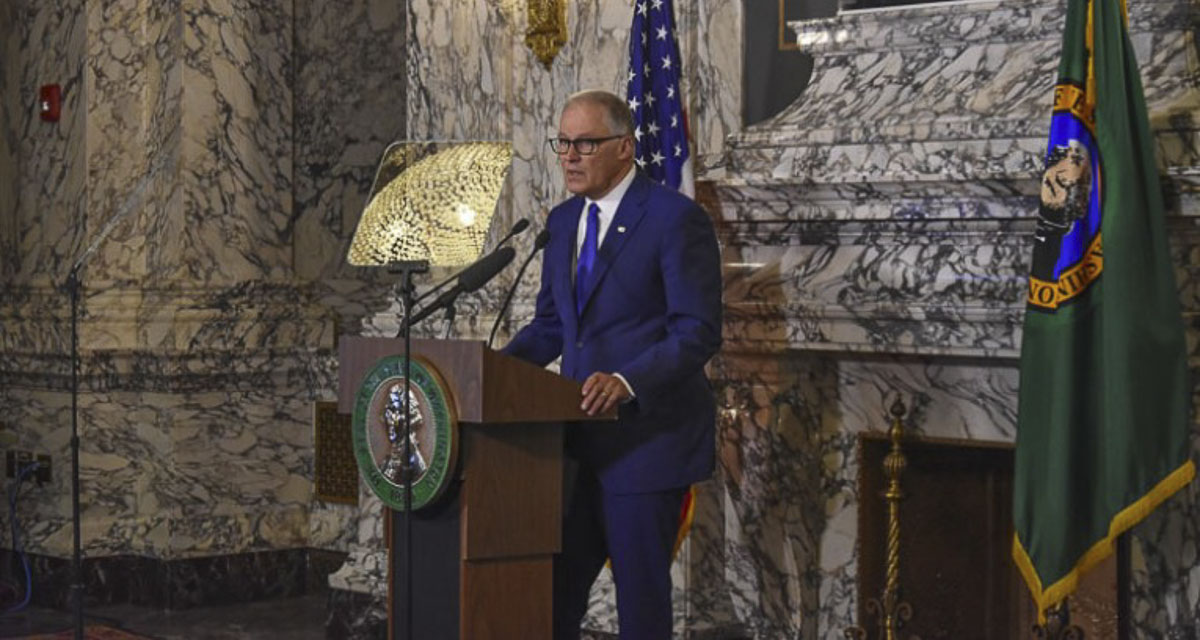
Todd Myers reminds us that Inslee made fighting climate change the rhetorical centerpiece of his time as governor and his short-lived presidential campaign
Todd Myers
Washington Policy Center
With passage of a federal budget that cuts subsidies for renewables like wind and solar and an executive order promising to “end taxpayer support for unaffordable and unreliable ‘green’ energy sources,” climate activists are considering new approaches to reduce the impact of greenhouse gases. One such champion stepping forward is former Washington state Gov. Jay Inslee.

Inslee made fighting climate change the rhetorical centerpiece of his time as governor and his short-lived presidential campaign. Inslee claims he made Washington state “a leader” in the fight against climate change, and Time magazine gave him a 2025 Earth Award, saying the former governor “believes in the power of local action.”
Having worked on environmental policy for 25 years in Washington state, I can attest that following Inslee’s lead would be a catastrophic mistake.
In a recent editorial, he argued that Democrats should use climate change to “win over young Trump voters.” His central, and repeated, error — the one he now encourages national climate activists to follow — is to treat climate change as a political tool, rather than focusing on effective solutions.
In fact, Washington state’s carbon dioxide emissions increased every year of Inslee’s first decade in office, except 2020. The governor’s policies were so ineffective that, in 2019, Florida’s per capita CO2 emissions were actually lower than Washington state’s, having been 10 percent higher just six years earlier. Florida, with no meaningful climate policy, outperformed Washington with Jay Inslee at the helm.
Given a choice between candidly assessing the results of his policies and political expediency, the governor routinely chose politics.
When he took office, Inslee promised to track the results of his policies, creating a web page that showed progress toward climate goals. He said the goal was to use that data to fix problems and improve outcomes. But in 2019, just prior to announcing his presidential campaign, Inslee’s administration shut down the page. His administration was missing virtually all its targets, an embarrassing reality for the “climate candidate.”
Washington is now so far behind its 2030 emissions targets the state will have to cut CO2 emissions by the equivalent of three COVID-level pandemic shutdown reductions cumulatively.
Washington’s electric vehicle policy is another example of how the state has performed so poorly. Last year, Inslee announced a $45 million program of subsidies to help “provide low-income Washingtonians access to electric vehicles.” The results were mixed at best, failing to “ensure the rebates reached overburdened and vulnerable communities.”
Governor Inslee deflects from those failures, instead focusing on the CO2 cap-and-trade system that took effect in 2023, promising that it will deliver results in the future. However, early results show projects funded by that system are failing to deliver emissions reductions. His own administration released a report showing that approximately two-thirds of the state’s climate projects create no “quantifiable emissions reductions.”
The pattern has been to make bold statements and send out press releases claiming victory while repeatedly failing to deliver. With each failure, Inslee relied on partisanship to paper over policy failures. That approach earned Jay Inslee national attention and accolades. It did not, however, help the planet.
This strategy is irresponsible and creates cynicism that undermines the ability to promote effective climate policy. Those who are sincere about climate and environmental policy are at a crossroads. They can take the route suggested by Inslee and put politics first, or they can honestly assess the record of the past two decades of climate policy and look for a better approach.
Those who believe climate change is — as Jay Inslee has often said — an “existential crisis” must live up to that rhetoric and ostracize self-serving politicians whose use of climate change as a political weapon has become a major barrier to addressing the problem. Politicians should look to companies like Microsoft and Amazon that invest in projects that are certified to reduce CO2 emissions — and if they don’t, the funding is returned. Prioritizing efforts based on effectiveness and innovation, rather than political grandstanding, is the only way to responsibly reduce the risk from climate change.
During the next three-and-a-half years of the Trump administration, those who care about reducing the risk from climate change can take the partisan (and failed) path that Inslee recommends. Or they can begin to find alternatives that aren’t contingent on politics and, instead, focus on results.
Todd Myers has worked on energy and environmental policy in Washington state for 25 years and is vice president for research at the Washington Policy Center in Seattle.
This report was first published by TheHill.com.

Also read:
- Opinion: Stalin would be proud – Clark County Socialists gathered for ‘No Kings’
 Reform Clark County’s Rob Anderson criticizes local and national groups for organizing protests that featured Auditor Greg Kimsey as a keynote, raising concerns about public trust and political partisanship.
 - Letter: Vancouver Mayor Anne McEnerny-Ogle makes several serious and incorrect engineering statements
 Bob Ortblad critiques engineering claims by Vancouver Mayor Anne McEnerny-Ogle, highlighting cost and safety advantages of an immersed tunnel for the I-5 crossing.
 - Opinion: The beginning of the end of anchor babies
 Lars Larson argues the Constitution excludes children born to non-legal residents, as the Supreme Court debates birthright citizenship and public opinion data shows limited support.
 - Opinion: Defend bail now or face more chaos on our streets
 A proposed Washington court rule would cap bail for most misdemeanors and allow defendants to bypass bondsmen, raising concerns about accountability and public safety.
 - Opinion: Some worker rights get a poster, others get fine print
 Elizabeth New questions why Washington state highlights some workplace protections while Janus First Amendment rights for public employees remain hidden in official materials.
