



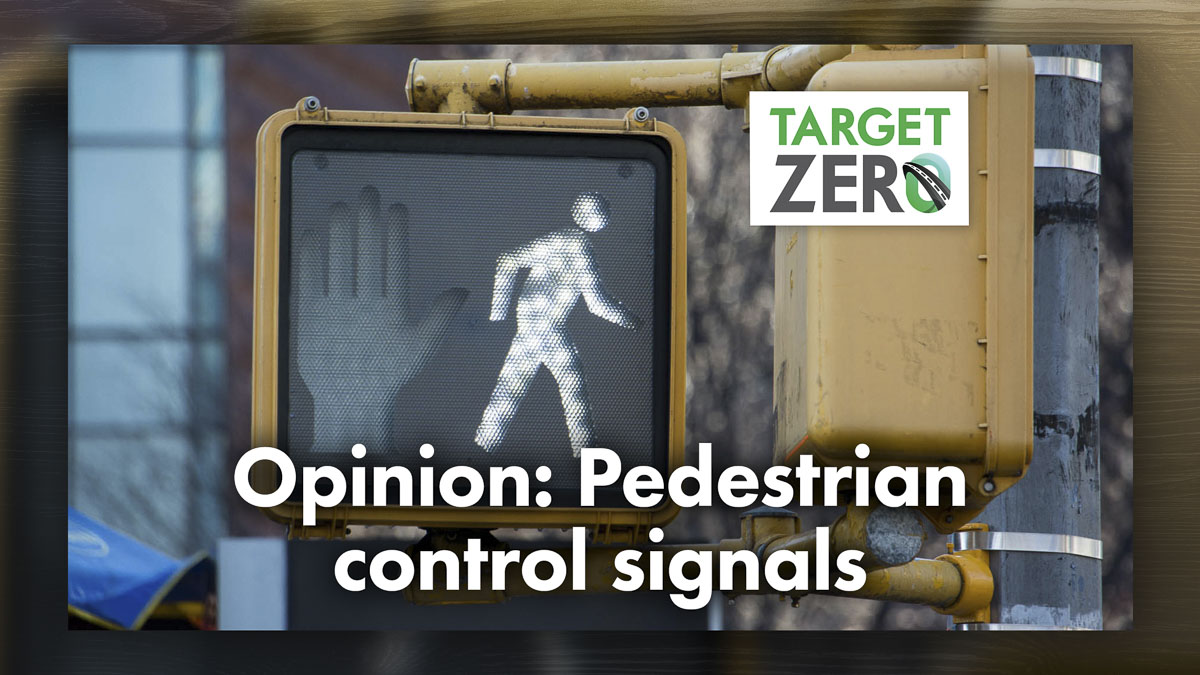
Doug Dahl answers a question about the rules about crosswalks at intersections with signal lights
Doug Dahl
The Wise Drive
Q: What are the rules about crosswalks at intersections with signal lights? Many people think that if they are in a crosswalk and the light is green for the automobile, they can still cross. Please elaborate.
A: I was initially puzzled by this question. The reason many pedestrians think they can cross the street when the light is green is because that’s what the law says: “Pedestrians… facing any green signal, except when the sole green signal is a turn arrow, may proceed across the roadway within any marked or unmarked crosswalk.”

At an intersection controlled by the standard red/yellow/green traffic signal, pedestrians mostly follow the same rules as drivers, with one exception. For drivers, the yellow light is a warning that a red light is coming, and once it’s red “vehicular traffic shall not enter the intersection.” For pedestrians, once the light turns yellow they “shall not enter the roadway.” That makes sense; intersections are timed so a car entering the when the light turns yellow should have enough time to clear before it turns red, while a pedestrian who starts crossing on a yellow light will likely be halfway across the street when the lights switch.
Those rules change though, if the intersection also has a pedestrian control signal. I suspect that’s what inspired this question. When there’s a signal with walk/don’t walk or it has the walking person and hand symbols, it sets the rules for pedestrians to follow.
But not too literally. I’m reminded of the scene in the movie Rain Man, when Dustin Hoffman, playing an autistic man, takes the “don’t walk” sign at its word and freezes in the street blocking traffic when it switches on. The law prohibits pedestrians from entering a road on either a flashing or solid hand symbol but, for sure, you should finish crossing once you start.
When an intersection has pedestrian controls, they likely won’t match up with the traffic control signals. For example, at an intersection near my home, when the traffic signal turns green the walk symbol lights up for only a few seconds. It then switches to a flashing hand symbol with a 24 second countdown before turning to a solid hand. About five seconds later, the green light for the traffic turns yellow. That works out to roughly half a minute longer for cars to enter the intersection than pedestrians.
For anyone who’s thinking 24 seconds would give them enough time to cross the street twice, yes, that may be true. The Manual on Uniform Traffic Control Devices recommends calculating pedestrian walking speed at four feet per second to allow slower walkers enough time to cross the street.
At intersections with a countdown, faster walkers might be tempted to start crossing the street when half the time is already used up. Here’s the problem: a driver approaching the intersection from the same direction as the late-crossing pedestrian, and intending to make a right turn, may see the flashing hand symbol and assume that they’re clear to make that turn. Mix a quick pedestrian with a driver’s assumptions and we have a conflict.
You might argue that a driver shouldn’t make assumptions, and I agree with you. When you’re the biggest and the fastest, you have a responsibility to wield that power safely. However, the law does state that the flashing “don’t walk” sign means pedestrians shouldn’t enter the roadway. And no matter who’s to blame, in a crash with a car and a pedestrian, the pedestrian loses. So, drivers and walkers, when you’re approaching a pedestrian control signal be smart and be predictable.
Also read:
- ‘Our new normal’: WA confronts another year of drought
 Casey Sixkiller says every watershed in Washington has dropped below 75% of normal water supply.
 - Schools expect minimal impact with Title IX pacts rescinded
 Federal officials rescinded agreements with six school districts, saying previous administrations misapplied Title IX protections.
 - Area Agency on Aging & Disabilities in Southwest Washington announces the Senior Farmers Market Nutrition Program
 AAADSW opens applications for $80 benefit cards to help eligible seniors buy fresh produce at farmers markets.
 - Free in-person workshops promote composting and sustainable living
 Clark County’s free workshops teach residents worm composting, green cleaning, and smart recycling through April and May.
 - Keeping afloat: A bittersweet chronicle of two women who endured the sinking of the Titanic
 Local historian Peri Muchich shares the story of Pacific Northwest Titanic survivor Anna Warren at Sunday’s museum event.
 - Letter: ‘This is the worst thing that ever happened to the region’
 A Hayden Island resident Sam Churchill is criticized in a letter calling the $14 billion Interstate Bridge Replacement project a “boondoggle” that destroys local businesses.
 - Washougal ramps up efforts to support small businesses
 Washougal launches Gateway to Success Series with free workshops starting April 15 at Best Western Plus Convention Center.
 wpDiscuz
