


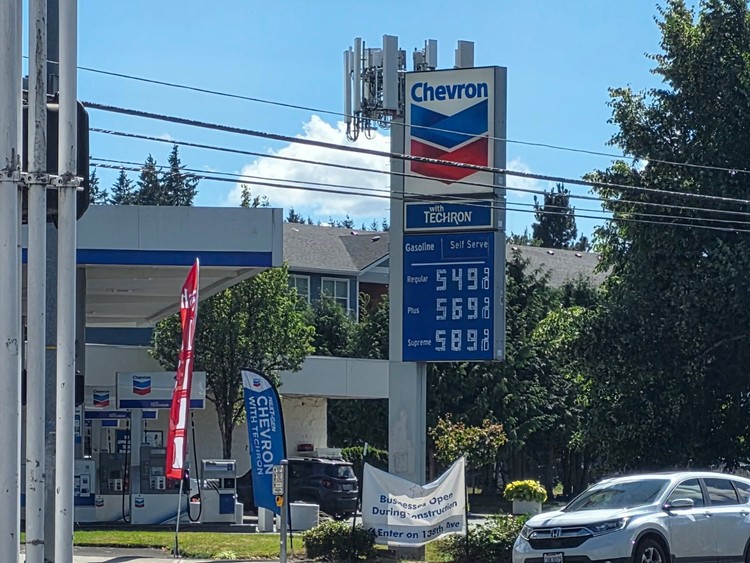
🎧 West Coast Climate Policies and the High Cost of Gas
Researchers first point out the carbon tax in Washington state, called the ‘Climate Commitment Act,’ and the Carbon Fuel Standard as the main drivers of the rapid increase in prices, driving gas prices up $0.41 to $0.48 per gallon
Bob Pishue
Mountain States Policy Center
New research reveals that gas prices are significantly higher in Democrat-controlled states than in Republican states. That’s not much of a surprise, however, until the researchers dive into what drivers already knew: West Coast climate policies are a major driver of high fuel costs in California, Oregon, and Washington.

Bob Pishue
Specifically, the researchers look at gas price increases between 2021 and 2026. In their analysis, prices rose in Red states by $0.62 per gallon versus $0.86 per gallon in Blue states. Excluding California, Hawaii, Washington, and Oregon, that $0.24 gap fell to just $0.09 between Red and Blue states. The results led the researchers to conclude, “The faster Blue-state increase is mostly a West Coast story, not necessarily a uniform Blue-versus-Red phenomenon.”
Before 2022, this “West Coast premium,” after factoring in taxes, was due to strict California refining regulations and federal refining rules, adding about $0.20 to $0.44 per gallon to the cost of gas. Yet between 2022 and 2026, the West Coast premium effect ballooned from $0.67 in 2022 to $0.91 cents per gallon in 2026.
Researchers first point out the carbon tax in Washington state, called the “Climate Commitment Act,” and the Carbon Fuel Standard as the main drivers of the rapid increase in prices, driving gas prices up $0.41 to $0.48 per gallon. They also point to California’s cap-and-trade allowances and Oregon’s Clean Fuels Program as to blame.
Interestingly, the authors said it has less to do with who is in office than it does with climate policies over the last 20 years. In short, it’s the policy to blame.
Shockingly, officials at the Washington state Department of Ecology continue to claim they “haven’t seen a clear relationship between the price of carbon and the price of gas.” Famously, when imposing the climate tax on gas, then Governor Inslee claimed it would cost “only pennies.” Those “pennies” are painfully adding up for families commuting to school and work.
Washington’s ongoing denial of the impact its climate policies are having on the price of gas is in stark contrast to California, with similar policies. The Golden State at least has the honesty to acknowledge the cost increases for drivers.
Drivers on the West Coast better buckle up. The price comparisons to other states, like Idaho, are going to continue, as West Coast climate policies continue to keep gas prices high while other states get to travel for less. Higher energy costs, including gasoline, fall hardest on those with the least ability to pay, stressing family budgets and increasing costs for goods and services in the region.
There’s an easy fix to this unnecessary climate policy penalty should lawmakers wish to reverse course.
Bob Pishue is a transportation policy fellow for the Mountain States Policy Center, an independent research organization based in Idaho, Montana, Washington and Wyoming. Online at mountainstatespolicy.org.

Also read:
- Opinion: Were Republican voters just sleeping during the August primary election?
 CCRP Chairman Matt Bumala says 60% of primary no-shows in the 17th and 18th districts were Republicans.
 - Opinion: WA Cares’ launch showcased care WA Cares did not provide
 Gov. Ferguson showcased a caregiving arrangement at the WA Cares launch that the program had not paid for a single day of.
 - Auditor, auditor candidate address scrutiny over job title
 Greg Kimsey says roughly 40 county employees hold the deputy county auditor designation Kelly used in his campaign.
 - Opinion: Is Mitchell Kelly misleading voters with his ‘deputy auditor’ claim?
 Clark County HR records show no position called “Deputy County Auditor” has ever existed, Anderson argues.
 - Opinion: Democrats rig the ballot to save their income tax
 Churchill argues the ballot disclosure warning voters of education cuts describes revenue never collected and not yet allocated.