



Liv Finne of the Washington Policy Center believes that expanding choices both within and outside the traditional system would give every family the same learning opportunities
Liv Finne
Washington Policy Center
The newest results of the prestigious National Assessment of Educational Progress (NAEP) show that Washington state public schools have delivered the largest declines in math and reading since NAEP tests started in 1990. Public schools failed to teach nearly four in 10 eighth graders basic math. The decision to close schools for nearly two years seriously harmed the learning of Washington’s 1.1 million public school children. (At the same time, private schools and charter schools opened much sooner.) Especially hard hit is child learning in math, where learning is cumulative.
A comparable control group, the Catholic education system, reports much better results. NAEP scores show that if this system were a state it would rank number one in the nation. (See Kathleen Porter-Magee in America, The Jesuit Review.)
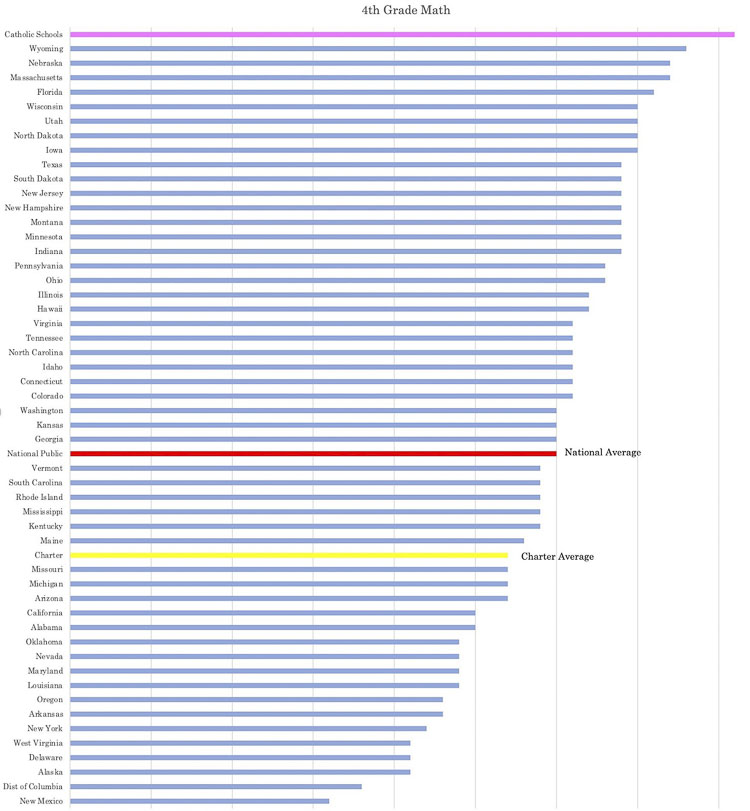
Naturally, as a policy analyst I want to know why. Here are the factors that I think account for this impressive result.
- Catholic schools operate based on parent choice – families opt in voluntarily and are welcomed as full partners in their children’s education.
- Catholic schools are highly decentralized. They operate at the community (parish) level.
- The student population is diverse; 21 percent are racial minorities, 18.6 percent are Hispanic, and 20 percent are students of other faiths. Historically the Catholic church is an immigrant church, welcoming students of color and foreign-born children.
- Catholic schools are efficient. Tuition averages (in 2022-23) around $12,200 per school year, well below the $18,175 average Washington public schools spend (Seattle spends $22,000 per student). Most Catholic schools provide scholarships based on need, so many students do not pay full tuition.
- Private schools in general are flexible and responsive to families. Private schools reopened to in-person learning in September 2020, over a year earlier than public schools.
- Private schools are free of unions and union politics, and are not subject to strikes, walk-outs, protests or picketing.
This last point is telling. In the public system child learning is often disrupted by union political action, or by union pressure to keep schools closed. For example, in September 2020 Larry Delaney, head of the Washington teachers union, insisted that schools stay closed even as children were falling behind.
The national indicators show that caring policymakers can learn from the best practices of the Catholic system, and from the real progress happening across the country. Currently 32 states, the District of Columbia and Puerto Rico offer families access to public resources so they can send their children to private schools.
The Washington state constitution makes it the paramount duty of lawmakers to provide for the education of children. The results of two years of shut-down show that school choice is the best way for them to fulfill that duty. One bill, HB 1633, would give families that want it access to up to $10,000 to send a child to the school of the parents’ choice, including qualified private schools.
Expanding choices both within and outside the traditional system would give every family the same learning opportunities the Catholic system has shown it can deliver to children of all backgrounds.
Liv Finne is the director of the Center for Education at the Washington Policy Center.
Also read:
- Opinion: Lawsuit filed against the unconstitutional income tax in Washington state
 Former Attorney General Rob McKenna and Supreme Court Justice Phil Talmadge challenge the 9.9% income tax in Klickitat Superior Court.
 - Vancouver Police investigate domestic violence homicide
 Vancouver Police Major Crimes Unit investigating after woman found dead with knife wounds on NE Oakbrook Circle.
 - Letter: ‘Oregon and Washington aren’t refusing to clean their rolls — they’re contesting federal jurisdiction and timing’
 Camas resident challenges Lars Larson’s fraud claims, explaining legal disputes over federal jurisdiction.
 - County Council to hold hearing on preferred land use alternative for comprehensive plan update
 Clark County Council will select preferred land use alternative from three options studied in environmental review.
 - Opinion: ‘When are we going to get the full and complete details of the Interstate Bridge Replacement Program’s I-5 Bridge replacement project?’
 IBR team buried key details about light rail ending at waterfront with massive elevator system required.
 - POLL: Do you support extending light rail beyond the waterfront to connect with C-TRAN at Library Square?
 Readers can weigh in on Anne McEnerny-Ogle’s proposal to extend light rail beyond the waterfront to Library Square for improved C-TRAN connections.
 - Opinion: Passing a cyclist – Law, myth and a little patience
 Most drivers can’t legally pass cyclists in-lane due to vehicle width versus road measurements.
 wpDiscuz
