



Chris Cargill of the Mountain States Policy Center discusses the misleading phrasing from those opposed to giving families more education options
Chris Cargill
Mountain States Policy Center
I have two boys at home. I’m used to repeatedly hearing something that isn’t true, in hopes that I’ll believe it. So, I guess I shouldn’t be surprised by the misleading phrasing from those opposed to giving families more education options.

When a new proposal was announced last week to provide Idaho families with an education tax credit – something that exists in both red and blue states and would not take any funding from public schools – those opposed to more education options called it a “universal school voucher scheme.” (Sounds scary!)
During the last legislative session, every time legislators put forward various ideas to expand options for students, those opposed screamed “voucher.” Sometimes, even the media would call a proposal a voucher – even if it really wasn’t.
It seems no matter what policy is introduced, there are some who will always call it a “voucher.”
Why the constant refrain? The simplest explanation is that the term “voucher” is not popular in public opinion research.
The dictionary defines voucher as a “form or check indicating a credit against future purchases or expenditures.”
By the very definition, tax credits are not vouchers. Education Savings Accounts are not vouchers. In fact, no one in Idaho has proposed a school voucher.
A voucher program would only let parents use taxpayer dollars to pay for tuition at a private school approved by the state. Typically, the state writes a “form or check” to a school in the name of a student to cover tuition.
An Education Savings Account is much different. First, money is held in an account by the state – it is not given directly to schools. Second, an ESA allows parents to use a portion of state funding on a variety of education services. Yes, it can include private school tuition, but it can also include tutoring, special needs services, curriculum, mental health treatment and much more – so long as it is for an educational purpose.
Tax credits are even more simple. Essentially, it’s no different than a tax credit for your mortgage interest or even a child tax credit. It’s completely separate from any public school funding.
In the end, tax credits are given to parents directly, ESA’s are given to parents via a state fund, and vouchers are given to schools or a specific institution by “form or check.”
No one who supports or opposes education choice options or covers the topic should use the term “voucher” unless an actual voucher bill is introduced. Doing so is simply inaccurate and on such an important topic, the clarity is crucial.
Regardless of the proposal, the goal is to meet the educational needs of all children in a fair, responsible, transparent, and accountable way.
The debate around efforts to expand options for students and families with enhanced education choice opportunities whether through ESAs, tax credits, or by expanding eligibility for Empowering Parents grants should focus on the policy and not be shrouded in misleading terms.
There will be a variety of education choice bills introduced in the 2024 Idaho Legislative session. Hopefully, lawmakers can come up with a plan that uniquely fits Idaho and helps more students succeed.
But no matter what they come up with, like the little boy who cried wolf, those opposed to new education options will still likely cry voucher.
Chris Cargill is the president of Mountain States Policy Center, an independent free market think tank based in Idaho, Montana, Wyoming and Eastern Washington. Online at mountainstatespolicy.org.

Also read:
- Opinion: Were Republican voters just sleeping during the August primary election?
 CCRP Chairman Matt Bumala says 60% of primary no-shows in the 17th and 18th districts were Republicans.
 - Opinion: WA Cares’ launch showcased care WA Cares did not provide
 Gov. Ferguson showcased a caregiving arrangement at the WA Cares launch that the program had not paid for a single day of.
 - Opinion: Portland’s War on Cars Part 4 – A smarter automobile strategy to end gridlock
 O’Toole argues fuel wasted in Portland-area congestion has sextupled since 1982, generating 250,000 tons of extra greenhouse gases annually.
 - Opinion: The Tooth Fairy’s secrets to making brushing & flossing magical
 Delta Dental of Washington’s Tooth Fairy Experience offers free resources to help children build lifelong brushing and flossing habits.
 - Opinion: Transit ridership trends are dismal but regional plans are oblivious
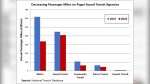 Puget Sound transit passenger-miles fell 31% from 2015 to 2024 despite a half-million-resident population increase.