



🎧 Income Tax Disclosure Statement: Facts or Electioneering?
Inherently, the statement assume future legislatures will keep their funding promises. This is not legally or historically accurate.
Ryan Frost, David Boze
Washington Policy Center
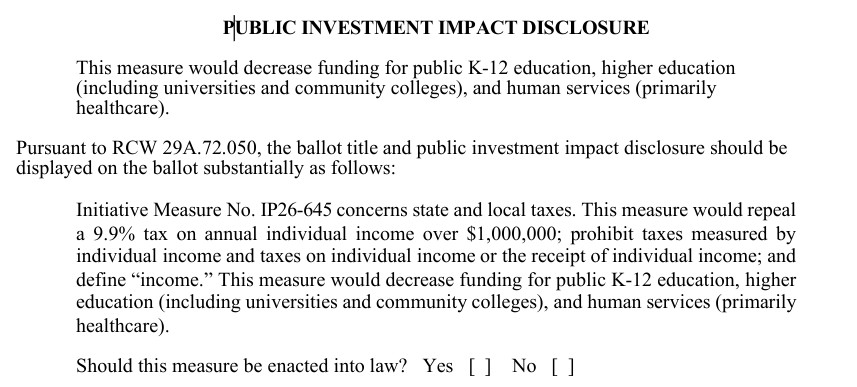
On Thursday, July 23, the State Attorney General’s office released the “public investment disclosure statement” detailing state services determined to be most affected by the potential repeal of the income tax.

Ryan Frost

David Boze
Inherently, these statements assume future legislatures will keep their funding promises. This is not legally or historically accurate. As House Majority Leader Joe Fitzgibbon says, future legislatures cannot be bound by current law and can spend money however they choose. There are many examples of legislatures using tax revenue contrary to the promises of previous legislatures. For example, in the current budget lawmakers took $15 million from the Apple Health and Homes Account for Medicaid recipients and put it into the general budget for use on any government program. As a result, any statement developed by the Attorney General would not be based on actual budget impact and does not reflect actual state budgets.
However, this public investment disclosure statement doesn’t even rely on legislative promises but states an impact on state services it doesn’t even fund yet and is not earmarked to fund. Here’s why the statement does not inform voters but works as an electioneering tool against the repeal of the tax:
- Claims that repealing the tax would cut schools, colleges, or healthcare are unsupported by the measure itself. The tax would not take effect until 2028, with the first payments arriving in 2029, and no current school district, college, or healthcare provider has an appropriation that depends on this revenue.
- The income tax earmarks nothing for K-12 education, higher education, or healthcare. The only dedicated allocation in the measure is 5% to the Fair Start for Kids Account beginning in 2029. The remaining revenue goes into the state general fund with no restrictions, where future legislatures may spend it however they choose.
The public investment impact disclosure requirement should be repealed.
Current law directs the attorney general to identify the three largest categories of general fund spending, which in Washington are always K-12 education, higher education, and healthcare. As a result, nearly any initiative affecting the general fund receives the same warning, regardless of whether the measure actually changes funding for those programs. It ignores the fungibility of funds and the changing priorities of new legislatures. It’s easy (and has at least the appearance of being intentional) for voters to read that language and conclude a “yes” vote would reduce funding for schools or healthcare, though the initiative does no such thing.
As former Governor Locke noted recently, Washington’s problem is spending, not revenue. The state operating budget has increased 55 percent since the 2013-2015 budget adjusted for inflation and population. Education spending has increased 39 percent (SY 2012-2013 to 2023-24).
Even after the largest tax increases in history, a capital gains tax generating more revenue than expected and (if it holds) an income tax, Washington will be facing yet another budget crisis in the coming session because the Legislature has spent more money than it brings in.
Ryan Frost is the director of budget and tax policy at the Washington Policy Center. David Boze is the communications and strategy director at the Washington Policy Center.
Also read:
- Vancouver Police investigate fatal collision
 A 74-year-old man in a motorized wheelchair died after a pickup truck struck him in a Vancouver intersection Wednesday evening.
 - Washington Policy Center tax expert warns that new income tax will affect everyone
 Ryan Frost argues Washington’s new 9.9% income tax has a $1M deduction that a simple legislative majority could remove.
 - Cost to battle 20 wildfires in WA has topped $200M
 Twenty wildfires have cost Washington $207M in one month, more than two-thirds of what DNR spent all last fiscal year.
 - Former State Rep. Liz Pike provides update on husband Neil Cahoon
 Neil Cahoon, a Camas resident, has undergone multiple surgeries including five on Aug. 15 after the Aug. 10 crash near La Center’s Daybreak Airport.
 - Auditor, auditor candidate address scrutiny over job title
 Greg Kimsey says roughly 40 county employees hold the deputy county auditor designation Kelly used in his campaign.