


Nancy Churchill believes ‘once we learn to see incentives, we begin to understand why systems function the way they do’
Nancy Churchill
Dangerous Rhetoric
If you reward something, you get more of it. If you punish something, you get less of it. This is true in families, workplaces, governments, and entire civilizations. Once we learn to see incentives, we begin to understand why systems function the way they do — and why so many outcomes that seem irrational or destructive continue year after year. This four-part series looks at the incentives shaping American life today and how they influence the way ordinary people interpret the world around them.

This is Part One of an ongoing series on incentives. Outcomes are not accidents. They are the predictable results of the behaviors we reward and the behaviors we penalize. When we understand who benefits, we understand why things are the way they are.
Part One: Fear is the product
Recently, a reader asked me, “Why shouldn’t normal Americans be afraid of the new Republican administration?” It was a sincere question, but it revealed something important about our cultural environment.
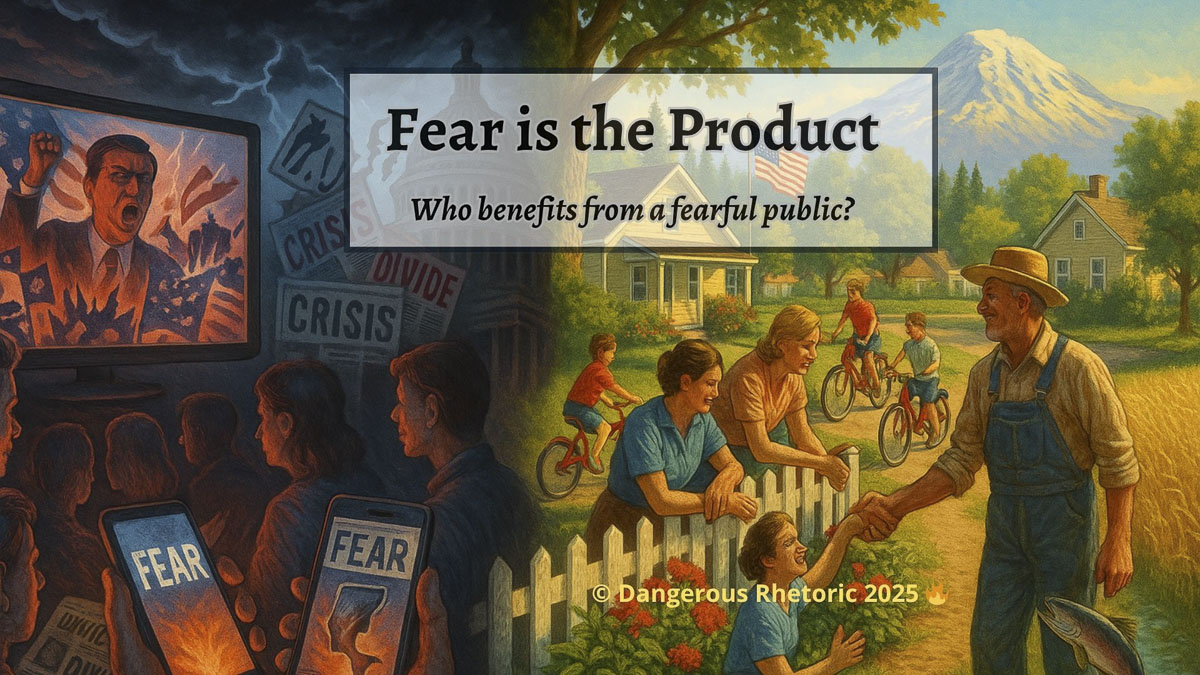
Many Americans today live in a constant state of anxiety and dread, especially around politics. That didn’t happen by accident. Fear has become a public habit — something we are encouraged to feel, rehearse and repeat. The emotional baseline of national life has shifted.
Fear has become the product.
If you turn on cable news, scroll social media or open most national newspapers, you will see the same pattern: heightened language, catastrophic predictions and the message that disaster is always just one election, one law or one group of people away.
When we are told every political disagreement is an existential threat, it becomes difficult to respond with reason or patience. Instead, we brace ourselves as though we are living in a state of emergency.
Who benefits from a fearful public?
Fear is one of the most powerful behavioral incentives we know. When people are afraid, they are less likely to question narratives, less likely to think independently and more likely to look for external authority to protect them.
Fear is useful because it narrows perception. It encourages obedience. And it makes people easier to influence. That is why fear is such a valuable asset in politics and media. It keeps audiences watching, supporters energized and opponents divided.
Modern propaganda is rarely about convincing anyone of a complex argument. Instead, it is about shaping emotional conditions — fear, outrage, resentment, and distrust — in order to guide public perception and behavior. The method is simple: Create a crisis, amplify it, and repeat it until the emotional response becomes automatic.
The dangerous ‘other’
Fear not only affects how we think, it affects how we relate to each other. Over the past several years, political rhetoric has shifted dramatically. Instead of treating those with differing viewpoints as neighbors who disagree, many now speak as if political opponents are dangerous, immoral or even fundamentally un-American.
Once a group or a person is labeled a threat, ordinary social rules feel suspended. It becomes easier to justify hostility, exclusion or even violence, because the other side is no longer seen as part of the community.
Fear has fractured relationships within families, workplaces, churches and civic organizations. If we continue to reward fear in our public life, we should not be surprised when trust erodes and unity breaks down. A nation cannot remain free when its citizens have been trained to see one another as enemies.
The way out of fear
Yet there is a way out of this emotional spiral, and it begins with reclaiming our attention. If engaging with the media leaves us anxious, angry, exhausted or overwhelmed, we should step back.
Turn the television off. Put down the phone. Go outside. Talk to the people next door. Spend time in the real world rather than the manufactured one built to provoke us.
Most Americans are not extremists or radicals. They are simply trying to raise families, work hard, and build stable lives. The real country looks far more ordinary — and far more hopeful — than the headlines.
Learning to see fear as a product helps us reclaim agency. We do not have to accept every narrative offered to us. We do not have to carry every emotional burden handed to us. We can choose to stand in truth rather than panic. We can choose to build rather than react. We can choose to live as free citizens rather than frightened subjects.
Reclaiming emotional ownership
We do not have to surrender our emotional lives to those who profit from our anxiety. Each of us has the ability to notice what we are feeling, pause, and choose a different response. Fear may arrive uninvited, but we decide whether it gets to stay.
Ask yourself: Why would I give politicians, pundits, or strangers on a screen the power to dictate my peace of mind? You can step back from the cycle. You can choose calm over agitation, clarity over alarm, and patience over panic. You can even make an effort to get to know the people whose viewpoints make you uncomfortable.
And if that feels unfamiliar at first, remember: it is simply a skill to practice. For many, prayer makes that practice possible—asking God to steady the heart and quiet the noise long enough to choose a better way. Your emotions are yours. You can choose peace instead of fear.
Next: In Part Two in this series on Incentives, we will look at what happens when fear is paired with claims about legitimacy. We’ll examine how the phrase “our democracy” has been reshaped into a tool for maintaining political power, and what happens when losing an election is treated not as a civic outcome, but as a crisis.
Nancy Churchill is a writer and educator in rural eastern Washington State, and the chair of the Ferry County Republican Party. She may be reached at DangerousRhetoric@pm.me. The opinions expressed in Dangerous Rhetoric are her own. Dangerous Rhetoric is available on Substack, X, and Rumble
Also read:
- Opinion: Were Republican voters just sleeping during the August primary election?
 CCRP Chairman Matt Bumala says 60% of primary no-shows in the 17th and 18th districts were Republicans.
 - High school football: New coach prepares for long-term success at Prairie High School
 James Young-Lewis, a Clark County native who graduated from Evergreen in 2009, became Prairie’s head coach in May after working as an assistant coach across various programs since 2015, joining Prairie’s staff in 2024.
 - Cost to battle 20 wildfires in WA has topped $200M
 Twenty wildfires have cost Washington $207M in one month, more than two-thirds of what DNR spent all last fiscal year.
 - Opinion: WA Cares’ launch showcased care WA Cares did not provide
 Gov. Ferguson showcased a caregiving arrangement at the WA Cares launch that the program had not paid for a single day of.
 - Former State Rep. Liz Pike provides update on husband Neil Cahoon
 Neil Cahoon, a Camas resident, has undergone multiple surgeries including five on Aug. 15 after the Aug. 10 crash near La Center’s Daybreak Airport.
 - Opinion: Portland’s War on Cars Part 4 – A smarter automobile strategy to end gridlock
 O’Toole argues fuel wasted in Portland-area congestion has sextupled since 1982, generating 250,000 tons of extra greenhouse gases annually.
 - $1,000 first prize for Camas Plein Air Art Event honoring Marquita Call on Sept. 26
 Plein air artists compete Sept. 26 in Camas for $1,000 first prize honoring gallery founder Marquita Call.
 wpDiscuz