


Todd Myers of the Washington Policy Center is willing to put his reputation and much more on the line
Todd Myers
Washington Policy Center
Based on the Department of Ecology’s projections, Washington state’s new tax on CO2 emissions will add about 46 cents to the cost of a gallon of gas next year. Governor Inslee disagrees. He says the impact will be “pennies.”

This calls for a bet.
Bets can provide a modicum of accountability for politicians and others who make claims that are, too often, based on politics rather than reality. Another way to put it is that bets are a tax on BS.
The Department of Ecology’s estimate for 2023 is that the cost of a permit to emit one metric ton of CO2 will be $58.31. For gasoline with a 10% ethanol blend, this amounts to an additional 46.6 cents per gallon.
The calculation is an estimate because, unlike a typical gas tax which sets a flat amount for the increase, the new law creates a market for a limited number of emissions permits. As demand for permits and companies’ ability to cut emissions efficiently fluctuates, so too will permit prices. That translates into a range of projections for how the CO2 law will translate into gas prices. Ecology’s projections are based on an independent analysis by Vivid Economics which modeled the projected market for next year and produced a price estimate.
The governor disputes those results. He says it will add only “pennies.” He told a reporter from Fox 13 that consumers “are not going to see much higher gas prices” due to the new taxes.
Let’s see who is right.
Since January, the average difference between Washington state gas prices and U.S. gas prices has been 45.5 cents per gallon, according to the U.S. Energy Information Administration. The difference can vary widely from week to week. The gap has been as low as 20 cents per gallon. Currently, Washington residents pay about 70 cents per gallon more than the average price in the U.S.
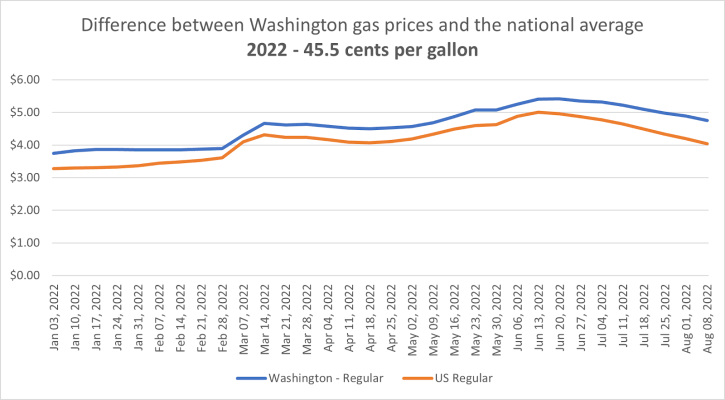
Given the fluctuation in the difference between Washington’s prices and the national average, and the uncertainty of implementation of the CO2 law, here is the bet we are offering.
- I predict that between January and the end of July 2023, the average price of Regular gasoline (All formulations) in Washington state will be an average of 70 cents per gallon higher than the national average. This is the current 45-cent per gallon gap plus an additional 25 cents per gallon from the new tax on CO2 emissions.
- If the average difference is above 70 cents per gallon, then I win. If it is less than 70 cents per gallon, I lose.
- I will bet $50 to charity. If I win, losers will make a donation to Plastic Bank, an organization that reduces the amount of plastic in the ocean.
- We will use data from the U.S. Energy Information Administration – https://www.eia.gov/petroleum/gasdiesel/
The governor has a history of making claims that are contradicted by his own agency or real-world experience. But if he believes his rhetoric, he should take me up on this bet. I am willing to test my prediction. Is he?
Others who believe the governor’s claim, including legislative sponsors of the bill, are welcome as well, although it is first-come-first-served, and I will probably cut off the number of bets after two or three.
Todd Myers is the director of the Center for the Environment at the Washington Policy Center.

Also read:
- Opinion: Were Republican voters just sleeping during the August primary election?
 CCRP Chairman Matt Bumala says 60% of primary no-shows in the 17th and 18th districts were Republicans.
 - Opinion: WA Cares’ launch showcased care WA Cares did not provide
 Gov. Ferguson showcased a caregiving arrangement at the WA Cares launch that the program had not paid for a single day of.
 - Opinion: Portland’s War on Cars Part 4 – A smarter automobile strategy to end gridlock
 O’Toole argues fuel wasted in Portland-area congestion has sextupled since 1982, generating 250,000 tons of extra greenhouse gases annually.
 - Opinion: The Tooth Fairy’s secrets to making brushing & flossing magical
 Delta Dental of Washington’s Tooth Fairy Experience offers free resources to help children build lifelong brushing and flossing habits.
 - Opinion: Transit ridership trends are dismal but regional plans are oblivious
 Puget Sound transit passenger-miles fell 31% from 2015 to 2024 despite a half-million-resident population increase.