



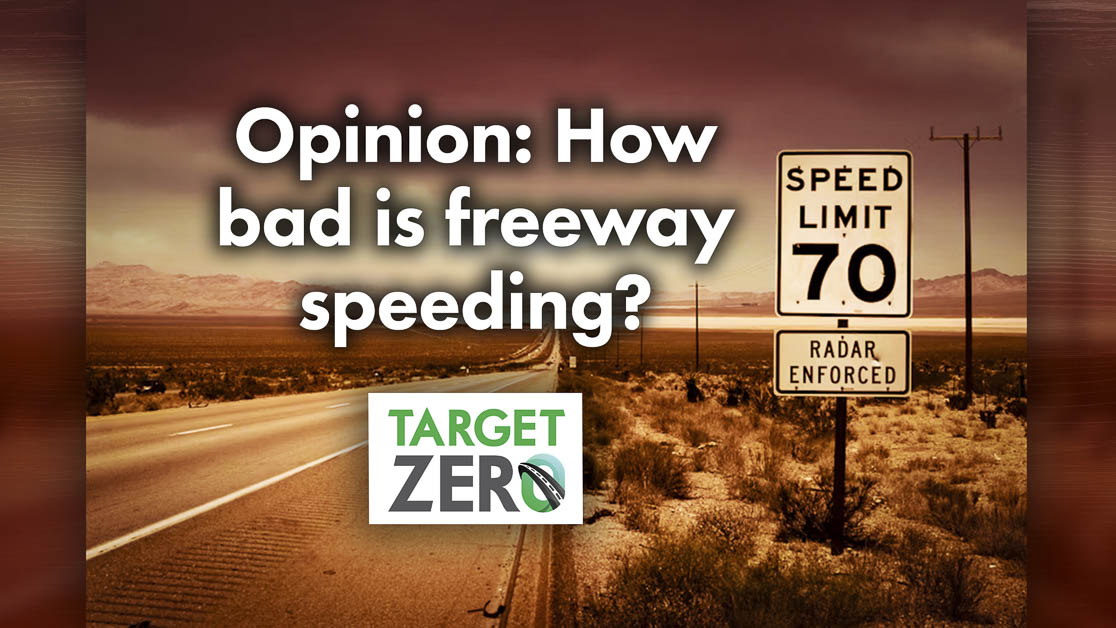
Target Zero Manager Doug Dahl answers a question about the commonplace of freeway speeding in Washington state
Doug Dahl
Target Zero
Q: I recently drove from Blaine to Kelso and back on a weekend. Other than downtown Seattle, the average speed on I-5 was 80 mph in both lanes, and there were vehicles passing me by. Twice, a motorcycle blasted through weaving between cars at over 100 mph. I’ve not experienced this kind of freeway driving in Washington before. Is this commonplace now?
A: What does it say about our driving culture that the part of your question I find hardest to believe isn’t the 100 mph motorcycles; it’s that you drove almost the entire I-5 corridor in Washington and only had slow traffic in downtown Seattle. My experience has typically been traffic jams starting near Olympia and continuing to Smokey Point. However, we’re not here to talk about slow traffic.

Speed is a problem, no doubt. But is it always as bad as you described? I’m not discounting your experience, but with a data set of one it’s hard to know if that’s an outlier or the norm. Fortunately, for this discussion, we have more sources. A recent speed observation survey by the Washington Traffic Safety Commission at over 200 locations across the state found that about three-quarters of drivers speed, at least a little bit. Of the drivers who were speeding, just over half of them were within five mph of the speed limit. About six percent of them were 16 or more mph over the speed limit. But none of those locations were on the freeway.
The Department of Transportation’s traffic count database includes vehicle speeds from many of its counting stations. To get an idea of typical I-5 speeds I picked a location that generally has an open flow of traffic and looked at data for the month of June. Of the nearly one million cars tracked, 44 percent of them were at or below the 70-mph speed limit. A third of them were no more than five mph above the speed limit. Less than one percent exceeded 85 mph. But that still works out to around 300 cars a day at excessively high rates of speed. On a long drive like you had, you’re bound to see some of them.
That’s the problem here. When we’re dealing with close to six million drivers in the state, a small percentage of high-risk drivers is still a lot. Speed increases both the likelihood of a crash and the severity of a crash. And I’ll argue that it’s not just the drivers going 15 mph over the speed limit who are creating unnecessary risk. The relationship between speed and crashes is a power function; for every one percent increase in speed there is a four percent increase in traffic fatalities. In Washington, about a third of all traffic fatalities include speed as a factor.

We’re also collectively driving 3.5 billion more miles per year than we did ten years ago, while the available lane miles have slightly decreased. To offer a poor analogy, if I lived on 100 acres, I could play Nickelback as loud as I wanted, but since I live in a neighborhood I have to consider the musical tastes and sleep schedules of my neighbors. But the consequences of loud music and risky driving aren’t equivalent. I’m stating the obvious; speeding and other dangerous driving puts more people at risk when there are more people on the road. So how about this: let’s expand our understanding of our neighborhood to include the roads we share with other drivers. And from that perspective, safe drivers make good neighbors.
TheWiseDrive is hosted by Doug Dahl, a Target Zero manager for the Washington Traffic Safety Commission.

Also read:
- Opinion: Half the road, full stop – Understanding pedestrian right-of-way
 Doug Dahl explains how Washington’s law requires drivers to stop when a pedestrian is within one lane of their half of the road, not just when directly in front.
 - Opinion: The state’s RFK-proofing bill comes with a cost
 Mandates like HB 2242 can lead to higher premiums as insurance companies absorb costs for new preventive services, affecting affordability statewide.
 - Opinion: What is the cost of a bridge?
 John Ley argues the I-5 Bridge replacement’s soaring cost stems from costly extras like light rail, noting other states deliver larger, toll-free bridges for much less.
 - POLL: Do you agree with giving a state commission the power to remove an elected sheriff?
 A new poll asks if a state commission—not voters—should have the power to remove an elected sheriff, following concerns raised by Clark County Sheriff John Horch.
 - Opinion: Defending Democracy by denying it?
 Washington voters are blocked from weighing in on new income taxes as state lawmakers and officials bypass public input, drawing criticism from Northwest voices.
