


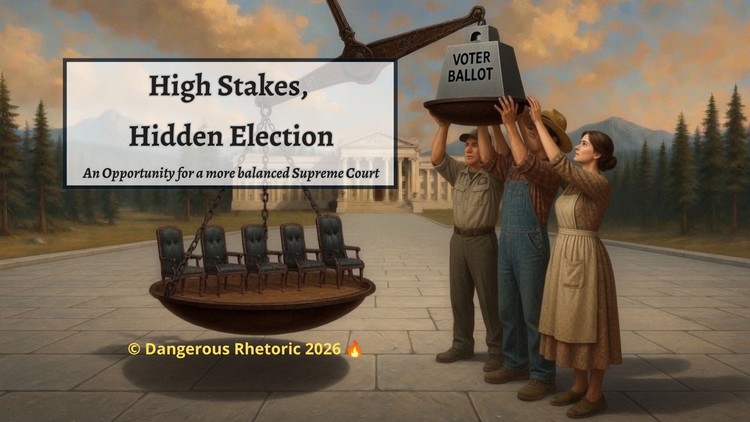
🎧 WA Supreme Court 2026: Five Seats, High Stakes
Nancy Churchill starts a series covering the 2026 WA State Supreme Court races with a discussion on the opportunity for a more balanced Supreme Court
Nancy Churchill
Dangerous Rhetoric
Imagine handing the keys to your home, your family’s future and your hard-earned property to nine anonymous people. That’s unsettling, right? That is exactly what is happening right now in Washington’s 2026 Supreme Court races. Five seats out of nine are up for election this year. Four seats will be on the primary ballot in August and an additional seat will be on the general election ballot in November.

Nancy Churchill
These races will shape everything from your taxes to your business’ survival. Will voters or black-robed activists control our state? The stakes are high. We cannot afford to ignore this election.
The undervote problem
In the 2024 election, there were 675,000 undervotes in judicial races. That means 675,000 people turned in ballots, but when they got to the judicial races, they did not vote!
Why does this happen? No one knows the candidates. Information about them is hard to find. These campaigns fly under the radar. Voters reach the bottom of the ballot tired and uninformed.
This year is unusual. Five Supreme Court seats appear on the ballot at once. That amplifies the danger. When informed conservatives stay home or skip these races, activist judges win by default. The court keeps reshaping our state without real accountability.
This is not democracy. This is abandonment of the field to those who want more government control over your life, your land, and your liberty. No more undervotes!
What’s really at stake: The cases coming to this court
The winners of these five seats will decide major cases that hit Washington families, first responders, taxpayers, and local control hard. The following cases will be considered within the term of whoever wins in August and November.
Here is what is on the line:
The income tax assault. The legislature passed SB 6346, a 9.9 percent levy on household income above $1 million. This law does not collect until 2029, but former Attorney General Rob McKenna already filed a constitutional challenge. This directly tests 93 years of precedent that prohibits income taxes in Washington.
Another consideration is I-2111, which passed in 2024. The Legislature approved the voter’s ban on state and local income taxes. The new court will decide if that initiative stands or falls.
The LEOFF 1 pension raid. Lawmakers swept nearly $4 billion from the retirement fund of about 5,945 retired police officers and firefighters. Retired first responders, including former Congressman Dave Reichert, filed suit.
This case heads straight to the Supreme Court. These are the heroes who protected us. Now politicians raid their pensions to fill budget gaps.
The natural gas initiative. Voters approved I-2066 to protect natural gas access for 1.28 million households. A King County judge overturned it. The Supreme Court will decide if a voter-approved initiative survives activist attack.
The sheriff decertification law. The legislature passed a measure letting unelected officials remove elected sheriffs. Courts issued injunctions. The final resolution comes to this Supreme Court. This strikes at local accountability and law enforcement chosen by the people.
Every one of these cases will be decided by the people you vote for on this ballot.
Why the balance matters: Past rulings
This court has shown a pattern of activist rulings that hurt rural Washington, public safety, and limited government. Full Court Press has published a judicial scorecard documenting some important decisions. Let’s review just a few of them.
In State v. Blake (2021), the court ruled simple drug possession laws unconstitutional. Hundreds walked free. Tens of thousands of convictions were vacated. Taxpayers footed millions in refunds. Prosecutors dropped cases. Public safety suffered. The legislature needed a special session for the “Blake Fix.” Drug possession is now a gross misdemeanor.
In the agriculture overtime case (Martinez-Cuevas v. DeRuyter Bros. Dairy, 2020), the court struck down the overtime exemption for farm workers. Farmers face higher labor costs on thin margins. Hours were capped. Families scrambled for second jobs. Ag operations began leaving the state. This ruling hurt the very industry that feeds Washington.
In Quinn v. State (2023), the court upheld the state capital gains tax by calling it an “excise” tax. This twisted decades of precedent and opened the door to more income-style taxes.
On union negotiations in Spokane in Wash. State Council of County & City Emps. v. City of Spokane (2022), the court ruled a voter-approved open bargaining provision unconstitutional. Government and union secrecy won over public accountability.
Recent court rule changes also make things worse, not better. One rule change slashed the number of cases a public defender can handle by 60 to 70 percent. As a result, local governments must hire more attorneys, cut prosecutions, or both. This pressures public safety budgets.
Another change to a court rule gave judges more power to dismiss criminal cases based on their personal view of fairness, not the law. Strong evidence cases, even violent ones, can get tossed.
These are not small adjustments. They reshape local government budgets, endanger public safety, reduce transparency, and harm agriculture across the state. Rural communities pay the price while activist interests cheer.
Time to act: Vote defend judicial balance
This election matters more than most. In future columns, we’ll look closely at the candidates in each race. We’ll use multiple resources to help cut through the noise. As we learn, spread what you know. Talk to your neighbors. Recruit them to vote in the primary. No more undervotes.
The five running for the Supreme Court in 2026 will help shape everything from your taxes and your sheriff’s authority to whether voters or judges have the final say. Let’s prepare for the election together.
Your property, your family, and your community depend on your informed vote. The fight for limited and transparent government, public safety, and common sense continues.
Nancy Churchill is a writer, educator, and conservative activist in rural eastern Washington state. She chairs the Ferry County Republican Party and advocates for effective citizen influence through Influencing Olympia Effectively. She may be reached at DangerousRhetoric@pm.me. The opinions expressed in Dangerous Rhetoric are her own. Dangerous Rhetoric is available on Substack and X.

Also read:
- Opinion: Were Republican voters just sleeping during the August primary election?
 CCRP Chairman Matt Bumala says 60% of primary no-shows in the 17th and 18th districts were Republicans.
 - Opinion: WA Cares’ launch showcased care WA Cares did not provide
 Gov. Ferguson showcased a caregiving arrangement at the WA Cares launch that the program had not paid for a single day of.
 - Auditor, auditor candidate address scrutiny over job title
 Greg Kimsey says roughly 40 county employees hold the deputy county auditor designation Kelly used in his campaign.
 - Opinion: Is Mitchell Kelly misleading voters with his ‘deputy auditor’ claim?
 Clark County HR records show no position called “Deputy County Auditor” has ever existed, Anderson argues.
 - Opinion: Democrats rig the ballot to save their income tax
 Churchill argues the ballot disclosure warning voters of education cuts describes revenue never collected and not yet allocated.