



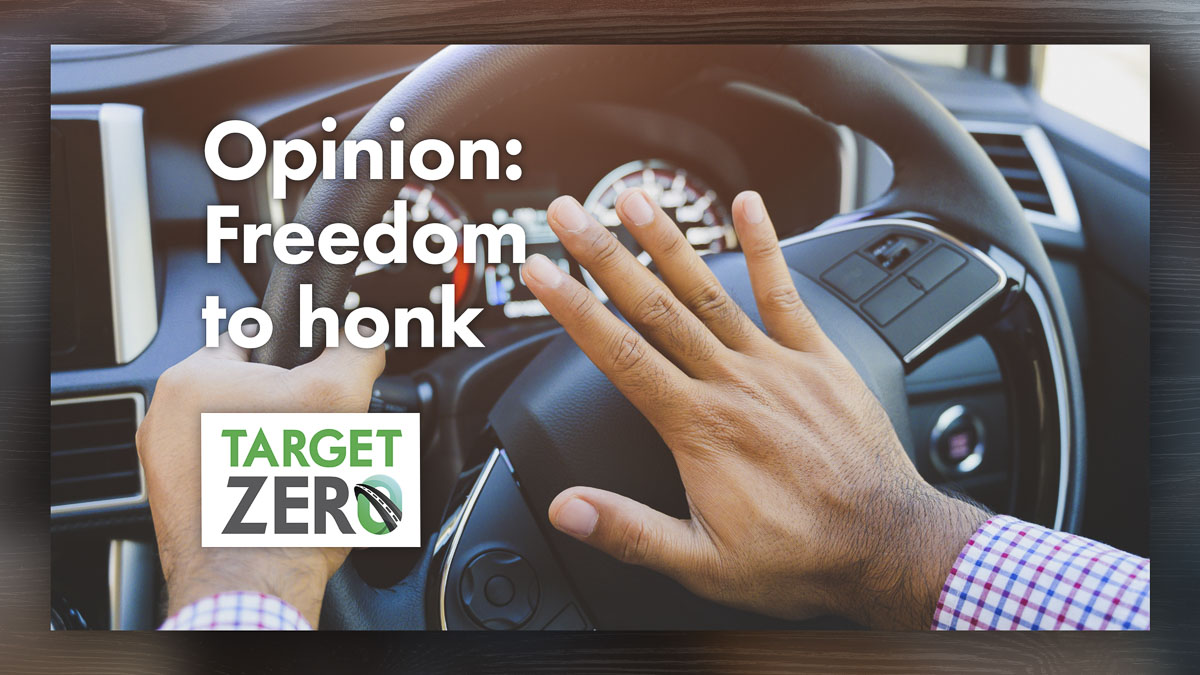
Target Zero Manager Doug Dahl answers a question about the legal use of a car horn
Doug Dahl
The Wise Drive
Q: Is it true that, besides warning others of danger, using your horn for free speech is the only other legal use of the horn?
A: Using your horn as an expression of speech is a real thing, but not everything you say with your horn is legal. Courts across the country have weighed in on this, and it’s not a simple answer, so I’d say the safest response to your question is, “Maybe?”
But first, did you know that you could be required by law to use your horn? Washington’s law states, “The driver of a motor vehicle shall when reasonably necessary to insure safe operation give audible warning with his or her horn but shall not otherwise use such horn when upon a highway.” In the law, “shall” is for mandatory actions. If you find yourself in a situation where a honk is the best way to warn someone of a hazard, honk that horn.

I say that for the overly-polite folks. For the rest of us, the second part of that sentence reminds us that honking is prohibited for any other purpose when you’re on the highway. When you’re not on a public road this law doesn’t apply, but a local noise ordinance might.
Where does free speech come in? I’m no expert on the US constitution, but the first amendment is pretty important. I mean, they put it first. Courts have said that some non-emergency honking is protected speech, but not all of it.
For example, you can’t blare your horn continuously as you drive by an RV park because it blocks your view of the river. The Montana Supreme Court said being obnoxious because you don’t like something is not protected speech (my paraphrase of a long legal document).
How about honking your horn for ten minutes straight at six am in a neighborhood because your HOA sent you a letter about your chickens? The Washington Supreme Court ruled in favor of the honker, but not because that was protected speech. It was because the local noise law she was arrested under was overly broad, conceivably making some kinds of protected speech illegal. If the chicken honker had been cited for violating the state’s horn law instead of a local noise law, maybe the court would have reached a different outcome.
Even if you’re honking as part of a political act, it might not be protected. A California woman who honked as she drove past a protest was cited, and courts found that the state’s interest in traffic safety took precedent over the honker’s communication, in part saying if honking is for more than warnings, horns lose their effectiveness. She took her case all the way to the US Supreme Court, where they declined to hear it.
Next time you drive past a demonstrator with a sign that says, “Honk if you love freedom!” What should you do? Remain silent and imply that you’re in favor of dictatorship? Honk and hope it’s protected speech? I encountered that situation last week while driving in heavy traffic and chose, instead of honking, to offer a thumbs-up gesture. We all love freedom, but I didn’t want to alarm someone, have them slam on their brakes, and cause an even bigger traffic jam (or crash).
After reading multiple cases, I can’t find a bright line that separates honking as protected speech from honking that violates the law. Practically though, I’m inclined to agree that if we all start expressing our views with our horns, like the boy who cried wolf, they’ll become less effective when we really need them.

Also read:
- Opinion: The growing gap between public voice and political power
 Todd Myers describes how large-scale protest and sign-ins often fail to sway state leaders, and argues authentic influence is most likely found through local action.
 - Opinion: Who is winning the race for affordable power?
 Hydroelectric power keeps Washington competitive, but new laws and carbon pricing are driving up electricity costs for residents each year.
 - Opinion: Half the road, full stop – Understanding pedestrian right-of-way
 Doug Dahl explains how Washington’s law requires drivers to stop when a pedestrian is within one lane of their half of the road, not just when directly in front.
 - Opinion: The state’s RFK-proofing bill comes with a cost
 Mandates like HB 2242 can lead to higher premiums as insurance companies absorb costs for new preventive services, affecting affordability statewide.
 - Opinion: What is the cost of a bridge?
 John Ley argues the I-5 Bridge replacement’s soaring cost stems from costly extras like light rail, noting other states deliver larger, toll-free bridges for much less.
