


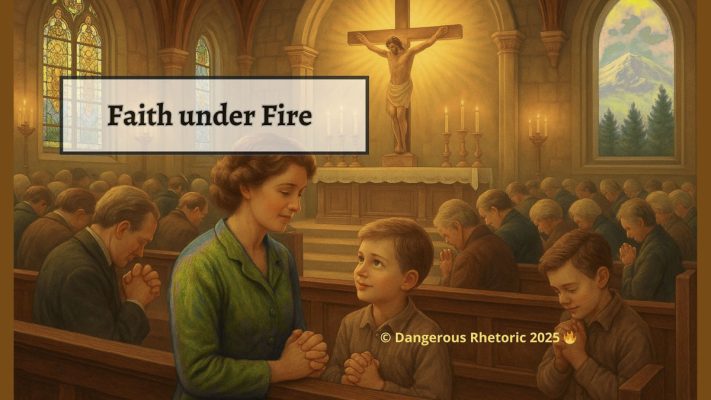
Nancy Churchill shares that progressives mock prayer and Christianity, but God transforms prayer into power
Nancy Churchill
Dangerous Rhetoric
The tragedy at Annunciation Catholic Church in Minneapolis was almost too much to comprehend: children gathered at Mass, praying in innocence, were gunned down in their pews. The grief is raw, the loss unbearable. In moments like these, people of faith turn instinctively to prayer — not because it erases pain, but because it anchors the soul when nothing else makes sense.

As Penny Nance with Concerned Women for America reminded us, “Prayer is a lifeline, especially for those grieving the tragic loss of children.”
And yet, instead of reverence, prayer itself came under attack. Why, in the wake of such horror, do progressive leaders mock the act of praying rather than respect it?
The shooter’s antagonism toward Christianity
The facts of the crime are chilling enough: a young man entered a sacred space and opened fire while children prayed. His message was unmistakable — hatred aimed not only at life but at the faith itself.
Even beyond the bloodshed, this crime carried a symbolic message: Christianity was being targeted. The victims were not random; they were worshippers, in the middle of prayer. That truth should have prompted universal sympathy and solidarity. Instead, what followed exposed the deeper fault lines in our culture.
Progressive reactions
For many Christians, the natural response to grief is prayer. According to reports, one priest at the scene pleaded, “I ask you to — please — pray.” But rather than honor that plea, progressive voices rushed to mock it. Jen Psaki’s response captured the contempt perfectly: “Prayer is not freaking enough. Prayers does not end school shootings… Enough with the thoughts and prayers.”
Sean Davis, CEO and co-founder of The Federalist, replied, “Ask yourself how an actual demon would respond to Christian children being martyred by a demon-possessed monster. Probably with explicit mockery of God and prayer. Then ask yourself why Psaki’s response is exactly how an actual demon would respond.”
Contrast Psaki’s disdain with the words of Vice President JD Vance: “We pray because our hearts are broken. We pray because we know God listens. We pray because we know that God works in mysterious ways, and can inspire us to further action. Why do you feel the need to attack other people for praying when kids were just killed praying?”
One response belittles prayer. The other dignifies it. That divergence reveals the cultural and political divide: one side turns to God in grief, while the other treats faith as an obstacle to its agenda.
Gun control as the political endgame
If prayer is mocked, it is because the narrative is already being directed elsewhere.
Each tragedy becomes a pretext for advancing the progressive policy agenda. Gun control quickly becomes the endgame, every time.
Within a single day of the massacre, Minnesota Democrats called for a ban on assault weapons. “Federal, state and city Democratic lawmakers joined gun safety advocates to call for a ban on assault weapons and high capacity magazines… ‘Thoughts and prayers are not going to cut it,’ said Minneapolis Mayor Jacob Frey.”
To many on the left, faith is an obstacle, not a source of comfort. Prayer reminds us that answers come not from government power but from God. For those who seek greater control, that is an unacceptable message. Thus prayer must be discredited, mocked, or silenced, while rights like self-defense must be restricted in the name of “safety.”
This reaction illustrates the pattern: before the bodies are even buried, prayer is dismissed as useless and the spotlight shifts to stripping away constitutional rights.
This hostility does not stop at the scene of a shooting. Across the country, public expressions of faith are increasingly met with resistance. In Seattle, progressive activists called Sean Feucht’s recent Christian worship rally “malicious harassment and incitement” against the LGBTQ community. The message is consistent: Christian prayer and worship are to be treated not as sacred, but as a problem.
Conclusion: Grief, prayer and moral clarity
In the wake of tragedy, Christians mourn and pray — not because prayer alone is a solution, but because prayer is the beginning of wisdom, compassion, and healing. “Prayer is a lifeline,” as Penny Nance said, not a punchline.
But make no mistake: progressives are not merely dismissing a spiritual practice; they are attacking the very faith of millions of Americans. They want a world where grief is not met with prayer, but with political slogans and government power.
Our charge must be simple yet unyielding: to grieve with the victims, to pray for healing, and to stand firm in defense of faith and freedom. When Christianity itself becomes the target, every believer must understand — we are all under fire.
But we are not powerless. “…The prayer of a righteous person is powerful and effective” (James 5:16).
Now is the time to pray boldly, to live faithfully, and to resist those who would strip both our freedom and our faith. In the face of darkness, prayer is not weakness — it is our greatest weapon. And if they mean to put Christianity under fire, then let us answer with a Church on its knees in prayer and fearless in proclaiming the truth of our faith.
Nancy Churchill is a writer and educator in rural eastern Washington State, and the chair of the Ferry County Republican Party. She may be reached at DangerousRhetoric@pm.me. The opinions expressed in Dangerous Rhetoric are her own. Dangerous Rhetoric is available on Substack, X, and Rumble

Also read:
- Opinion: Were Republican voters just sleeping during the August primary election?
 CCRP Chairman Matt Bumala says 60% of primary no-shows in the 17th and 18th districts were Republicans.
 - Opinion: WA Cares’ launch showcased care WA Cares did not provide
 Gov. Ferguson showcased a caregiving arrangement at the WA Cares launch that the program had not paid for a single day of.
 - Opinion: Portland’s War on Cars Part 4 – A smarter automobile strategy to end gridlock
 O’Toole argues fuel wasted in Portland-area congestion has sextupled since 1982, generating 250,000 tons of extra greenhouse gases annually.
 - Opinion: The Tooth Fairy’s secrets to making brushing & flossing magical
 Delta Dental of Washington’s Tooth Fairy Experience offers free resources to help children build lifelong brushing and flossing habits.
 - Opinion: Transit ridership trends are dismal but regional plans are oblivious
 Puget Sound transit passenger-miles fell 31% from 2015 to 2024 despite a half-million-resident population increase.