




Opponents of I-2109 say that if it passes lawmakers will cut funding for K-12 education, early learning and daycare programs, but history shows they won’t
Paul Guppy
Washington Policy Center
The Washington Observer reports on the repeated false claim of opponents of Initiative 2109 that if voters passed it and repeal the capital gains income tax the state would “lose” $2.2 billion over five years. As shown in an earlier Washington Policy Center Fact Check, this claim is not true.

The state has plenty of money and lawmakers can’t “lose” revenue they never had in the first place. To its credit, The Washington Observer notes that the money would come from “a new source of state revenue,” so it’s clear that no existing tax source would be affected.
State revenue is rising and in the years ahead lawmakers expect to receive billions in increased revenue without the capital gains income tax.
To show just how abundant state tax revenue is consider the following facts. State spending has doubled in the last ten years, up 118%, triple the rate of inflation. Spending on early learning and childcare programs has increased nearly every year those programs have existed, and will likely continue to do so in the next budget cycle.
In March, the governor signed a supplemental budget bill, SB 5950, that added some $2 billion to the current 2023-25 budget, raising it to over $72 billion, the highest in state history. In other words, lawmakers have so much money they are spending two billion dollars more in the current year than they had planned as recently as 2023.
Here are examples, selected at random, of the state agencies and programs that received millions in additional funding:
Office of the Governor, Office of the Public Defender, Office of Civil Legal Aid, Office of Financial Management, Economic Revenue and Forecast Council, Superintendent of Public Instruction, programs for behavior health, school safety, and threat assessment, added funding for failing schools, basic education program, general apportionment, pupil transportation, special education, institutional education, programs for highly capable students, bilingual programs, learning assistance programs, Washington kindergarten inventory for developing skills, and the beginning educator support program.
Further, the 2023-24 budget includes an added $5,000 bonus for teachers at schools where at least half of students are entitled to receive free or subsidized meals.
Far from losing money, the state is collecting increasing revenue from the public at record rates.
Elected leaders lose credibility when they constantly claim, backed by sympathetic and unquestioning media, that the state is broke, when tax collections regularly exceed previous estimates. Sometimes tax collections go up so fast lawmakers have to scramble and pass extra budget bills mid-cycle to spend all the money the state treasury is taking in.
No wonder the public’s confidence in public institutions and traditional media is at record lows.
Here’s a prediction. If Initiative 2109 passes the legislature will not “cut K-12 education, early learning and childcare programs” below current levels. Lawmakers will simply re-adjust priorities using the abundant revenue they receive now and make sure these important programs are kept whole.
I can say this with confidence because the same panicky sky-is-falling predictions are made every time the public seeks modest tax relief through direct democracy. Public officials tell the public they will close the local kindergarten, daycare, swimming beach or public park, but they never do. Such empty rhetoric is standard political messaging and is only intended to scare voters into compliance.
People are increasingly wise to these dishonest and mean-spirited tactics, and popular tax relief ballot measures often pass anyway. When lawmakers don’t follow through on their budget-cutting threats, the result is better allocation of the ample revenue they receive now, as well as welcome financial relief for heavily burdened taxpayers.
That’s a winning outcome for everyone. Now, in this heated campaign season, we just have to get past the usual rhetorical threats.
Paul Guppy is a senior researcher at the Washington Policy Center.

Also read:
- White House govt. Funding request for 2027 cuts $73 billion
 President Trump’s budget seeks to boost defense funding while cutting $73 billion from agencies like the EPA, NASA, and Agriculture, prompting sharp criticism from Democratic leaders.
 - Heywood asks WA Supreme Court to allow referendum effort on income tax
 Brian Heywood is petitioning the state Supreme Court after the Secretary of State rejected a referendum to repeal Washington’s new 9.9% tax on income over $1 million.
 - VIDEO: Families at center of WA transgender sports debate face-to-face with OSPI
 Two Washington high school students and their parents met with Superintendent Chris Reykdal to discuss concerns about sports policies after one student faced an investigation for harassment.
 - As Washington lawmakers punt on school cellphone ban, some want more action
 At Robert Eagle Staff Middle School, all-day phone removal led to fewer conflicts and more student engagement, but some parents and lawmakers argue a ban should not be imposed statewide.
 - POLL: Do you agree with giving a state commission the power to remove an elected sheriff?
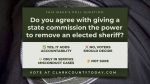 A new poll asks if a state commission—not voters—should have the power to remove an elected sheriff, following concerns raised by Clark County Sheriff John Horch.
 wpDiscuz
