



Liv Finne of the Washington Policy Center suggests we ask why lawmakers put so much public money into creating nice jobs for adults while allowing student learning to suffer
Liv Finne
Washington Policy Center
Politicians in Washington state like to say the public schools need more money. They often make this subjective claim not because of any real financial need since Washington’s public schools have ample funding, but to justify increasing taxes on the hardworking people of the state.

Today public schools have slowing enrollment but increasing budgets. Schools receive over $20 billion a year, enough to provide over $19,000 per student, which is more than tuition at most private schools.
So a caring taxpayer may rightly wonder, “Where is all that money going?”
A new analysis from the Office of Fiscal Management (OFM) provides the answer. The data shows public school administrators are hiring more administrators and other non-teachers at twice the rate of hiring teachers for the classroom.
Currently, 80% of school operating budgets go to paying salaries and benefits for staff. That means that each new administrative and non-teacher position deprives students of classroom resources.
Let’s review. In 2011-12 the biennial state budget for public schools was $13.1 billion. In 2023-25, it is $30.6 billion. (See 2024 Citizen’s Guide to K-12 Funding, page 12 here.) Over the same period total annual per student funding, from all state, local and federal resources, grew from $10,000 to $19,100.
For comparison the current average private school tuition is $14,000 for elementary school and $16,000 for high school.
The doubling of education funding is the result of policy decisions. Starting in 2012 the legislature dramatically increased school spending in response to the McCleary court ruling. Then in 2018 state lawmakers increased the property tax burden so they could further boost education spending.
The bulk of the increased spending went to non-teaching staff. State data show that teaching staff increased by 25%, the number of school principals increased by 42%, other administrative staff increased by 54%, and non-teacher staff positions increased a whopping 66%.
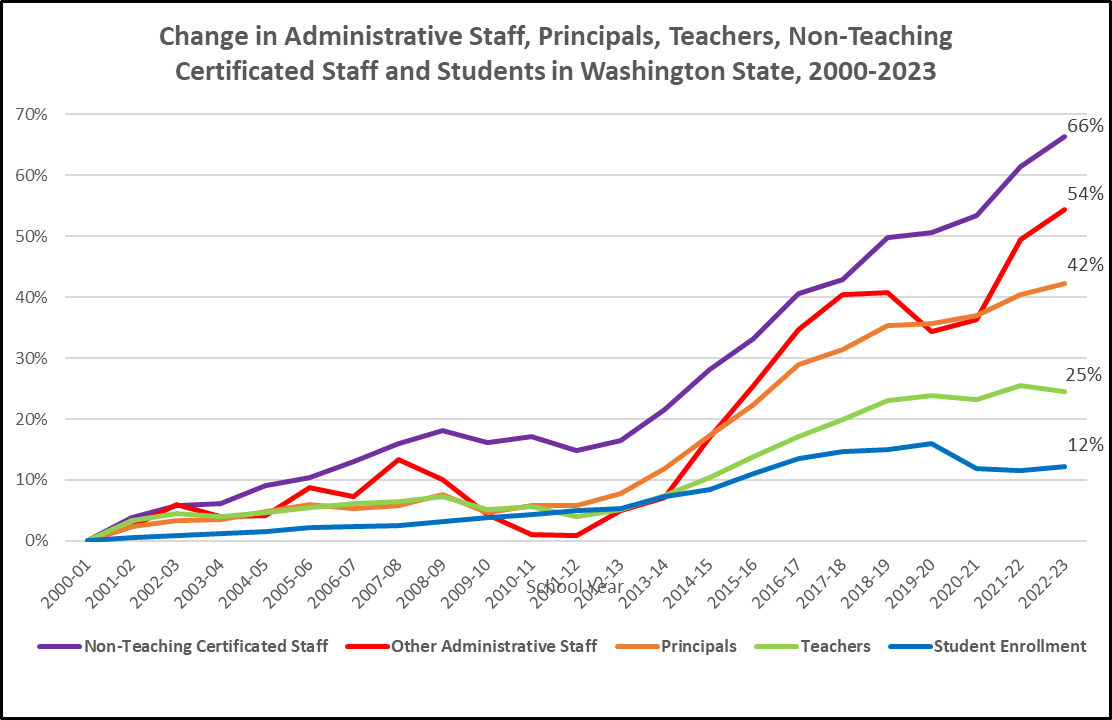
The next time an elected official says we should pay higher taxes for schools, show him or her this graph from OFM. And while you’re at it, you might also ask why lawmakers put so much public money into creating nice jobs for adults while allowing student learning to suffer.
Liv Finne is the director of the Center for Education at the Washington Policy Center.

Also read:
- Opinion: Sheriffs fight back
 Four county sheriffs are suing to block a new law giving a governor-appointed board power to decertify and remove sheriffs, bypassing voter oversight in Washington.
 - Opinion: The growing gap between public voice and political power
 Todd Myers describes how large-scale protest and sign-ins often fail to sway state leaders, and argues authentic influence is most likely found through local action.
 - Opinion: Who is winning the race for affordable power?
 Hydroelectric power keeps Washington competitive, but new laws and carbon pricing are driving up electricity costs for residents each year.
 - Opinion: Half the road, full stop – Understanding pedestrian right-of-way
 Doug Dahl explains how Washington’s law requires drivers to stop when a pedestrian is within one lane of their half of the road, not just when directly in front.
 - Opinion: The state’s RFK-proofing bill comes with a cost
 Mandates like HB 2242 can lead to higher premiums as insurance companies absorb costs for new preventive services, affecting affordability statewide.
 wpDiscuz
