



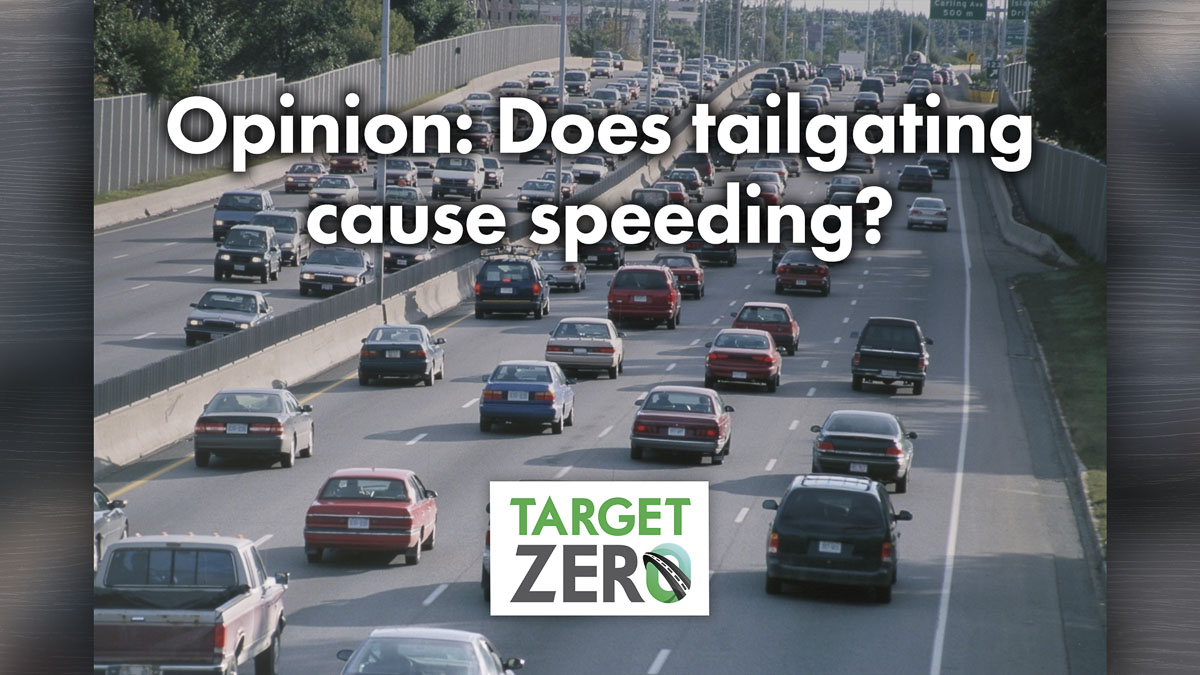
Target Zero Manager Doug Dahl says ‘of all the traffic infractions a driver could commit, tailgating seems to me to offer the least upside compared to the risk’
Doug Dahl
The Wise Drive
Q: The city I live in is planning on installing speed cameras. I don’t know if that’s a good idea, but if they want to stop speeding, they should look at tailgating. When someone’s on your bumper, it pressures you to speed. Enforcing tailgating laws would reduce speeding and crashes.
A: Allow me to reveal my bias up front. There’s a guide available to local jurisdictions considering automated speed enforcement in their community. This guide explains the value of automated speed enforcement and walks the reader through the process to establish an automated enforcement program. Clearly, it’s pro-speed cameras. I wrote that guide.

From that, you can guess my response to the comment, “I don’t know if that’s a good idea.” Speed cameras, when properly implemented, reduce vehicle speeds. That’s a good thing. For a local example, a speed camara performance analysis in Kirkland found that over two years automated enforcement cut speeding vehicles in school zones by nearly half.
Even better, speed cameras reduce crashes. Numerous studies confirm that when speed cameras go in, crashes go down. And speed cameras are especially good for our most vulnerable road users. For pedestrians, a few miles per hour makes a big difference in injury severity and even survivability of a crash. That’s why Washington prioritizes speed cameras in school zones and other high pedestrian traffic areas.
But how much speeding is caused by tailgaters? Do tailgaters really force others to drive faster? Maybe sometimes, but tailgating usually has the opposite effect. When you follow too closely, you end up braking more often, and those brake lights telegraph through all the traffic behind you. When traffic slows for no apparent reason (called a phantom traffic jam), it might be caused by a tailgater.
And tailgaters won’t increase speeding as long as we don’t let another driver pressure us into driving faster than we want to go. If someone is tailgating you, maintain a safe speed and move out of the way if you have an opportunity to do so. To the folks who think it’s their calling to enforce the speed limit on tailgaters, don’t. That tailgater is increasing their risk of a crash, but they’re doing it with you. Why take on the potential consequences of someone else’s bad driving?
All of that doesn’t diminish your point – that more tailgating enforcement would reduce crashes and save lives. Rear-end crashes (often caused by tailgating) make up 17 percent of traffic fatalities in multi-vehicle crashes. I’ve seen police enforce tailgating laws, but not as frequently as speed enforcement (which contributes to a third of traffic fatalities in Washington).
Of all the traffic infractions a driver could commit, tailgating seems to me to offer the least upside compared to the risk. (Things like impaired driving and reckless driving are worse, but those are crimes, not infractions.) There is a following distance at which you can’t stop in time, no matter how good your reflexes are or how recently you installed new tires. You don’t want to drive at, or barely above, that distance.
A good driver leaves some cushion for the surprises that pop up while driving. What if the driver in front of you hits their brakes for a stray cow in the road, right when you’re checking your rearview mirror? You need a few seconds of following distance for reaction time and stopping. The minimum is three to four seconds in good conditions, with a couple more seconds in the rain, and a few more in snow. Or just stay home when it snows, if you can, and save yourself the stress.
Also read:
- Opinion: Hidden costs, withheld documents, and a $17 billion question – Why the Interstate Bridge Replacement demands immediate oversight
 Gary Clark argues that withheld documents, rising cost estimates, and rejected alternatives show the Interstate Bridge Replacement Program requires immediate independent oversight.
 - Opinion: The IBR’s $10-$12 billion funding problem and lack of truthfulness
 Rep. John Ley argues that escalating costs, funding shortfalls, and withheld information have undermined public and legislative confidence in the Interstate Bridge Replacement Program.
 - POLL: With updated estimates reaching as high as $17.7 billion, what should happen to the I-5 Bridge replacement project?
 A new poll asks readers how the I-5 Bridge replacement project should proceed amid higher cost estimates and questions about transparency within the Interstate Bridge Replacement Program.
 - Opinion: ‘The IBR team has been lying to us and thanks to a veteran Oregon journalist, we have the smoking gun’
 Ken Vance argues newly obtained documents show Interstate Bridge Replacement staff withheld updated cost estimates from lawmakers and the public.
 - Oregon Gov. Kotek calls for repeal of transportation funding package she championed
 Oregon Gov. Tina Kotek is urging lawmakers to repeal a transportation funding package she previously supported after a referendum effort halted key tax increases.
 wpDiscuz
