



Nancy Churchill says it’s central planning with a green coat of paint
Nancy Churchill
Dangerous Rhetoric
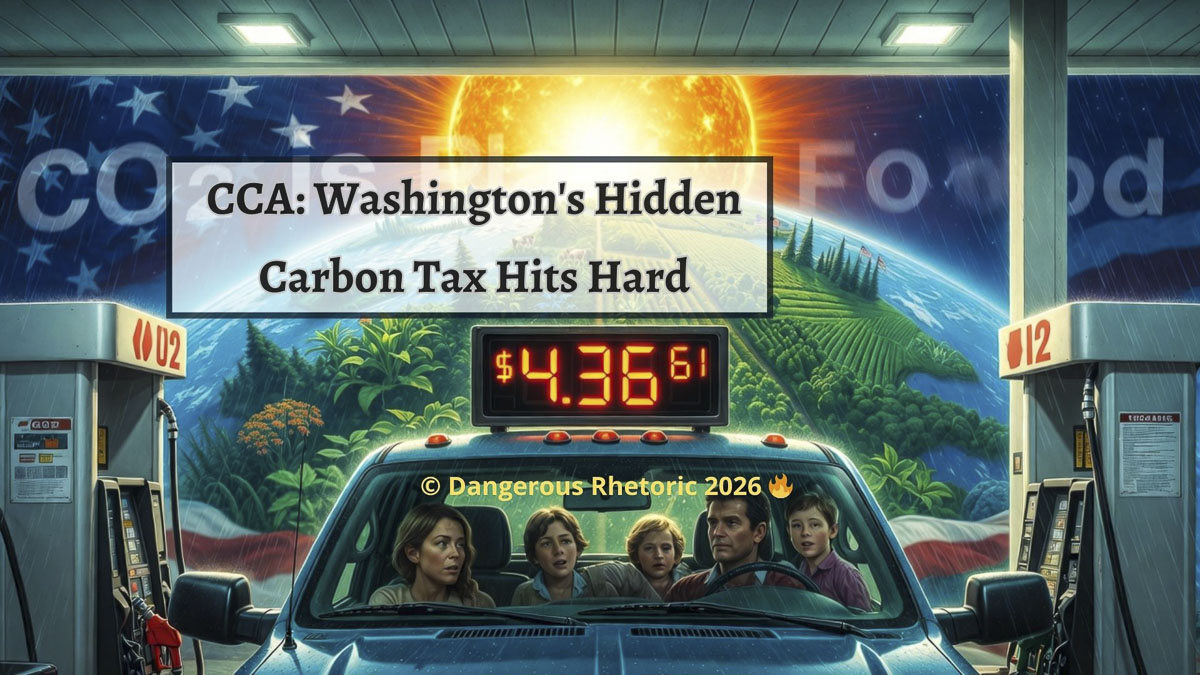
According to Future 42, gas in Washington state averaged $4.36 a gallon last week, a massive 18 cent increase. The national average sits at $2.98. Washington drivers now pay $1.38 more per gallon than the national average. Why? State gas taxes of $0.55. The Climate Commitment Act adds another $0.57. That is $1.12 in state-imposed costs before you even turn the key.

And prices jumped another 18 cents in one week while the rest of the country barely moved. This is the result of the CCA and it’s carbon tax, and it will likely rise again after the next carbon credit auction.
Yet in Olympia, politicians celebrate. They boast of billions raised for “climate justice.” Rep. Travis Couture called the CCA the “USAID of Washington state government”. He exposed grants like $40,000 for “Learning Circles,” $650,000 to link local activists with issues in Africa, and $450,000 for “Community Café Conversations” to train student organizers.
This was sold as environmental salvation. It looks more like a slush fund.
The illusion of carbon markets
Here is how cap-and-trade works in plain English. Imagine the state hands out snack tickets. Snacks are limited, so companies must have a ticket to have any snacks. The state limits the tickets. Then it auctions them off. Fewer tickets mean higher prices. Companies buy or trade tickets, and pass those costs to you.
That is the Climate Commitment Act.
Enacted in 2021 and fully active since 2023, the CCA caps emissions and auctions permits to large emitters. The Washington Department of Commerce says the money funds climate projects and community programs. In 2025 alone, the program is projected to bring in over $2 billion.
That money does not fall from the sky. It is siphoned from your gas tank, added to your heating bill, and included in your grocery receipt.
Supporters call it a market. But it is not a free market. It is central planning with a green coat of paint. Bureaucrats decide who gets exemptions. Data centers receive special treatment to attract tech jobs. Meanwhile, truckers, farmers, and commuters pay full freight.
Energy is life. Energy is prosperity. When our government rations energy, it also rations freedom.
Carbon dioxide is not the villain
Carbon dioxide makes up about 0.04 percent of the atmosphere. Jonathan Cohler points out that “CO₂ is not a pollutant and never has been… CO₂ is plant food. It is breath. It is life. It is the single biggest driver of the ongoing global greening and the reason billions of people have more food on their plates today than ever before.”
Satellite data shows the Earth has greened in recent decades as CO₂ levels rose. Global crop yields have climbed. That benefits Washington farmers from Yakima orchards to Palouse wheat fields.
Astrophysicist Dr. Willie Soon reminds us that climate has always changed. Ice ages came and went. Warm periods flourished long before SUVs existed. Solar cycles, volcanic eruptions, and ocean patterns drive powerful shifts. As Dr. Soon bluntly puts it, “IT’S THE SUN, STUPID!”
A totalitarian perspective
Wide Awake Media published a short summary of the climate agenda by Journalist Alex Newman: “The notion that CO₂ is pollution is absolutely preposterous… But from a totalitarian perspective, if you can convince people that CO₂ is pollution, there’s no human activity that doesn’t result in CO₂ emissions.”
Newman continued, “Every single aspect of your life, then, if we submit to the idea that CO₂ is pollution, then comes under the regulatory control of the people who claim to be saving us from pollution.”
So calling CO₂ a “pollutant” can justify sweeping government control. Every aspect of life from heating, to travel, to shopping is suddenly something that can be taxed, to “save the planet.” It expands agencies. It funds activist networks. It punishes industry. It steals from your pocket.
The crushing cost to Washington families
Steve Mur on X says, “Say it with me. Progressive policies are inflationary.”
Even if you drive an EV, you pay for higher fuel costs. Trucks haul your food. Delivery vans bring your packages. Contractors buy diesel. Restaurants heat ovens. When gas jumps, everything jumps.
The CCA has already collected more than $5 billion. Much of it flows to the Department of Ecology and layers of bureaucracy. Over 70 percent reportedly funds programs and administrative structures instead of direct relief. Meanwhile, rural families pay hundreds more per year.
In Eastern Washington, long drives are not a luxury. They are life. You drive to work. You drive to school events. You drive to medical care. The CCA hits those miles like a hammer.
And what do we get? Grants for talking circles. Funds for activist training. Global justice seminars. That is not cleaner air. That’s not protecting the environment. That’s not even better roads. That is a political revolution to centralized planning in place of free markets.
Meanwhile, industries quietly relocate. Jobs drift to states with lower costs. Emissions do not vanish. They just move. Global climate patterns roll on, driven by forces far bigger than Olympia. Forces like the sun, the oceans, and volcanoes. Foreign countries like China and India.
There is a better path. Real innovation in nuclear energy. Smart farming. Efficient technology. Voluntary conservation. Practical adaptation.
Washington voters have already shown they can push back. Initiatives can repeal bad law. Legislators can be replaced. Policies can change.
The CCA is a totalitarian grift
The Climate Commitment Act was sold as a cure. It acts like a tax. It functions like control. It funds ideology. It punishes work.
Washington families deserve affordable fuel, honest science, and accountable government. They deserve leaders who trust them and help them prosper, not schemes that squeeze them.
Call your lawmakers. Demand transparency. Support candidates who will repeal this carbon racket. Refuse to accept higher prices as destiny.
The people of this beautiful state built dams, farms, ports, and businesses without climate bureaucrats rationing their fuel. We can protect our land and water without surrendering our wallets.
This fight is not about weather. It is about freedom.
And freedom is worth defending.
Nancy Churchill is a writer, educator, and conservative activist in rural eastern Washington State. She chairs the Ferry County Republican Party and advocates for effective citizen influence through Influencing Olympia Effectively. She may be reached at DangerousRhetoric@pm.me. The opinions expressed in Dangerous Rhetoric are her own. Dangerous Rhetoric is available on Substack and X.

Also read:
- Opinion: The legislature has committed $2.4 billion to recurring pension increases since 2018
 Six legislative COLAs have raised public employer costs by $2.38 billion since 2018, driving up unfunded pension liabilities and increasing burdens on county and city budgets.
 - Opinion: ‘Just because they got away with it doesn’t mean they weren’t wrong’
 A Skamania County deputy’s report found violations of county rules and the Open Public Meetings Act, but no prosecutor acted on the findings.
 - Opinion: Small things grow great by concord
 Washington’s initiative process gives citizens direct power to challenge lawmakers. Failed restrictions and new measures on girls’ sports, parental rights, and citizenship prove the influence of grassroots action.
 - Opinion: California’s $20 fast food minimum wage creates less jobs and lower income
 Study data show California fast food workers now face fewer shifts, higher menu prices, and widespread automation after the $20 wage hike.
 - Opinion: State is rightly emphasizing experience and skills, not degrees
 Elizabeth New explains how a new state policy removes unnecessary advanced degree requirements, supporting skills-based employment and broadening opportunities for capable workers.
 wpDiscuz
