


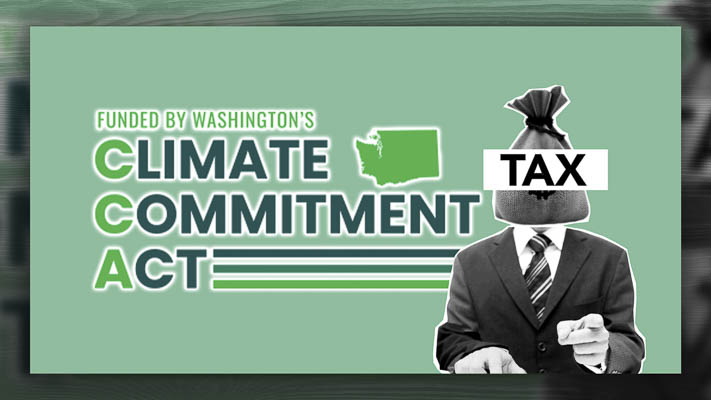
Todd Myers says this won’t be the last example of the Inslee Administration using taxpayer funds to promote its political agenda
Todd Myers
Washington Policy Center
As Washington’s CO2 tax, known as the Climate Commitment Act, heads to the ballot this fall, this logo highlighting projects that received funding from that tax will become more prevalent.
And you are paying for it.

The use of taxpayer-resources to promote the CO2 tax follows the decision by the legislature to send one-time checks of $200 to utility customers funded by the Climate Commitment Act just two-months before the November election. It is part of a pattern we are likely to see accelerate as the vote on I-2117, which would repeal the CO2 tax, draws near.
The new Climate Commitment Act logo is from a web page created by the Inslee Administration that includes branding guidelines for what fonts (Oswald Regular and Poppins Bold), sizes (must be more than 100 px), and colors (CMYK: 92, 49, 60, 35) for the CCA logo. The explicit purpose is to use taxpayer resources to promote the CO2 tax.
The taxpayer-funded web page says the purpose of the logo is “To strengthen public awareness of how Climate Commitment Act (CCA) funding is put to work.” The page goes on to note that “The Climate Commitment Act logo is a symbol of the state’s commitment to fighting climate change and pollution. The simple but powerful design conveys our progress towards a cleaner, zero emission future.”
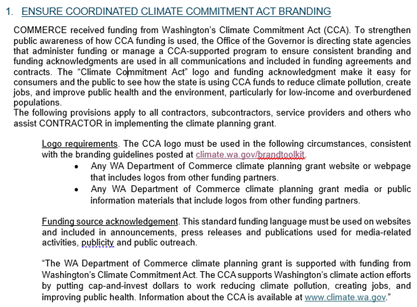
In an email to organizations receiving CCA money, the Inslee Administration wrote, “the Office of the Governor is directing state agencies that administer funding or manage a CCA-supported program to ensure consistent branding and funding acknowledgments are used in all communications and included in funding agreements and contracts…” (emphasis mine).
Using taxpayer money as a bludgeon, the Inslee Administration is requiring any organization that receives state money to use the logo for planning and other government projects funded by the CO2 tax. State law also requires cities to update their planning to address potential climate impacts. The funding is simply used to pay for additional bureaucratic planning required by the state.
The state requires communities to update their government plans and then requires those communities to highlight the fact that the funding to comply with the requirement comes from the CO2 tax.
It isn’t just the logo.
Organizations are required to use overtly political language on websites, press releases, publications, and any media or public outreach.
After acknowledging that the state provided the money, organizations are required to include, “The CCA supports Washington’s climate action efforts by putting cap-and-invest dollars to work reducing climate pollution, creating jobs, and improving public health. Information about the CCA is available at www.climate.wa.gov.”
As we’ve noted before, contrary to the claims that the money from the CO2 tax is being used to reduce carbon emissions, most of the money thus far has been spent expanding government and subsidizing special interest groups.
This won’t be the last example of the Inslee Administration using taxpayer funds to promote its political agenda. It is another example of politicians using the power and resources of government to promote their agenda, rather than acting as public servants for the citizens of the state.
Todd Myers is the director of the Center for the Environment at the Washington Policy Center.

Also read:
- Opinion: Were Republican voters just sleeping during the August primary election?
 CCRP Chairman Matt Bumala says 60% of primary no-shows in the 17th and 18th districts were Republicans.
 - Opinion: WA Cares’ launch showcased care WA Cares did not provide
 Gov. Ferguson showcased a caregiving arrangement at the WA Cares launch that the program had not paid for a single day of.
 - Opinion: Portland’s War on Cars Part 4 – A smarter automobile strategy to end gridlock
 O’Toole argues fuel wasted in Portland-area congestion has sextupled since 1982, generating 250,000 tons of extra greenhouse gases annually.
 - Opinion: The Tooth Fairy’s secrets to making brushing & flossing magical
 Delta Dental of Washington’s Tooth Fairy Experience offers free resources to help children build lifelong brushing and flossing habits.
 - Opinion: Transit ridership trends are dismal but regional plans are oblivious
 Puget Sound transit passenger-miles fell 31% from 2015 to 2024 despite a half-million-resident population increase.
 wpDiscuz