



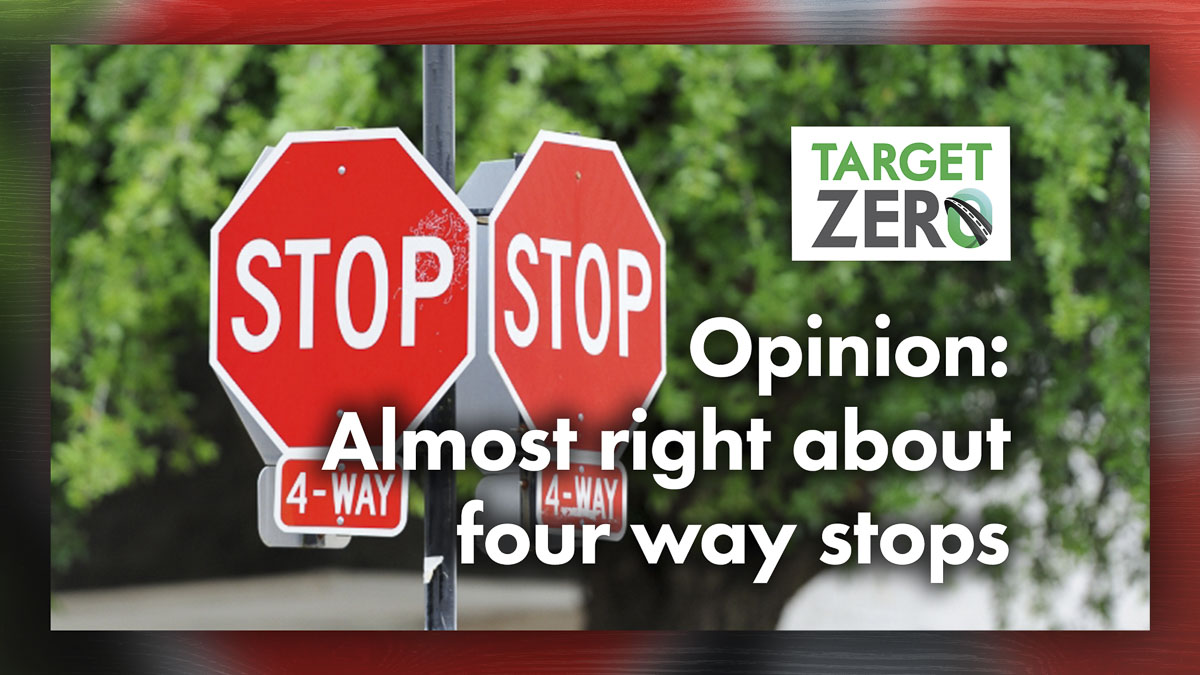
Target Zero Manager Doug Dahl answers a question about four-way stops
Doug Dahl
The Wise Drive
Q: At a four-way stop with three cars approaching the intersection, in what order do they go? The first to arrive is the first to leave, but then does it pass to the left or pass to the next to arrive?
A: Sometimes you don’t have to be right. You just have to be right enough. Take Issac Newton, for example. In 1687 Newton published a book explaining the universal law of gravity. For anything you’re going to encounter on Earth, and most anywhere in our solar system (except for an anomaly in Mercury’s orbit), Newton’s math works fine.

It’s sort of like the “first to arrive is the first to leave” theory for four-way stops. It’s not exactly right, but it works. If you want to get more accurate about gravity you need Albert Einstein’s general relativity. If you want to get more accurate about intersection rules you need the Revised Code of Washington. I won’t attempt to explain general relativity, but I’ll give the intersection laws a shot.
Before we get to the RCW though, let’s take a look at what’s in the Washington Driver Guide. The guide says (like you noted) that at an intersection controlled by stop signs, the first vehicle to arrive is the first to go. The second vehicle to arrive goes next, and it continues on. If two vehicles arrive at about the same time, the driver on the left yields to the driver on the right.
The law, though, doesn’t say the first to arrive is the first to go; that’s an interpretation of the law. Instead, it says that after stopping for a stop sign, a driver “shall yield the right-of-way to any vehicle in the intersection or approaching on another roadway so closely as to constitute an immediate hazard.”
Functionally, at a four-way stop, if everyone obeys the stop signs, you’ll do just fine by following the Driver Guide. Everyone takes their turn and we all get along. Until someone loses count. Humans making mistakes is as reliable as gravity. If someone at a four-way stop doesn’t yield when they are supposed to, take a breath, let it go, and reset the taking-turns process.
While we’re on the topic of nearly-right traffic rules, the Driver Guide also says that a driver turning left must yield the right of way to drivers going straight or turning right. It’s close, but there’s something missing. Similar to the stop sign law, the left-turn law says left-turning drivers “shall yield the right-of-way to any vehicle approaching from the opposite direction which is within the intersection or so close thereto as to constitute an immediate hazard.” Without the hazard part, you could conceivably have a left-turning driver waiting indefinitely at a busy four-way stop, yielding to every oncoming driver that’s going straight.
The Driver Guide is right about who yields to whom when two drivers arrive at the same time. In the law, like the guide, you yield to the driver on the right. If I understand your question correctly, that’s the reverse of what you asked. That may have just been a writing error, but it inadvertently makes an important point.
Even the best-intentioned drivers don’t always get it right, so sometimes we need to adapt. When a driver who should have yielded pulls into the intersection, it’s now the responsibility of other drivers to “yield the right-of-way to any vehicle in the intersection.” If that seems unfair, think of it this way; you’re trading a few seconds for a safer intersection experience. That seems like a pretty good deal.
Also read:
- Opinion: Half the road, full stop – Understanding pedestrian right-of-way
 Doug Dahl explains how Washington’s law requires drivers to stop when a pedestrian is within one lane of their half of the road, not just when directly in front.
 - Opinion: What is the cost of a bridge?
 John Ley argues the I-5 Bridge replacement’s soaring cost stems from costly extras like light rail, noting other states deliver larger, toll-free bridges for much less.
 - Letter: Vancouver Mayor Anne McEnerny-Ogle makes several serious and incorrect engineering statements
 Bob Ortblad critiques engineering claims by Vancouver Mayor Anne McEnerny-Ogle, highlighting cost and safety advantages of an immersed tunnel for the I-5 crossing.
 - Washington’s studded tire deadline is March 31
 Drivers must remove studded tires by March 31 or face a $137 fine, with WSDOT urging early action due to busy service centers and no planned deadline extension.
 - VIDEO: WA diesel hits record $6.53, crushing truckers and school budgets
 With diesel nearing $6.53 per gallon in Washington, trucking businesses and school districts now confront sharply higher fuel expenses affecting budgets and workers.
