



🎧 One Retirement, Two Jobs: Should Clark County Split the Role?
Peter Bracchi says Before Clark County replaces one person, it should decide whether it really needs to fill two jobs.
Editor’s note: Opinions expressed in this letter to the editor are those of the author alone and may not reflect the editorial position of ClarkCountyToday.com
Dr. Alan Melnick’s retirement should be recognized respectfully. He has served as Clark County’s health officer since 2006 and led Public Health through the COVID-19 pandemic and numerous other challenges.

Peter Bracchi
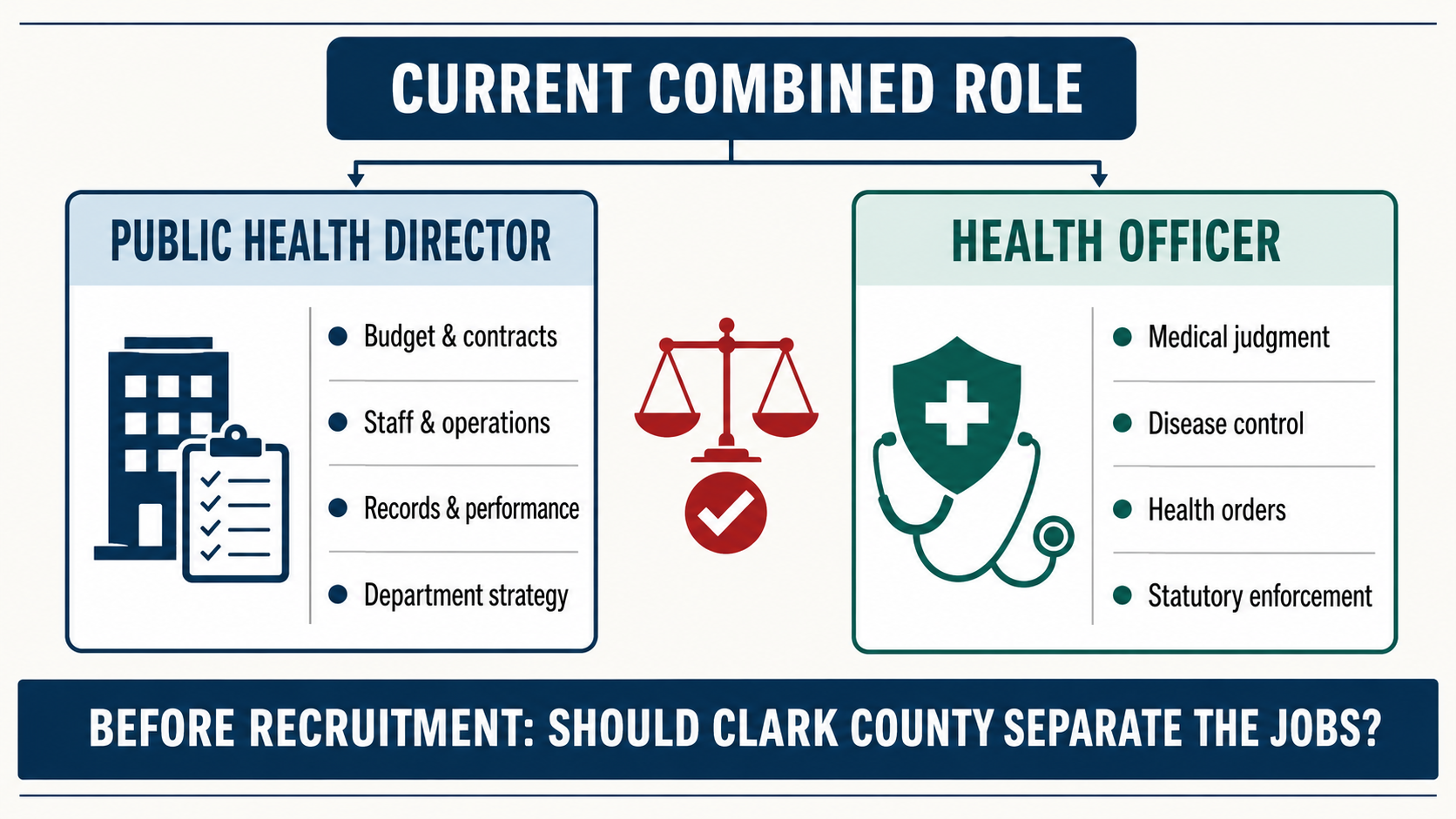
His departure also gives Clark County a rare opportunity to reconsider how its Public Health Department is governed. Before officials advertise for another person to fill Melnick’s combined position, the Board of Health should publicly evaluate whether the Public Health director and county health officer should again become two separate jobs.
Clark County combined the positions in 2013 as part of a departmental reorganization projected to save approximately $262,000 annually. Melnick, who was already the health officer, assumed the additional responsibility of directing the department. That may have been a reasonable financial decision at the time, but a cost-saving arrangement adopted 13 years ago should not automatically become permanent government structure.
Clark County is no longer operating a small public-health agency. The county’s population reached an estimated 532,119 in 2025. The Public Health Fund had a 2025 budget of approximately $23.1 million, with 156.35 full-time-equivalent employees working across 36 program areas. Clark’s medical leadership also provides health-officer services to Pacific, Skamania and Wahkiakum counties.
Those responsibilities deserve more than an automatic replacement decision.
Washington law clearly distinguishes between an administrative officer and a health officer. The administrative officer manages operations and performs duties assigned by the Board of Health. The health officer must be a qualified Washington-licensed physician and exercises specific medical, scientific and enforcement powers established by law.
Those physician-only responsibilities include enforcing public-health statutes, directing disease-control measures, responding to dangerous health conditions, addressing public-health nuisances and making decisions that can affect facilities, food supplies, sanitation, isolation, quarantine and emergency actions.
One position manages the organization. The other exercises specialized medical and statutory authority over matters that can affect individual rights, regulated organizations and the safety of the entire community.
When both positions are held by one person, the concern is not necessarily bad faith or personal misconduct. The concern is structural. The department director is responsible for budgets, staffing, policies, contracts, records, program performance and public communications. The health officer may then be called upon to judge whether that same department responded properly, whether stronger action is necessary and whether enforcement is warranted.
Even a conscientious official can be placed in the position of reviewing, defending or correcting work performed under that official’s own administrative authority. The public may also have difficulty distinguishing between an administrative defense of the department and an independent medical or enforcement judgment.
Separating the positions would not create two competing health departments. Properly designed, it would create a professional check inside one department. The director would run the organization, while the health officer would concentrate on medical judgment, disease control and statutory enforcement. Clear job descriptions, written reporting lines and direct health-officer access to the Board of Health could prevent confusion and preserve accountability.
Clark County would not be experimenting alone. When Tacoma-Pierce County’s longtime combined director and health officer retired in 2023, its Board of Health evaluated the structure and divided the position. Tacoma-Pierce explained that executive administrators and physician health officers bring different qualifications and skill sets. Separating the positions also broadened its recruitment pool: 33 people applied for the administrative director position, while the department conducted a separate search for its physician health officer.
There are reasonable arguments against separation. Two positions may cost more. Divided leadership can produce disagreement, duplicated duties or finger-pointing if responsibilities are poorly defined. Those concerns deserve a serious cost and organizational analysis—not an assumption that the 2013 model remains best for Clark County in 2026.
Before recruitment begins, the Board of Health should hold a public work session comparing the combined and separated models. That review should identify costs, reporting relationships, regional health-officer obligations, emergency succession plans and the responsibilities already carried by the deputy director and deputy health officer.
The Public Health Advisory Council should participate as well. Washington law specifically gives community health advisory boards a role in providing input during the recruitment and selection of both administrative officers and health officers. The public should be able to see that process before a decision is made.
Clark County should also clearly disclose who will exercise the director’s administrative authority and who will hold the health officer’s statutory authority during the transition. One retirement should not leave the public uncertain about two critical government functions.
This is not an argument against Melnick’s service. It is an argument for using his departure wisely. Good government does not depend solely on finding one exceptional person capable of carrying two demanding offices indefinitely. It builds a structure that distributes authority, encourages professional challenge and remains accountable when leadership changes.
Conducting that evaluation now would not predetermine the outcome. Automatically reposting the combined position would.
Before Clark County replaces one person, it should decide whether it really needs to fill two jobs.
Peter Bracchi
Vancouver
Art N Graphs was produced by me
Also read:
- Cost to battle 20 wildfires in WA has topped $200M
 Twenty wildfires have cost Washington $207M in one month, more than two-thirds of what DNR spent all last fiscal year.
 - Former State Rep. Liz Pike provides update on husband Neil Cahoon
 Neil Cahoon, a Camas resident, has undergone multiple surgeries including five on Aug. 15 after the Aug. 10 crash near La Center’s Daybreak Airport.
 - Auditor, auditor candidate address scrutiny over job title
 Greg Kimsey says roughly 40 county employees hold the deputy county auditor designation Kelly used in his campaign.
 - Ridgefield Waterfront plans meet resistance: Community voices weigh in
 Residents opposing Ridgefield’s waterfront development cite scale, wildlife impact, and inadequate boat launch parking as key concerns.
 - Gunfire at Hockinson Park leaves one dead; BGHS graduate, UW baseball signee charged with manslaughter
 Trent Richardson, 18, died from a gunshot wound at Hockinson Meadows Community Park; James Gill III charged with second-degree manslaughter.
 wpDiscuz