



🎧 Vancouver’s Misdemeanor Justice System Is Running Short
Peter Bracchi says Vancouver’s misdemeanor problem ‘also exposes a larger failure: a basic function of city government was allowed to run short of capacity’
Editor’s note: Opinions expressed in this letter to the editor are those of the author alone and may not reflect the editorial position of ClarkCountyToday.com
Vancouver’s misdemeanor problem is no longer complicated to describe. More than 50 cases have been dismissed because defense attorneys were unavailable, and police have been directed to limit enforcement of several lower-level offenses so scarce legal capacity can be preserved for more serious cases.

Peter Bracchi
That may be necessary triage today. But it also exposes a larger failure: a basic function of city government was allowed to run short of capacity.
Basic duty. Capacity. Priorities.
Those three words should frame this discussion.
Washington’s new public-defense standards reduce the number of cases individual attorneys may handle. Vancouver therefore needs more defense capacity, yet the City currently advertises contract representation at $500 per case and $1,000 when a case goes to trial.
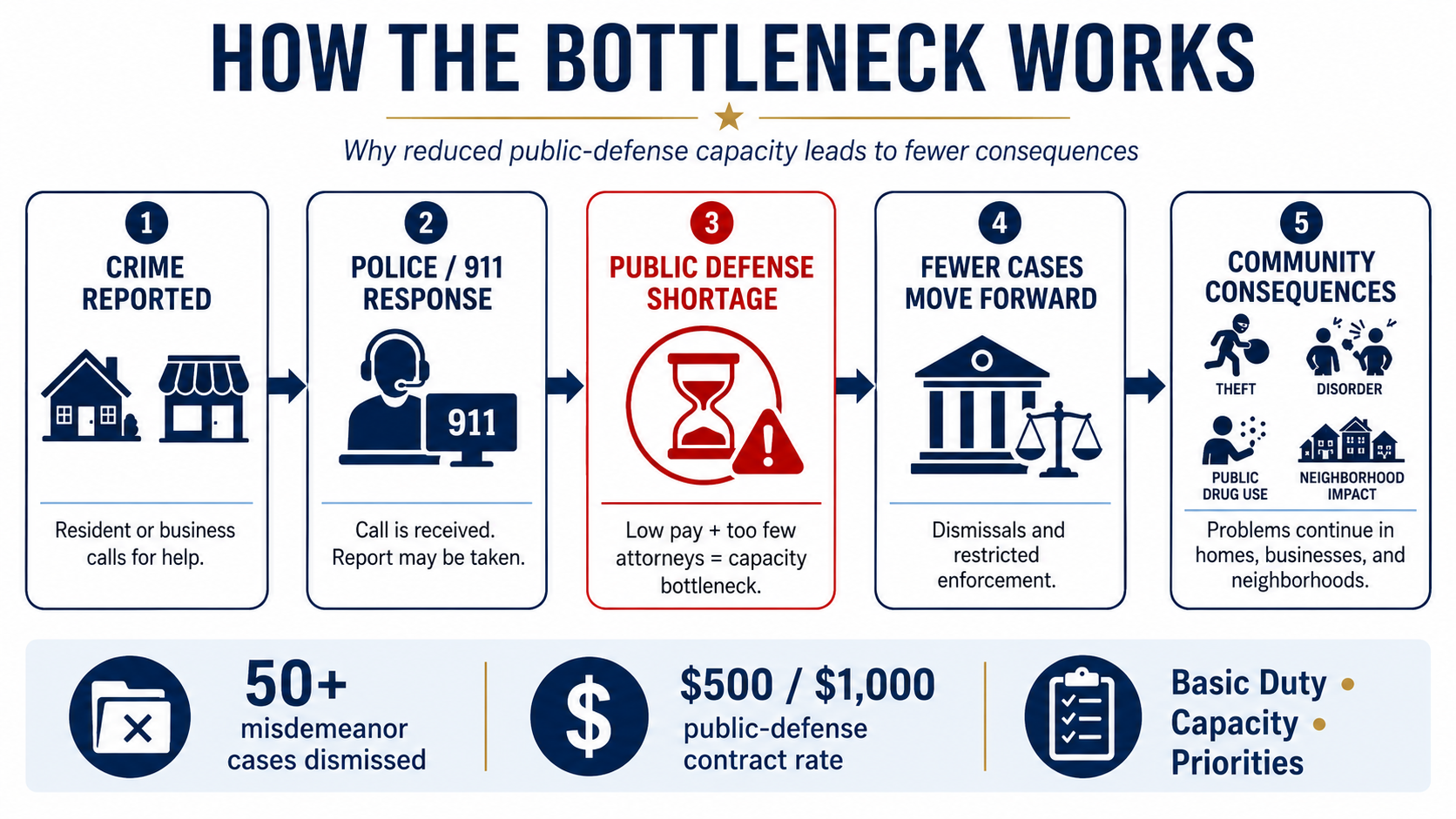
The immediate shortage may be real, but the underlying problem is also one of management. Cities can raise contract compensation, employ salaried public defenders, contract through other government agencies or explore regional arrangements. Vancouver should determine what level of funding and structure is necessary to make the system work and then treat that expense as what it is: the cost of performing a basic government responsibility.
That is more important than continually explaining why enforcement must be reduced.
Police, courts, prosecution and constitutionally required public defense are not just four more programs competing for space in a city budget. They are part of the foundation of civil government. Other goals—housing, climate programs, cultural programs, equity initiatives, economic development and community events—may have value, but their success ultimately depends upon a community in which people believe basic laws are enforceable.
This distinction matters especially to residents and businesses that experience repeated lower-level disorder. Theft may rank below assault in criminal seriousness, but it is not insignificant to the shop owner losing merchandise. Trespassing is not an abstract misdemeanor to the homeowner dealing with it repeatedly, and public drug use looks very different from the sidewalk than it does on a list of criminal classifications.
I have watched that tension around Vancouver’s Men’s Share House for years. Residents have complained about recurring neighborhood impacts involving camping, trash, public disorder and other conditions while government has experimented with outreach, diversion, community court and different approaches to homelessness.
Those programs may have a place. The problem comes when alternatives to enforcement stop being genuine alternatives and become the only practical choice because the traditional justice system lacks capacity.
That is the line Vancouver is approaching now.
The City’s 2025–26 budget also reduced two half-time Assistant City Attorney II positions in the Criminal Division. Those were prosecutors, not public defenders, so eliminating them did not create the present defense shortage. Still, reducing criminal-justice legal capacity while a major statewide public-defense restructuring was approaching deserves scrutiny.
The larger point is not that eliminating a climate program, cultural grant or equity position would magically solve the attorney shortage. Some funding is legally restricted, and municipal budgeting is more complicated than moving dollars from one box to another.
The point is about priority.
When an essential function lacks resources, government should first determine what is required to restore that function. Only then should it explain why other discretionary priorities deserve protection while something as fundamental as the misdemeanor justice system operates below capacity.
Clark County Sheriff John Horch’s response provides a useful contrast. The Sheriff’s Office operates under a different structure and the comparison is not perfect, but Horch has said his deputies will continue responding and taking enforcement action when appropriate. The same statewide legal changes therefore do not automatically dictate one particular local response.
Vancouver now needs to move beyond explaining the shortage and present a solution. Determine how many defense attorneys are required, establish what competitive compensation will cost, evaluate alternative delivery models and fund the most sustainable option.
Then restore enforcement capacity.
Diversion, treatment and community court should remain tools available because they work for appropriate cases—not because the traditional justice system can no longer handle the workload.
That is the distinction this controversy has exposed.
A functioning city can pursue ambitious social goals. A city struggling to carry out its most basic responsibilities needs to repair the foundation first.
Basic Duty. Capacity. Priorities.
Before City Hall tries to change the world, the city itself has to work.
Peter Bracchi
Vancouver
Also read:
- Save Vancouver Streets will make its argument before Washington State Court of Appeals
 Save Vancouver Streets will argue before the WA Court of Appeals on Sept. 11 after collecting 6,500 signatures.
 - VIDEO: Federal court hears Puyallup wrestler’s alleged sex assault, Title IX case
 16-year-old Kallie Keeler is seeking a federal injunction after alleging sexual assault during a Dec. 6, 2025 wrestling match against a transgender athlete.
 - Vancouver Police investigate fatal collision
 A 74-year-old man in a motorized wheelchair died after a pickup truck struck him in a Vancouver intersection Wednesday evening.
 - Washington Policy Center tax expert warns that new income tax will affect everyone
 Ryan Frost argues Washington’s new 9.9% income tax has a $1M deduction that a simple legislative majority could remove.
 - Cost to battle 20 wildfires in WA has topped $200M
 Twenty wildfires have cost Washington $207M in one month, more than two-thirds of what DNR spent all last fiscal year.
 wpDiscuz