



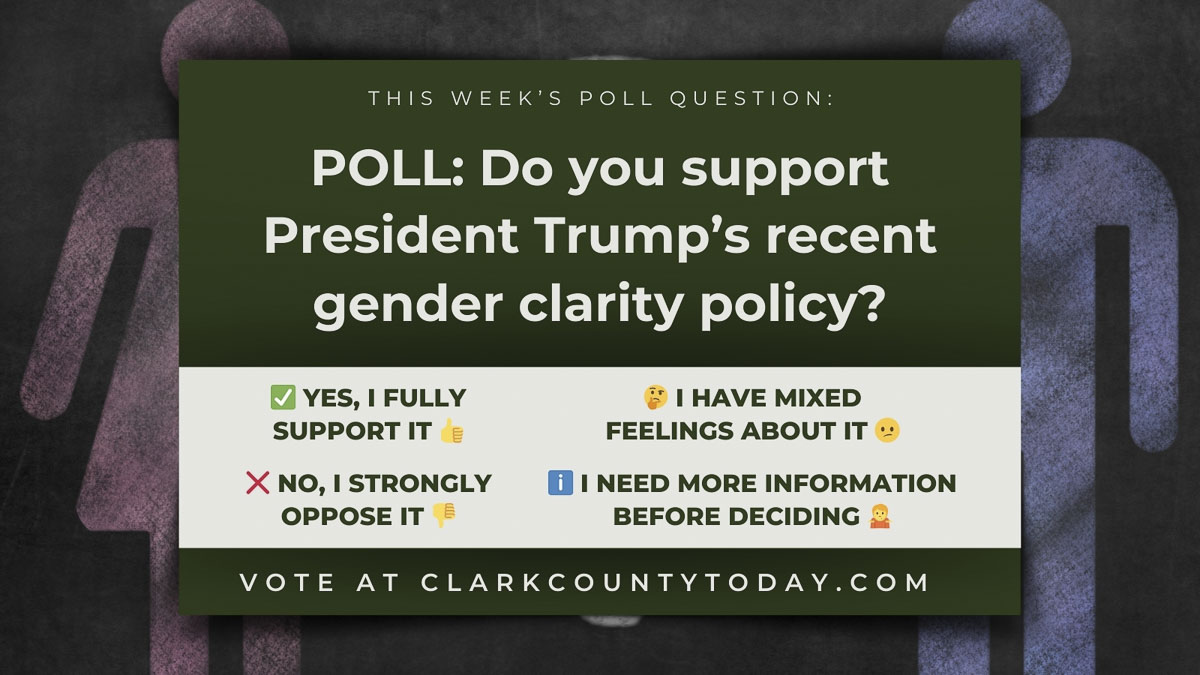
This week, President Donald Trump fulfilled a campaign promise by announcing his gender clarity policy, stating that the federal government will only recognize two sexes—male and female. This move has renewed the debate over transgender participation in sports, especially in states like Washington, where student-athletes have been allowed to compete based on gender identity for nearly two decades. Supporters argue that the policy protects female athletes and maintains fairness in competition, while opponents view it as discriminatory and harmful to transgender individuals. Where do you stand on this issue? Cast your vote in this week’s CCT Poll! ⬇️
More info:
Opinion: How will President Trump’s gender clarity position impact transgender sports participation?

Ken Vance examines how President Trump's gender policy could influence transgender participation in Washington state sports.
Read more

Also read:
- Opinion: Half the road, full stop – Understanding pedestrian right-of-way
 Doug Dahl explains how Washington’s law requires drivers to stop when a pedestrian is within one lane of their half of the road, not just when directly in front.
 - Opinion: The state’s RFK-proofing bill comes with a cost
 Mandates like HB 2242 can lead to higher premiums as insurance companies absorb costs for new preventive services, affecting affordability statewide.
 - Opinion: What is the cost of a bridge?
 John Ley argues the I-5 Bridge replacement’s soaring cost stems from costly extras like light rail, noting other states deliver larger, toll-free bridges for much less.
 - POLL: Do you agree with giving a state commission the power to remove an elected sheriff?
 A new poll asks if a state commission—not voters—should have the power to remove an elected sheriff, following concerns raised by Clark County Sheriff John Horch.
 - Opinion: Defending Democracy by denying it?
 Washington voters are blocked from weighing in on new income taxes as state lawmakers and officials bypass public input, drawing criticism from Northwest voices.
