



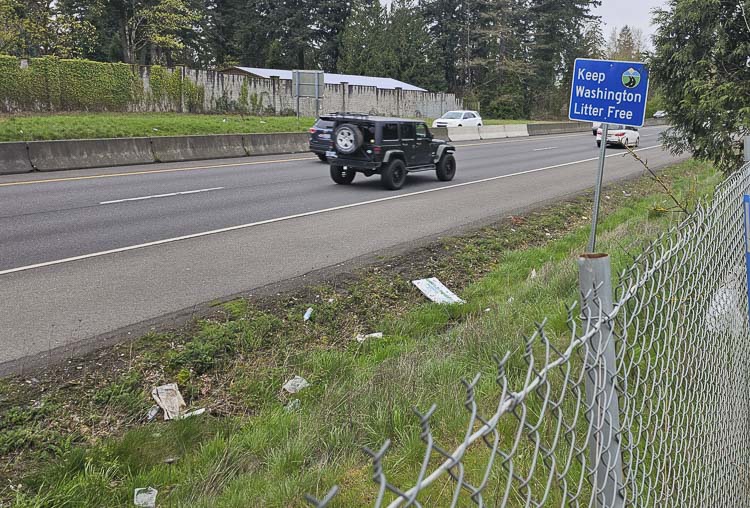
Washington State Department of Transportation says litter cleanup is a ‘complex issue’ dealing with budgets, work crews, and the time of year, but it is working working to reduce roadside garbage
Paul Valencia
ClarkCountyToday.com
A truck driver who has become frustrated at the site of garbage on the sides of local freeways and highways had a question for the mayor of Vancouver on Monday during a community forum.
He asked what the city is doing in regard to cleaning up the litter.
“Sir, who do you think owns that property?” the mayor asked.
She answered her own question.
“The state of Washington.”
She, too, shared her frustration.
“And try as we may, for the last 45 years, we have been contacting (them) … to clean up their freeways. Whether it’s I-5, 205, (state routes) 500, 14, the onramps, the graffiti on their sound walls … Time and time again,” Mayor Anne McEnerny-Ogle said.
“If it’s not between the white lines, it’s low priority,” the mayor added. “Unless it’s a safety hazard in the lane, low priority.”
She even suggested that the truck driver give the Washington State Department of Transportation a call.
“If you make any progress, let me know how you did it,” she said.
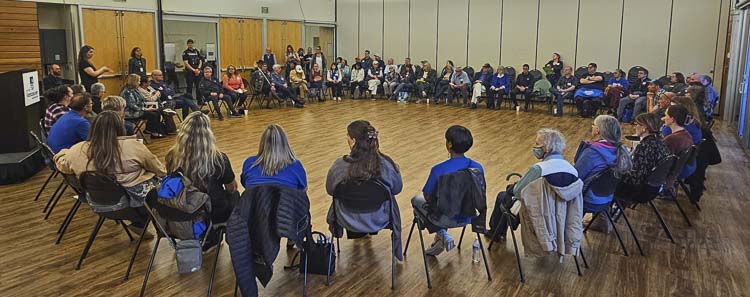
Clark County Today took the mayor’s advice and reached out to WSDOT.
It is true that garbage clean-up along the sides of the freeways and highways is a lower priority than debris obstructing lanes of traffic. But it is not as simple as just hiring a crew to pick up garbage. WSDOT is working with a budget, as well.
“Litter cleanup is a complex issue for many reasons, and one of the most significant is funding,” according to an email from Kelly Hanahan, communication manager for WSDOT’s Southwest Region. “Funding for litter cleanup competes in the same bucket of money as other critical maintenance work like repairing guardrails and potholes, striping roadways, maintaining safe rest areas, and responding to weather events including snow and ice conditions. This available budget is already very tight, so that is why litter is so difficult to address.”
WSDOT and the Department of Ecology invest $12 million annually in litter and debris removal statewide, the email noted.
Also, generally speaking, litter is not considered a critical highway safety task unless it is blocking a travel lane. Road maintenance crews remove deceased animals or large items such as mattresses that fall out of unsecured load. If travelers see something that is an immediate safety concern, they are encouraged to call 9-1-1.
Other challenges include creating safe conditions for little cleanup crews. And there are times when specialized crews are needed if biohazardous conditions exist.
Hanahan also said that this is the time of the year when litter looks the worst because crew activity is often paused during the wet winter months.
Statewide, WSDOT expects crews from the departments of Ecology and Corrections to resume in the spring. The WSDOT Southwest Region, however, stopped using crews from Corrections when the Larch Mountain Corrections Center closed in 2023.
There are also 607 volunteer groups, statewide, as part of the Adopt-A-Highway program.
Still, litter is an ongoing problem.
Here are some of ways WSDOT is addressing roadside litter:
Supporting Adopt-a-Highway Volunteers
- Providing training, safety equipment, traffic control gear, litter bags and disposal services for volunteer groups.
- Picking up bags of trash collected by Adopt-a-Highway teams.
- Some highways are not eligible for adoption due to safety concerns, such as narrow shoulders.
- Groups are generally more active in warmer months.
Maximizing efficiency by cleaning areas crews already visit
- When regional maintenance crews are assigned multiple tasks in one area (ex. guardrail and pothole repairs), they may also incorporate shoulder sweeping, litter pickup and graffiti removal in the work zone.
- Contractors and major project teams also integrate cleanup efforts when scheduling allows.
- This approach may require daytime lane closures or occasional short-term full highway closures for safety. We work to balance these ongoing needs with the need to keep people moving and full closures are very disruptive.
Partnering with other cleanup programs
- Ecology Youth Corps (July – August) and Ecology adult crews (March – November) handle additional roadside litter removal. Open positions for these crews are posted online.
- Specialized hazardous waste contractors are hired to assist in litter cleanup following encampment removals, after local jurisdictions post notices and conduct social service outreach.
Note: Look for a story next week on Clark County Today focusing on WSDOT’s advice on how to reduce litter on the highways.
Also read:
- VIDEO: WA diesel hits record $6.53, crushing truckers and school budgets
 With diesel nearing $6.53 per gallon in Washington, trucking businesses and school districts now confront sharply higher fuel expenses affecting budgets and workers.
 - Opinion: In plain sight – yielding to pedestrians
 Drivers often fail to see pedestrians due to inattentional blindness, which highlights the need for more focused awareness at intersections and stronger safety practices.
 - Expect delays on SR 14 in Vancouver for guardrail repairs Wednesday
 State Route 14 travelers in Vancouver should plan for morning delays as WSDOT will close two eastbound lanes for guardrail repairs, affecting mileposts 6.0 to 7.0.
 - Overnight closure planned on westbound SR 14 Camas Slough Bridge Tuesday
 WSDOT crews will close westbound SR 14 at Exit 14 in Camas to collect bridge deck samples and plan future repairs; detours will be in effect.
 - Opinion: Stay in your lane – seriously, it’s the law
 Drivers must choose the nearest lane when turning in Washington, and left turns bring added risk. Even with signals, every driver must help prevent crashes by following law.
 wpDiscuz
