



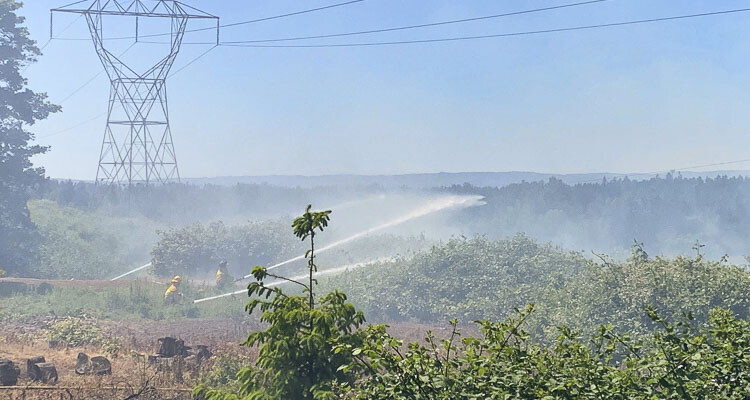
According to the DNR’s Wildfire Dashboard, there have been 375 fires in the state so far this year, burning 1,275 total acres
Logan Washburn
The Center Square Washington
Washington’s Department of Natural Resources is advising residents to prepare for the fire season.
“It’s getting longer and hotter due to the changing climate,” said Guy Gifford, assistant division manager for the DNR’s Community Resilience Program. “We’re seeing more fires and larger fires.”
Two brush fires broke out this weekend, one in Bellevue and another in the Central Washington town of Orondo, according to MyNorthwest. According to the DNR’s Wildfire Dashboard, there have been 375 fires in the state so far this year, burning 1,275 total acres.
The DNR has finished recruiting staff for fire season and is conducting training, Gifford said. Local fire departments are taking similar measures and preparing more equipment, and according to KOMO, have already been fighting fires.
Residents should be prepared for quick evacuations, according to Gifford. He said residents may get hours of notice for a large fire, but they may need to evacuate immediately for a smaller and quickly-developing fire.
“People think they would get notified hours ahead of time, and get time to prepare for evacuation,” Gifford said. “You may or you may not.”
Gifford said residents should sign up for local emergency alerts, consider high-risk weather and watch for smoke so they can adapt quickly.
Residents can prepare their structures to survive in what the DNR calls Zones One, Two and Three of a property, according to Gifford.
Zone One includes the first five feet in all directions from the building. Gifford said residents should consider replacing material like bark dust with nonflammable material like rock or dirt. He also said regular gardening, maintenance and clearing of debris can reduce fire risk.
“Sparks come from the fire, they can travel over a mile and land around your home,” he said. “They start small things on fire, that start bigger things on fire, that can start your structure on fire.”
More expensive measures, Gifford said, include pruning trees and replacing flammable roofs or old decks. He said the state offers programs to offset tree pruning costs and experts to give advice and tree health evaluations. He also said replacing a deck with a patio can be a fire-safe improvement.
Zone Two spans five to 30 feet from the building, often including the yard and garden. Gifford said residents should take steps like pruning trees and isolating fire risks.
“What we’re trying to do is minimize big flames,” he said. “Minimize anything burning there, or if it starts to burn, it just burns one area.”
Zone Three includes anything more than 30 feet from the building, often woods or brush. Gifford said residents should reduce potential for “radiant heat” by thinning the area, keeping it clean and spacing out fire risks.
Residents can find fire preparation resources at dnr.wa.gov and wildfireready.com.
This report was first published by The Center Square Washington.
Also read:
- Vancouver Police arrest barricaded man
 Terry Meyers, 58, faces multiple assault charges after pointing firearm at neighbor and barricading himself.
 - 49th Legislative District Democrats share their reasons for backing state income tax at Town Hall
 Three Democrat legislators defended the new income tax affecting only those earning over $1 million annually.
 - Letter: Freeze the scope and build the bridge
 Vancouver resident calls for project discipline after 22 years of planning and nearly half a billion in costs.
 - Ekklesia Theatre presents ‘Every Brilliant Thing’
 Interactive theatre production donates 50% of ticket sales to local counseling services.
 - Opinion: Public workers’ First Amendment rights are getting attention – in Idaho, not Washington
 Idaho moves to stop public schools from collecting union dues through government payroll while Washington continues favoring unions over worker choice.
 - Opinion: Lawsuit filed against the unconstitutional income tax in Washington state
 Former Attorney General Rob McKenna and Supreme Court Justice Phil Talmadge challenge the 9.9% income tax in Klickitat Superior Court.
 - Vancouver Police investigate domestic violence homicide
 Vancouver Police Major Crimes Unit investigating after woman found dead with knife wounds on NE Oakbrook Circle.
