



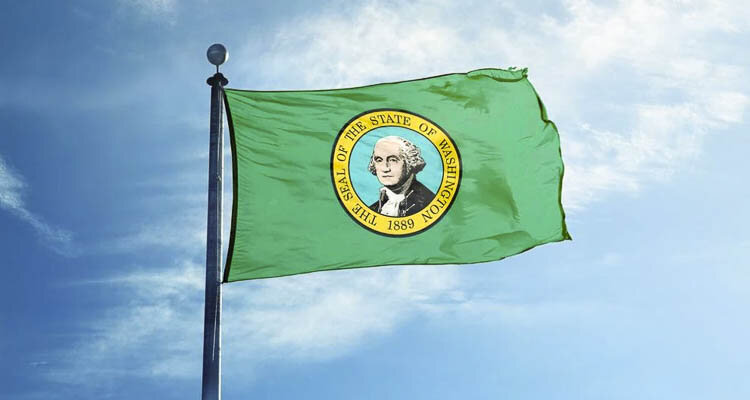
The Washington, D.C.-based think tank ranks the 50 U.S. states according to how their public policies affect individual freedoms in the economic, social and personal spheres
Brett Davis
The Center Square Washington
Washington comes in at No. 37 in the Cato Institute’s most recent “Freedom in the 50 States 2023” report.
In its study, the Washington, D.C.-based libertarian think tank ranks the 50 U.S. states according to how their public policies affect individual freedoms in the economic, social and personal spheres.
“The 2023 edition updates and expands on the six previous editions of Freedom in the 50 States,” the report’s introduction states. “It examines state and local government intervention across a wide range of policy categories – from taxation to debt, from eminent domain laws to occupational licensing, and from drug policy to educational choice.”
Washington’s No. 37 ranking puts it in the second-from-the-bottom category as organized in the report, from most free to least free: the five most free states at the top, followed by four groupings each of 10 states and the five least free states at the bottom.
“Washington is a stereotypical blue state that performs better on personal freedom than on economic freedom,” according to the report’s analysis of the Evergreen State. “Although Washington has had one of the more regulated economies in America for a long time, it has benefited from the fact that California and Oregon have had the same. Plus Washingtonians face a better fiscal policy environment than their left coast neighbors. However, it is a far cry from comparative regulatory heaven in neighboring Idaho.”
The report notes Washington “lacks an income tax; as a result, its fiscal policy is fairly good. Localities raise below the national average in taxes, 3.4 percent of adjusted income. State government, meanwhile, raises 5.9 percent of income, near the national historical average and a bit below the FY 2022 mean.”
While Washington does not have a state income tax, it has a capital gains tax.
In 2021, the state Legislature passed a capital gains tax and Gov. Jay Inslee signed it into law. It creates a 7% tax on profits of more than $250,000 from the sale of some assets, such as stocks and bonds.
In March, the state Supreme Court upheld the constitutionality of the tax.
The report dinged Washington on land use and labor-market freedom.
“Washingtonians enjoy little freedom to use their own land,” the study says. “Local and regional zoning and planning rules have become quite strict. Eminent domain abuse is almost unchecked.”
The report goes on to note, “It is one of the worst states on labor-market freedom. It lacks a right-to-work law, limits choices for workers’ compensation programs, and has extremely high minimum wages relative to its wage base.”
Washington’s minimum wage – $15.74 an hour – is already the highest state minimum wage in the country and is set to go up to $16.28 an hour next year.
The report gave Washington high marks for its criminal justice policies, calling them “among the best in the nation.”
“Incarceration and victimless crime arrest rates are far below national averages and fell substantially even before marijuana legalization,” the study notes. “They appear to have declined even more dramatically since 2019, perhaps due to changes in policing.”
Washington legalized medical marijuana in 1998 and recreational cannabis in 2012.
During a special legislative session in May, lawmakers passed a bill making intentional possession or public use of small amounts of illegal drugs a modified gross misdemeanor, punishable by up to six months in jail for the first two offenses and up to a year after that.
Inslee signed the bill into law less than two months before a temporary statute was set to expire that would have essentially decriminalized drug possession in Washington.
The new law came just as local governments were preparing to enact their own ordinances on drug possession, likely resulting in a confusing patchwork of laws throughout the state.
The five freest states according to Cato are:
1. New Hampshire
2. Florida
3. South Dakota
4. Nevada
5. Arizona
The five least free states according to Cato are:
50. New York
49. Hawaii
48. California
47. New Jersey
46. Oregon
This report was first published by The Center Square Washington.
Also read:
- WA and OR scale back I-5 Bridge ambitions as cost balloons
 A $14.4 billion price tag prompts Washington and Oregon leaders to delay portions of the I-5 bridge project and prioritize just the main spans.
 - Opinion: Washington passed an income tax to fund education, then the same majority cut education — and left $700+ million on the table
 State officials passed a new income tax to fund education, then approved over $1 billion in cuts—while forgoing $700 million in annual federal scholarships students could have received.
 - Letter: In defense of Joe Kent, a war hero
 Ozzie Gonzalez shares a firsthand account of his time working for Joe Kent, emphasizing Kent’s military background and principled stance on foreign policy controversies.
 - Opinion: ‘Washington’s majority party is panicking’
 Nancy Churchill argues that controversial state policies, including new taxes, law enforcement changes, and agency power grabs, are generating a wave of backlash in communities across Washington.
 - Letter: ‘Now we have Engineer Bob telling us the I-5 Bridge needs replacing because it is built on shifting sand with wooden structures’
 Amboy resident Thomas Schenk critiques Democrat leadership, tax policies, and the addition of light rail to the I-5 Bridge, while urging Republican voters to participate more in midterm elections.
 - Clark County Baseball presents Baseballism Kickoff this week with action all over the region
 Thirty-six teams from across the Northwest, including two state champs, are competing in free high school baseball tournaments at local turf fields in Vancouver, Camas, and Ridgefield.
 - The I-5 Bridge is vulnerable to collapse, but apparently not that vulnerable
 State leaders and Vancouver’s mayor warn about bridge safety, but insist it’s safe enough for daily use as they focus on moving forward with a costly replacement including light rail—despite decades of public resistance.
