



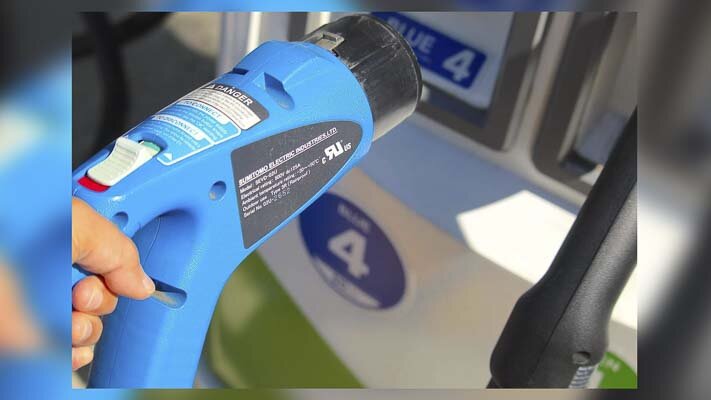
To meet the 3 million mark, Washington state will need to install 250,000 ports every single year starting this year – in 2021, just 460 were built
TJ Martinell
The Center Square Washington
The state of Washington has a goal of ending the sale of new gasoline vehicles by 2035. It also has created a Transportation Electrification Strategy, or TES, to ensure “that electric vehicle incentives and infrastructure are accessible and available to all Washingtonians.”
However, it’s going to need a lot more charging ports.
According to the Electric Vehicle Council, the state will need 3 million by 2035. It’s not yet known whether this includes both private and public charging ports.
Either way, the state has a long way to go.
Currently, there are roughly 4,500 public EV chargers in the state, mostly level 2 charging ports and just under 1,000 direct current fast charging ports.
Charging infrastructure is one of the critical aspects of making EV use en masse practical. Recently US Secretary of Energy Jennifer Granholm went on a road trip across the country to promote EV use, but the fleet hit a snag when there weren’t enough chargers for them all to use.
To meet the 3 million mark, Washington state will need to install 250,000 ports every single year starting this year – in 2021, just 460 were built.
Then there’s the cost, a topic that was raised at the state Electric Vehicle Coordinating Council’s most recent meeting on Wednesday. The council is preparing a draft update to the TES, which will include more details about the EV charger requirements.
Regarding the goal of 3 million charging ports, EV Council Co-Chair Tonia Buell said “my biggest question is how are going to do that?” She also told meeting participants that she did not know of any funding sources at this time that might cover the costs.
Those costs will vary depending on the type of charger installed. The average cost of installation is $300 to $1,500 cost for single EV port level 1, $6,000 for single EV port level 2, and $10,000-$40,000 for DC fast charging port.
However, in an email to The Center Square, Buell wrote that this just represents the equipment side of installation costs, which can be three times higher. According to the Oregon Department of Transportation, the total installation cost for a 350kW DC fast charging port can be as high as $172,000.
While a level 1 charger cost is estimated to be far less, it’s not considered practical for EVs used daily. A 30-minute charge on a level 1 port will only get a vehicle five miles, whereas a DC fast charger can provide enough energy for an EV to go 200 miles or more.
Even if the state only needed to install level 1 charging ports, the estimated price tag would still be $3 billion, and $18 billion if only level 2 charging ports were installed.
The TES draft update will include a forecast of what types of charging ports will need to be built.
Right now, there are 104,000 all-electric vehicles registered in Washington, placing it fourth in the nation in terms of total EVs. Another challenge for the coordinating council is how to get more drivers into EVs, which can cost more than what many households earn annually.
The TES draft update will be available for comment next month. The state Department of Commerce will submit the final draft to the state Legislature by the end of the year.
This report was first published by The Center Square Washington.
Also read:
- Vancouver Police release critical incident video from Dec. 28 officer-involved shooting
 Vancouver Police Department released a Critical Incident Video related to a December 28 officer-involved shooting while the Office of Independent Investigations continues its review.
 - Opinion: Transit agencies need accountability not increased state subsidy
 Charles Prestrud argues that Washington transit agencies face rising costs and declining ridership due to governance structures that lack public accountability.
 - Letter: ‘For years, American foreign policy too often felt like a blank check’
 Vancouver resident Peter Bracchi argues that the 2025 National Security Strategy marks a long-overdue shift toward clearer priorities, shared responsibility, and interest-based American leadership.
 - POLL: Are you better off than you were a year ago?
 This week’s poll asks readers to reflect on their personal financial situation and whether they feel better off than they were a year ago as economic conditions continue to shift.
 - Opinion: Does tailgating cause speeding?
 Target Zero Manager Doug Dahl examines whether tailgating contributes to speeding and explains why following too closely increases crash risk with little benefit.
 - Opinion: ‘The Democrats’ part of the bargain’
 Clark County Today Editor Ken Vance reflects on a New Year’s Eve encounter and a Bill Maher commentary to assess what he sees as cultural and political changes from the past year.
 - Free fares on New Year’s Eve is a big hit with C-TRAN riders
 C-TRAN’s New Year’s Eve free-fare program provided extended late-night service and a safe transportation option for riders across Clark County just after midnight.
 wpDiscuz
