



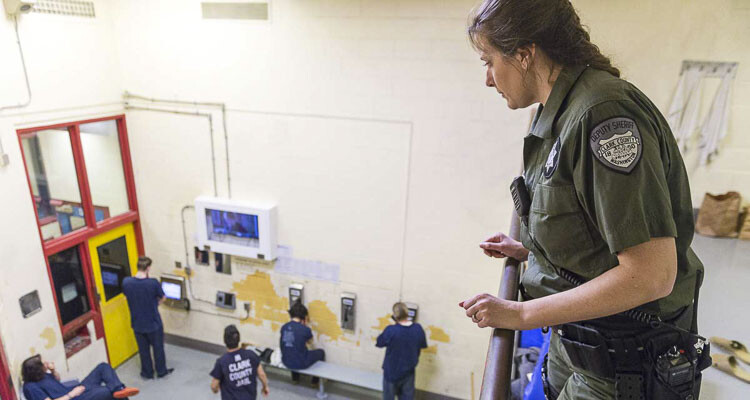
Rep. Tarra Simmons contends that the 13th amendment of the U.S. Constitution, which outlawed slavery, excluded inmates and that allowed states to continue ‘exploiting’ people
RaeLynn Ricarte
The Center Square Washington
A Washington legislator who served time behind bars contends it is time for the state to stop saving millions on the backs of inmates who are paid pennies for work in prison jobs.
“This is an evolution of slavery,” Rep. Tarra Simmons, D-Bremerton, told reporters. She is proposing that inmates be paid minimum wage when they work in the kitchen or produce furniture or other goods.
Simmons, an attorney, is co-founder and director of the Civil Survival Project, a program that advocates for people formerly incarcerated.
She has pre-filed House Bill 1024, known as the “Real Labor, Real Wages Act,” for consideration in the 2023 legislative session, which begins Jan. 9.
Simmons contends that the 13th amendment of the U.S. Constitution, which outlawed slavery, excluded inmates and that allowed states to continue “exploiting” people.
As a result, the American Civil Liberties Union and other reform groups argue that incarcerated people are coerced into working for very little return under threats of additional punishment, including solitary confinement or suspension of visitation with loved ones.
The current pay structure has outside companies complaining about unfair competition because they must pay at least minimum wage, driving up their production costs.
Washington Correctional Industries is a revenue-generating branch within the Department of Corrections that operates businesses in the state’s 12 prisons.
According to the Washington Department of Corrections, CI generates up to $70 million in sales a year, ranking as the nation’s fourth-largest prison labor program. The nearly 2,000 inmates working on CI projects reportedly earn between 65 cents to $2.70 per hour.
“When I was incarcerated, I was paid 42 cents an hour,” said Simmons of her experience.
She is believed to be the first person elected to the legislature after being convicted of a felony. She served a 30-month prison sentence for drug and theft charges. During that time, Simmons said that she worked in the kitchen, laundry room and as a custodian.
Not only are prisoners inadequately paid, she said, the money they do make often goes toward fines and fees imposed by courts, which leaves them with next to nothing to cover basic needs and save for future release.
Exiting prison without financial support leads to recidivism, homelessness and sometimes substance abuse, said Simmons.
The DOC sees prison work programs as one way to help people successfully transition back into society after their sentence is served. The state agency points to the findings of a Washington State University study that incarcerated individuals who participate in CI programs are less likely to commit new crimes leading to conviction when they are released.
In addition, formerly incarcerated people who worked inside were more likely to have a legal source of income, earn more than $1,000 per month, and earn an average of $1.03 more per hour than their peers who did not participate.
Simmons is proposing that half of an inmate’s minimum wage earnings be placed into an account that cannot be accessed until their release.
“If people can leave with enough money to have transportation, for housing, clothing, food and potentially some job training, hopefully they will have a better chance at not coming back,” she said.
This report was first published by The Center Square Washington.
Also read:
- Fort Vancouver athletics improving under partnership with Trico League
 Fort Vancouver High School athletics are showing measurable gains in competition and participation during the second year of a partnership competing in the Class 1A Trico League.
 - Opinion: Inviting courts into health care policy discussion
 Elizabeth New (Hovde) warns that Senate Joint Resolution 8206 could invite lawsuits by placing vague health care mandates into Washington’s Constitution.
 - Opinion: 24 States In. Washington Out? $732 Million Lost?
 Vicki Murray argues Washington risks forfeiting $732 million in federal education funding if state leaders do not opt into the federal tax-credit scholarship program.
 - C-TRAN offering free service on Transit Equity Day, Feb. 4
 C-TRAN will offer free service across its entire system on February 4 in observance of Transit Equity Day, honoring the legacy of Rosa Parks.
 - City of Battle Ground prepares for 75th Anniversary Celebration
 The City of Battle Ground is marking the 75th anniversary of its incorporation with a year-long series of community activities and celebrations planned throughout 2026.
 - Opinion: Nationwide strike in support of illegals and opposing the rule of law?
 Lars Larson argues that a reported nationwide strike reflects opposition to immigration enforcement and the rule of law, criticizing political leaders and media coverage.
 - POLL: Should councilors serving on boards be required to vote the way the full council decides?
 A new poll asks whether Clark County councilors serving on boards should be required to vote in line with the full council’s position or retain independent judgment.

Pay them but then charge them for room, board and restitution to their victims.
My goodness. I’ve seen everything now. Bleeding hearts are destroying everything in this country. Hey tired of paying rent/utilities etc., just go to jail for a while, food and board for free and then come out better off than the law abiding citizens. Why obey any laws.
I have no problem with this, as long as their room & board is then deducted from their wages. If they are going to be paid, then they should pay for rent, utilities & food like every other hard-working person.
Great idea