



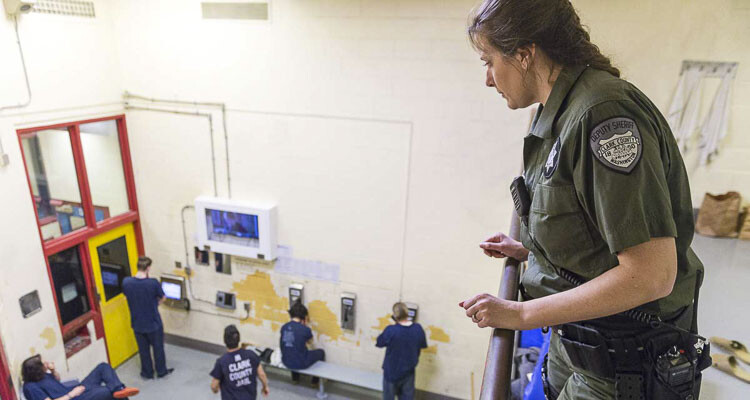
Rep. Tarra Simmons contends that the 13th amendment of the U.S. Constitution, which outlawed slavery, excluded inmates and that allowed states to continue ‘exploiting’ people
RaeLynn Ricarte
The Center Square Washington
A Washington legislator who served time behind bars contends it is time for the state to stop saving millions on the backs of inmates who are paid pennies for work in prison jobs.
“This is an evolution of slavery,” Rep. Tarra Simmons, D-Bremerton, told reporters. She is proposing that inmates be paid minimum wage when they work in the kitchen or produce furniture or other goods.
Simmons, an attorney, is co-founder and director of the Civil Survival Project, a program that advocates for people formerly incarcerated.
She has pre-filed House Bill 1024, known as the “Real Labor, Real Wages Act,” for consideration in the 2023 legislative session, which begins Jan. 9.
Simmons contends that the 13th amendment of the U.S. Constitution, which outlawed slavery, excluded inmates and that allowed states to continue “exploiting” people.
As a result, the American Civil Liberties Union and other reform groups argue that incarcerated people are coerced into working for very little return under threats of additional punishment, including solitary confinement or suspension of visitation with loved ones.
The current pay structure has outside companies complaining about unfair competition because they must pay at least minimum wage, driving up their production costs.
Washington Correctional Industries is a revenue-generating branch within the Department of Corrections that operates businesses in the state’s 12 prisons.
According to the Washington Department of Corrections, CI generates up to $70 million in sales a year, ranking as the nation’s fourth-largest prison labor program. The nearly 2,000 inmates working on CI projects reportedly earn between 65 cents to $2.70 per hour.
“When I was incarcerated, I was paid 42 cents an hour,” said Simmons of her experience.
She is believed to be the first person elected to the legislature after being convicted of a felony. She served a 30-month prison sentence for drug and theft charges. During that time, Simmons said that she worked in the kitchen, laundry room and as a custodian.
Not only are prisoners inadequately paid, she said, the money they do make often goes toward fines and fees imposed by courts, which leaves them with next to nothing to cover basic needs and save for future release.
Exiting prison without financial support leads to recidivism, homelessness and sometimes substance abuse, said Simmons.
The DOC sees prison work programs as one way to help people successfully transition back into society after their sentence is served. The state agency points to the findings of a Washington State University study that incarcerated individuals who participate in CI programs are less likely to commit new crimes leading to conviction when they are released.
In addition, formerly incarcerated people who worked inside were more likely to have a legal source of income, earn more than $1,000 per month, and earn an average of $1.03 more per hour than their peers who did not participate.
Simmons is proposing that half of an inmate’s minimum wage earnings be placed into an account that cannot be accessed until their release.
“If people can leave with enough money to have transportation, for housing, clothing, food and potentially some job training, hopefully they will have a better chance at not coming back,” she said.
This report was first published by The Center Square Washington.
Also read:
- Vancouver Police investigate domestic violence homicide
 Vancouver Police Major Crimes Unit investigating after woman found dead with knife wounds on NE Oakbrook Circle.
 - Letter: ‘Oregon and Washington aren’t refusing to clean their rolls — they’re contesting federal jurisdiction and timing’
 Camas resident challenges Lars Larson’s fraud claims, explaining legal disputes over federal jurisdiction.
 - County Council to hold hearing on preferred land use alternative for comprehensive plan update
 Clark County Council will select preferred land use alternative from three options studied in environmental review.
 - Opinion: ‘When are we going to get the full and complete details of the Interstate Bridge Replacement Program’s I-5 Bridge replacement project?’
 IBR team buried key details about light rail ending at waterfront with massive elevator system required.
 - POLL: Do you support extending light rail beyond the waterfront to connect with C-TRAN at Library Square?
 Readers can weigh in on Anne McEnerny-Ogle’s proposal to extend light rail beyond the waterfront to Library Square for improved C-TRAN connections.
 - Opinion: Passing a cyclist – Law, myth and a little patience
 Most drivers can’t legally pass cyclists in-lane due to vehicle width versus road measurements.
 - County seeks public comment on plans tied to CDBG and HOME funding
 Clark County proposes $2.4 million in federal funding for dental care, affordable housing, and sidewalk improvements.
 wpDiscuz
