



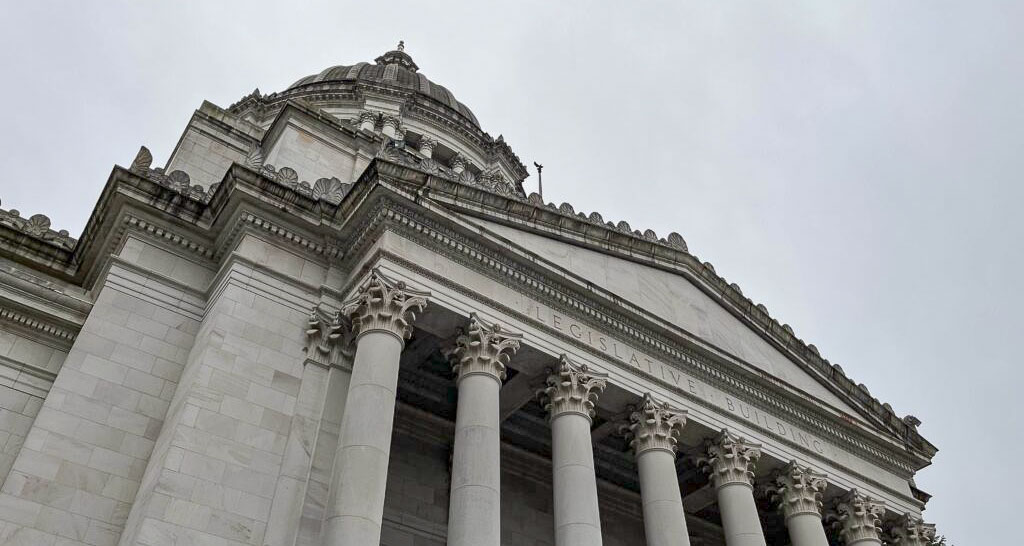
Lawmakers from the two chambers will also have to work with Gov. Bob Ferguson to finalize a spending plan
Jerry Cornfield
Washington State Standard
The Washington state House passed its budget just after midnight on Tuesday, setting the stage for negotiations with the Senate and the governor on a spending blueprint to address a looming multi-billion dollar shortfall.
The House approved the two-year $77.8 billion operating budget on a 54-44 vote in which five Democrats joined all Republicans in opposition.
The decision followed a roughly six-hour debate in which majority Democrats rejected more than two dozen Republican amendments to curb taxes and fees, boost special education funding, improve health care services and halt the proposed closure of a women’s prison.
The plan spends roughly $5.3 billion more than the current budget. Of that, $920 million is for new policies on top of the sum needed to pay for rising costs of current programs and uphold statutory obligations. The spending plan leaves $1.7 billion in reserves at the end of the first fiscal year and $3.2 billion by the end of the biennium.
Washington’s next budget cycle begins July 1 and runs through June 30, 2027.
To balance their proposal, House Democrats pencil in $5.2 billion from a revenue package that includes removing the 1% cap on annual growth in property tax collections, adding a surcharge on large corporations and financial institutions, and levying a new and untested tax on wealth that is similar, but not identical, to one proposed in the Senate.
Those new dollars will prevent deeper reductions to critical state programs and services, Democrats said.
“An all-cuts budget would be catastrophic. People will die,” said Rep. Mia Gregerson, D-SeaTac, who was part of the Democrat budget writing team.
Rep. Timm Ormsby, D-Spokane, chair of the House Appropriations Committee, said the budget “is what we were able to do with the resources we have. This is a budget that puts people first.”
Republicans said the new taxes and higher fees will hit working families hardest. Several cited the proposal to lift the 1% cap on annual property tax collections as maybe the most harmful.
“This budget doesn’t just tax the wealthy. It taxes every day working residents,” said Rep. April Connors, R-Kennewick. “Enough is enough. My constituents need real tax relief. We should stop using them as a bottomless ATM.”
House Minority Leader Drew Stokesbary, R-Auburn, said the budget spends more than it brings in. And the tax package, he said, is too large and will drive jobs out of state.
“This budget is the wrong direction for Washington state,” he said.
On Saturday, the Senate passed its $78.5 billion operating budget. It relies on nearly $6.2 billion from a four-year, $17 billion package of tax changes drawn up by Democrats that has yet to be voted on.
It contains measures similar to those in the House to increase the cap on annual growth in property tax collections and to tax wealthy individuals. The Senate also wants to impose a new tax on the payrolls of large companies, axe several tax breaks and reduce the sales tax rate.
With the passage of budgets in each chamber, negotiations can begin in earnest to reconcile differences in the spending approaches.
House and Senate budget writers will also need to work with Gov. Bob Ferguson, a first-term Democrat, who has pressed lawmakers to reduce spending before considering new taxes to deal with the shortfall.
Ferguson is expected to share his thoughts on each budget at a news conference Tuesday afternoon.
The governor and Democratic lawmakers estimate the shortfall to be in the $12 billion to $16 billion range over four years. The sum represents the amount needed to maintain current levels of service, pay for new and expanded programs authorized in previous budgets and cover the cost of new collective bargaining agreements with employee unions.
One of the largest cost-cutting moves in the House budget is a delay in the expansion of popular early learning and child care programs. The Senate takes a similar step.
But the House does not look to save money by furloughing state workers for up to 13 days or to balance by draining the state’s emergency savings, referred to as the rainy day fund. The Senate seeks to do both.
On the spending side, the House pledges about $1 billion less in new funding for special education and public school operating costs.
The House budget has $25 million — $12.5 million in each fiscal year — for grants to help local governments hire more law enforcement officers. They promise to make another $25 million available in the 2027-29 budget for a four-year total of $50 million. There’s nothing like this in the Senate plan.
This will be an area to work out with Ferguson. In his inaugural address, the governor said he wanted $100 million for this purpose in the next two-year budget. “That idea was a cornerstone of my campaign for governor. Any budget I sign must include this funding,” he said.
Republican lawmakers in the House proposed an amendment to boost the amount for grants as the governor sought, but it was defeated.
This report was first published by The Washington State Standard.

Also read:
- Rep. Stephanie McClintock’s bill to modernize beer warehousing laws receives a public hearing
 House Bill 2207, sponsored by Rep. Stephanie McClintock, received a public hearing as lawmakers considered updates to Washington’s beer warehousing laws.
 - Michelle Belkot announces bid for re-election to Clark County Council, District 2
 Clark County Councilor Michelle Belkot announced she is seeking re-election in District 2 in the November 2026 General Election.
 - Legislation from Rep. David Stuebe to strengthen Medicaid support for emergency ambulance services receives a public hearing
 House Bill 2531, sponsored by Rep. David Stuebe, received a public hearing as lawmakers consider changes to Medicaid reimbursement and funding stability for emergency ambulance providers.
 - Opinion: ‘Please make your voice heard by taking my legislative priorities survey’
 Rep. John Ley invites Clark County residents to share their views by participating in a legislative priorities survey during the 2026 session.
 - POLL: Do the proposed changes to the Clark County Council’s Rules of Procedure suggest the council lacked authority in 2025?
 A new reader poll asks whether proposed changes to the Clark County Council’s Rules of Procedure indicate the council lacked clear authority during a 2025 board removal.
 wpDiscuz
