



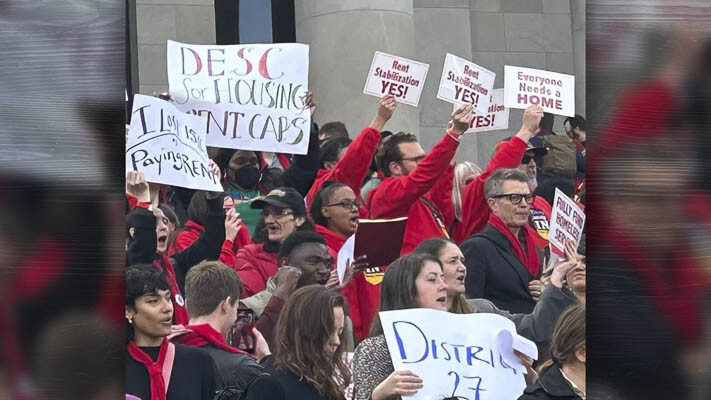
House Bill 2114 passed on a near-party-line vote with 54 yeas, 43 nays, with one excused absence
Carleen Johnson
The Center Square Washington
Minutes before a 5 p.m. legislative deadline and after a lengthy floor debate, the Washington State House of Representatives passed a bill on Tuesday that limits rent increases statewide to 7% annually. House Bill 2114 passed on a near-party-line vote with 54 yeas, 43 nays, with one excused absence.
HB 2114 now moves to the Senate where its future is uncertain. A version of the bill died there last month.
Other provisions of the bill include longer notification periods for a rent increase, no increases during the first rental year, and a cap on late fees.
Rep. Emily Alvarado, D-Seattle, is the prime sponsor of the legislation.
“The momentum is building because people are hurting,” she said.
Alvarado said HB 2114 can help provide predictability for renters.
But several landlords and developers say capping rents will discourage construction and worsen the state’s housing shortage.
During public hearings on the bill last month, Morgan Shook with ECOnorthwest, specializing in land use and redevelopment policy, told lawmakers years of experience and many economic studies have proven rent control policies fail.
“Many academics and housing professionals know price controls result in unintended consequences, namely that many of the short-term benefits are outweighed by the long-term damage to the housing market,” he said.
The bill passed by the House on Tuesday would cap late fees for rent payments at $10 per month and all move-in fees at no more than one month’s rent.
It also prohibits landlords from having different rent prices and fees for month-to-month leases compared to fixed-term leases, though new construction would be exempt from the rules for the first 10 years of occupancy.
Additionally, the proposal would require the Department of Commerce to create an online landlord resource center, and it calls for the Attorney General’s Office to publish model lease provisions for rent and fee increases.
“A balanced approach aimed at helping tenants while offering flexibility to landlords to deal with rising costs and to developers investing in new construction,” Alvarado said during last month’s testimony. “It allows landlords to raise the rent, but it prevents excessive rent increases.”
Rep. Chris Corry, R-Yakima, is not a fan of the legislation.
“It will have the opposite impact,” he predicted. “Look at what has happened across our country. Portland saw 6,400 units leave.”
In 2019, Oregon became the first state in the nation with statewide rent control.
Rep. Peter Abbarno, R-Centralia, urged fellow lawmakers to oppose the bill.
“This is not going to help our renters, or our landlords,” he said from the House floor.
April Connors, R-Kennewick, urged members to vote against the bill.
“Tenants rely on the existence of housing providers,” she said. “Again tenants rely on the existence of housing providers. I fear this policy is not going to fix the housing crisis, but will drive up housing costs.”
Conners argued rents year-over-year have come down, citing statistics from Zillow.
“Control on the price of rent does not fix the housing crisis,” she said.
In support of the bill, Rep. Alex Ramel, D-Bellingham, read from a message he received from a constituent.
“A constituent in Anacortes wrote to me saying, ‘I know I’m not the only one in crisis. I’m a single mom who has lived in Anacortes my son’s whole life, and my apartment complex has proposed a rent increase of $98.00,'” he said.
Ramel went on to say, “She said she doesn’t know how she will pay the increase along with medical bills and wants some kind of hope that things will improve.”
Senate Bill 5961 that would have limited yearly rent increases to 15% for existing tenants, while giving cities and counties the option to set lower caps, failed to pass out of the Senate Housing Committee last month.
This report was first published by The Center Square Washington.
Also read:
- Letter: ‘Only Florida has a more regressive tax structure than Washington’
 Washington households earning the least pay 13.8% in taxes, while the wealthiest 1% pay only 4.1%, according to Camas resident Anthony Teso’s letter.
 - Battle Ground Citizen of the Year for 2025 announced & celebration planned
 Johanna Hyatt has helped lead fundraising events, library initiatives, and aid for multiple local nonprofits during over a decade of community service in Battle Ground.
 - Clark College State of the College Address highlights achievements, challenges and regional impact
 Clark College’s annual address showcased student achievements, rising enrollment, robust scholarships, and workforce-driven academic programs influencing the regional economy in Southwest Washington.
 - Opinion: ‘I-5 Bridge replacement plan does not accomplish the needs of the project’
 Transportation architect Kevin Peterson outlines why the current I-5 Bridge proposal falls short on mobility, urban design, and transit, and offers alternative solutions including BRT and urban integration improvements.
 - Vancouver Police investigate convenience store robbery
 Police are investigating after two males reportedly robbed a convenience store on E Mill Plain Blvd at gunpoint, taking cash and merchandise but leaving the clerk unharmed.
 - School bus involved in crash in Vancouver on Friday
 A Pontiac G8 collided with an elementary school bus at NE 99th and NE 23rd Ave, but no children or drivers required hospitalization, according to officials.
 - Crown Point Country Museum Grand Opening set for Sat., March 21
 Visitors to Corbett’s new Crown Point Country Museum can explore the region’s early settlements, Wasco Nation heritage, art by Charles W. Post, and unique geological collections.
