


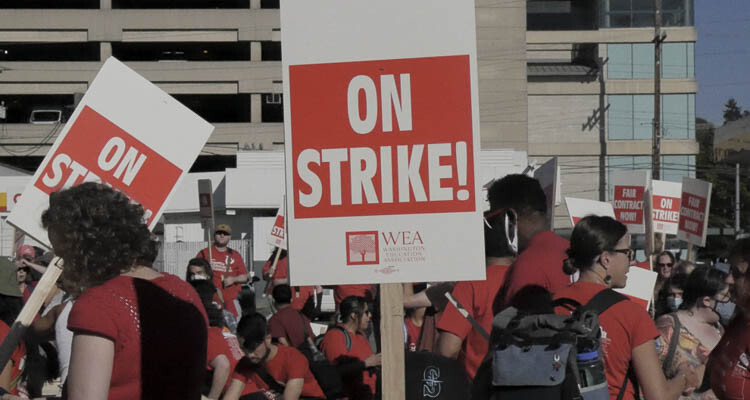
House Bill 1893 would remove the prohibition against receiving unemployment insurance benefits for workers taking part in a strike
Spencer Pauley
The Center Square Washington
The Washington House of Representatives has passed a bill that would allow workers in the state to receive unemployment insurance during strikes.
Currently, a worker is disqualified from receiving benefits if he or she is unemployed because of a labor action. House Bill 1893 would remove the prohibition against receiving unemployment insurance benefits for workers taking part in a strike.
The House approved a notable amendment to the bill to shift costs onto employers involved in labor disputes covered by HB 1893, instead of spreading the expense across the unemployment insurance system. This is a change from the underlying bill which would have had those benefits socialized across the unemployment insurance system.
Rep. Chris Corry, R-Yakima, noted that there is a 5.4% cap on the employment experience factor, so if there is a large strike with a lot of benefits paid out, the employer gets capped at the 5.4% mark.
“[This] inherently means that all the employers in the state are going to pick up the rest of the tab on the impact,” Corry said late Monday night during House floor debate.
According to the bill’s fiscal note, Washington could potentially see an increase this year in unemployment insurance claims from 812 to 3,000. That translates into an increase of $9.8 million to $14.1 million in annual payout of benefits that currently sit around $120 million a year.
The note also found that the state denied an average of 2,313 claims per year due to a labor dispute.
According to Cornell University’s Labor Action Tracker, thousands of workers went on strike in one of 26 labor actions in Washington in 2023.
During the floor debate, Rep. Suzanne Schmidt, R-Spokane Valley, argued that strikes are supposed to be what employees do as a last resort, because negotiations have stalled and this bill incentivizes employees to take advantage of the unemployment benefits.
“By paying employees unemployment during this time, it makes it an easier choice,” Schmidt said. “I fear that this is going to be something that becomes more usual and more often.”
Schmidt added that when workers go on strike, it slows down other industry sectors.
The House passed the bill by a 53-44 vote. The bill now goes to the Senate for consideration.
This report was first published by The Center Square Washington.
Also read:
- Opinion: Were Republican voters just sleeping during the August primary election?
 CCRP Chairman Matt Bumala says 60% of primary no-shows in the 17th and 18th districts were Republicans.
 - High school football: New coach prepares for long-term success at Prairie High School
 James Young-Lewis, a Clark County native who graduated from Evergreen in 2009, became Prairie’s head coach in May after working as an assistant coach across various programs since 2015, joining Prairie’s staff in 2024.
 - Cost to battle 20 wildfires in WA has topped $200M
 Twenty wildfires have cost Washington $207M in one month, more than two-thirds of what DNR spent all last fiscal year.
 - Opinion: WA Cares’ launch showcased care WA Cares did not provide
 Gov. Ferguson showcased a caregiving arrangement at the WA Cares launch that the program had not paid for a single day of.
 - Former State Rep. Liz Pike provides update on husband Neil Cahoon
 Neil Cahoon, a Camas resident, has undergone multiple surgeries including five on Aug. 15 after the Aug. 10 crash near La Center’s Daybreak Airport.
 - Opinion: Portland’s War on Cars Part 4 – A smarter automobile strategy to end gridlock
 O’Toole argues fuel wasted in Portland-area congestion has sextupled since 1982, generating 250,000 tons of extra greenhouse gases annually.
 - $1,000 first prize for Camas Plein Air Art Event honoring Marquita Call on Sept. 26
 Plein air artists compete Sept. 26 in Camas for $1,000 first prize honoring gallery founder Marquita Call.
 wpDiscuz