


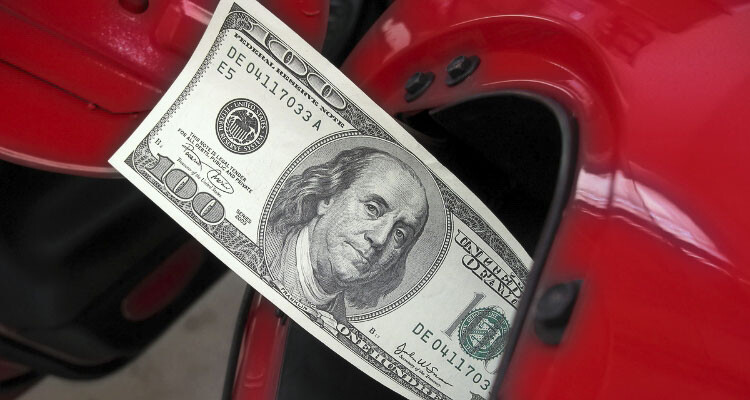
While fuel prices have been rising slightly when looking at the national average, citizens of the Evergreen State are still firmly on the expensive end of the market nationwide
Timothy Schumann
The Center Square Washington
Following over thirteen straight weeks of price declines, Washington fuel prices increased again for the third week in a row.
On Monday, the average price of a gallon of regular unleaded was sitting at $4.06 statewide, up from $3.99 the week prior, according to AAA data. This 7-cent increase per gallon continues the sharp reversal in Washington state’s over three-month-long trend of fuel prices.
“The recent rising temperatures led to rising pump prices,” said AAA Spokesperson Andrew Gross in a statement. “And with the cost of oil hitting $80 a barrel, there is a lot of upward pressure on gas prices at the moment.”
While fuel prices have been rising slightly when looking at the national average, citizens of the Evergreen State are still firmly on the expensive end of the market nationwide. Washington’s pump prices held at third most expensive nationally being beat out only by California and Hawaii, who filled out second and first on the list.
Washington’s $4.06 per gallon places it 64 cents per gallon higher than the national average of $3.42 per gallon. That is $1.02 per gallon above the nation’s least expensive fuel costs of $3.04 per gallon, currently paid by Texas state residents.
In Washington, intra-state variance remains high, spiking to $1.29 per gallon, a 26 cent per gallon increase over last week across all counties. The outliers this week, again San Juan and Asotin counties, represent the most and least expensive gas prices statewide at $4.80 and $3.51 per gallon, respectively.
This price variance still largely follows the Cascade Range, with residents to the west paying a higher premium at the pump than residents to the east.
On top of these higher prices, as of Jan. 1 of this year, Washingtonians also have a new cap-and-trade system to pay for at the pump.
According to a recent report by the Washington Policy Center’s Environmental Director Todd Meyers, gas prices in Washington have already spiked 10 cents per gallon relative to California and Oregon.
“What the data show is that prices in Washington state jumped suddenly over the last two weeks much more than the other states on the West Coast,” the report stated.
Ultimately, the full impact of the new Carbon Tax won’t be known until regular auctions occur. The report notes that the new law “sets a minimum price of $22/metric ton of CO2, which translates to 17 cents per gallon. The price could go as high as $81/MT which would be 65 cents per gallon.”
That means the recent 10-cent deviation from West Coast gas pricing is likely just the beginning for drivers in the Evergreen State.
This report was first published by The Center Square Washington.
Also read:
- Opinion: Portland’s War on Cars Part 4 – A smarter automobile strategy to end gridlock
 O’Toole argues fuel wasted in Portland-area congestion has sextupled since 1982, generating 250,000 tons of extra greenhouse gases annually.
 - Opinion: Transit ridership trends are dismal but regional plans are oblivious
 Puget Sound transit passenger-miles fell 31% from 2015 to 2024 despite a half-million-resident population increase.
 - Interstate Bridge Replacement Program seeks qualified firms for bridge replacement contract
 The CRBR project is backed by $5.7 billion from state funds, federal grants, and future tolling.
 - Opinion: Bankrupt – A $3.5 billion Rose Quarter Freeway widening project
 Joe Cortright argues ODOT’s Rose Quarter project has grown from a $450M approval to a $3.5B estimate, with a $2B funding gap.
 - Opinion: Portland’s War on Cars 3 – Ending the war on automobiles
 O’Toole argues Portland should add toll lanes, fix safety hazards, and redesign TriMet routes to end its anti-auto policies.
 wpDiscuz