


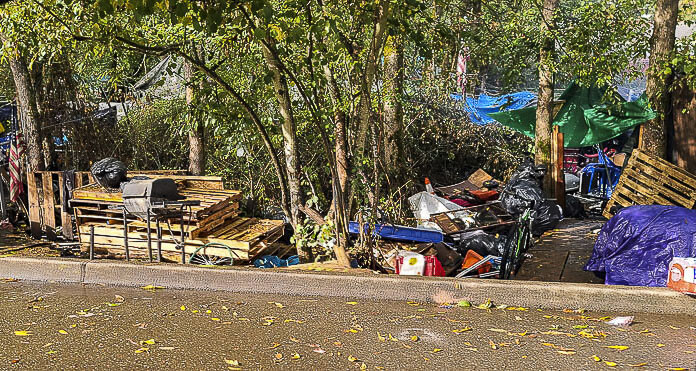
In order for the state of emergency to be over, the city manager has to present the Vancouver City Council with a resolution voting to rescind the declaration
Spencer Pauley
The Center Square Washington
Vancouver recently declared a state of emergency as a result of an increasing number of homeless people within city limits.
On Monday, the Vancouver City Council voted to ratify an emergency declaration related to homelessness. City Manager Eric Holmes made the emergency declaration the previous Friday.
The U.S. Department of Housing and Urban Services Office of Community Planning and Development found that between 2020 and 2022, Washington experienced the fourth largest increase in homelessness in the nation at 15.6%.
According to the city, it has surpassed the state averages, despite efforts to increase the available supply of affordable housing, among other initiatives to address homelessness.
At the time of the last Point-In-Time count conducted in January 2023, there were 1,300 homeless people in Clark County, with 672 being counted as unsheltered. The results also showed a 54% increase in chronic homelessness and a 78% increase in chronic unsheltered homelessness since 2022.
The Vancouver Homeless Assistance and Resources Team’s informal observations have produced a rough estimation of between 500 to 600 unsheltered homeless people within city limits.
Shortly after declaring the state of emergency, Holmes signed two initial emergency orders.
The first order allows increased authorization of a streamlined process for the city to accept donations, access financial reserves for budgeting needs, and buy goods and services needed to address homelessness.
For the duration of the emergency order, the city manager has the authority to increase the city budget to access its emergency reserve fund.
The second order allows Holmes to close up to 48 acres of public property to outdoor habitation, as a result of the city determining that homelessness continues to threaten the lives of residents.
“We are committed to doing everything we can to address homelessness in our city,” Holmes said in a statement. “While not all actions need the declaration, this mechanism will give us the agility we need to take action quickly as we continue to develop effective outreach-led, enforcement-backed solutions.”
In order for the state of emergency to be over, the city manager has to present the Vancouver City Council with a resolution voting to rescind the declaration.
This report was first published by The Center Square Washington.
Also read:
- Opinion: Were Republican voters just sleeping during the August primary election?
 CCRP Chairman Matt Bumala says 60% of primary no-shows in the 17th and 18th districts were Republicans.
 - High school football: New coach prepares for long-term success at Prairie High School
 James Young-Lewis, a Clark County native who graduated from Evergreen in 2009, became Prairie’s head coach in May after working as an assistant coach across various programs since 2015, joining Prairie’s staff in 2024.
 - Cost to battle 20 wildfires in WA has topped $200M
 Twenty wildfires have cost Washington $207M in one month, more than two-thirds of what DNR spent all last fiscal year.
 - Opinion: WA Cares’ launch showcased care WA Cares did not provide
 Gov. Ferguson showcased a caregiving arrangement at the WA Cares launch that the program had not paid for a single day of.
 - Former State Rep. Liz Pike provides update on husband Neil Cahoon
 Neil Cahoon, a Camas resident, has undergone multiple surgeries including five on Aug. 15 after the Aug. 10 crash near La Center’s Daybreak Airport.
 - Opinion: Portland’s War on Cars Part 4 – A smarter automobile strategy to end gridlock
 O’Toole argues fuel wasted in Portland-area congestion has sextupled since 1982, generating 250,000 tons of extra greenhouse gases annually.
 - $1,000 first prize for Camas Plein Air Art Event honoring Marquita Call on Sept. 26
 Plein air artists compete Sept. 26 in Camas for $1,000 first prize honoring gallery founder Marquita Call.
 wpDiscuz